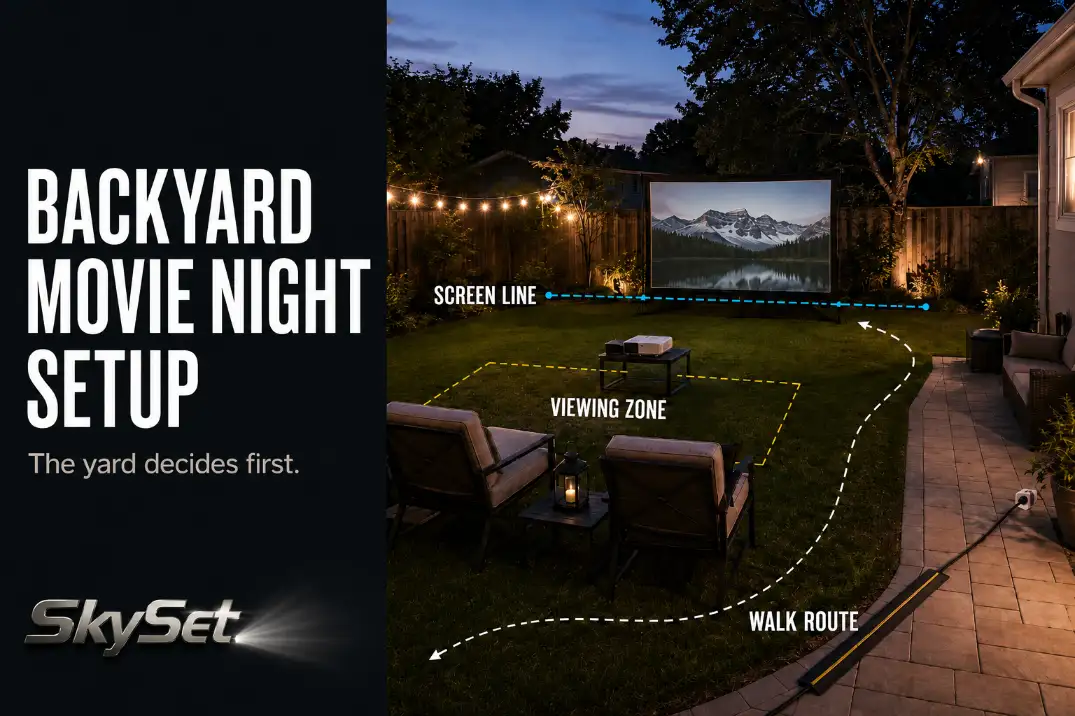
A backyard movie night works when the setup order is right: yard first, screen second, projector third, then sound, power, seating, and a real night test.
Most failed setups do not fail because the projector is useless. They fail because the screen sits in wind, the projector lands in the walking path, the sound comes from the wrong direction, or one extension cord controls the entire layout.
Start with the physical space. A 100-inch screen often needs about 8 to 12 feet of projector distance, depending on the model, and a comfortable first seating row around 8 to 10 feet back.
The test should happen 20 to 30 minutes after sunset, not in daylight. This is different from setting up a movie indoors, where walls, outlets, and furniture already define the room. Outdoors, the yard becomes the room.
Start With the Yard
The first decision is not which projector to buy. It is where the movie can happen without fighting the yard.
Read the yard before the gear
Look for the calmest usable viewing area. A patio edge, fence line, pergola side, or flat lawn section can work, but the screen needs more than a place to stand.
It needs a viewing direction, a stable base, and enough open space for people to move after dark.
Wind matters earlier than people expect. A screen can look steady during setup and start shifting once evening gusts reach 10 to 15 mph.
Even small movement makes subtitles, faces, and sports motion feel less sharp. In that situation, a brighter projector will not fix the problem because the image is moving on the surface itself.
The best screen spot is usually the one that balances stability, darkness, and traffic flow. A perfectly centered screen is less useful if it sits in the path to the back door, grill, drink table, or bathroom route.
Keep three zones separate
A working backyard movie night has three zones: the viewing zone, the walking route, and the power route. They can sit near each other, but they should not fight each other.
The viewing zone is where people sit without turning their heads or looking sharply upward for 2 hours. The walking route is the path people use after the movie starts. The power route is where the cord can run without becoming a trip line.
This is the setup-first logic behind SkySet: the outdoor space has to work before the gear can perform well.
If guests keep crossing between the projector and screen, or if the cord runs across the main patio door, the problem is the arrangement, not equipment quality.
Screen First or Projector First
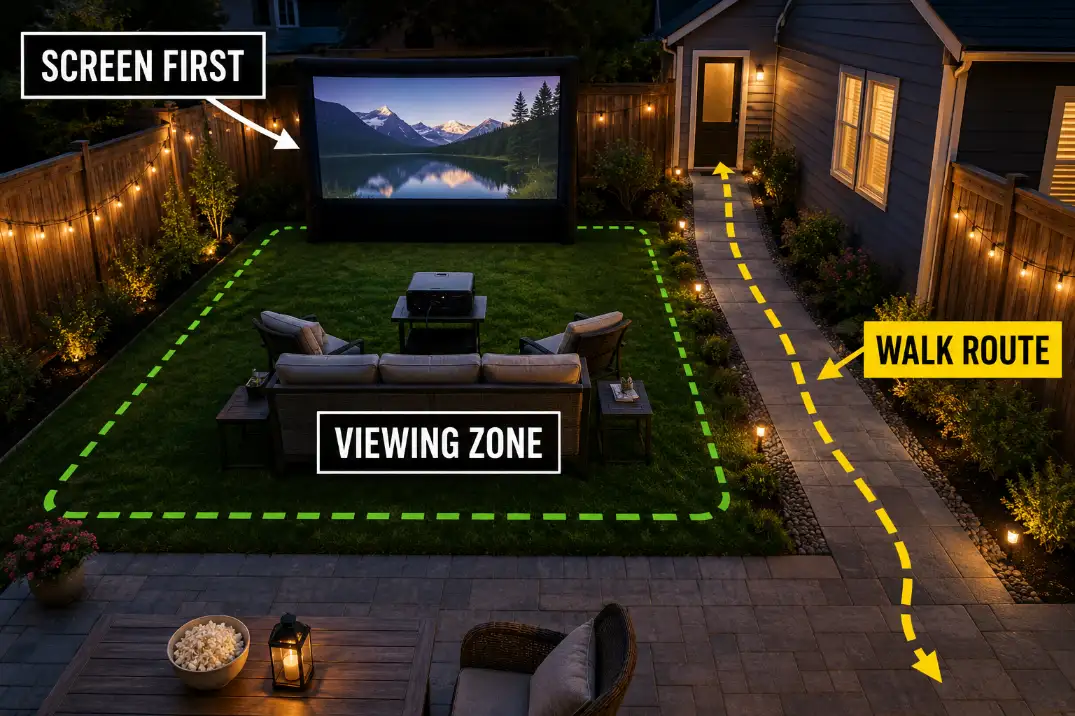
For most backyard movie nights, the screen should be placed before the projector is chosen or positioned. The screen decides the viewing direction, wind exposure, seating comfort, sound direction, and whether the projector can sit safely.
Screen first is the normal rule
A screen is less flexible than it appears. It needs a flat viewing face, stable support, a dark enough background, and a direction that does not point into porch lights, streetlights, or bright neighbor windows.
Once the screen spot is chosen, the projector either fits the real throw distance or it does not. A projector with a 1.2:1 throw ratio may need roughly 10 feet to fill a 100-inch diagonal screen.
A short-throw model may need much less. That difference can decide whether the projector sits safely behind the seats or awkwardly in the middle of the patio.
This is where people often waste money. They buy the projector first, then discover it needs to sit where the best chair should go, where kids walk, or where the extension cord becomes awkward.
Projector first only when space is fixed
The projector should lead only when the yard has a hard space limit: a narrow townhome patio, a covered seating area, a fixed outlet, or no safe place behind the seats.
In those cases, the useful question is not “How big can I go?” It is “What image size can this space actually support?”
A 120-inch screen sounds better than a 100-inch screen, but it also needs more viewing distance, more brightness, more stable support, and more room for sound and power. Bigger is only better when the yard can support the bigger setup.
A white sheet or blank wall can work for a casual first night, but it has limits. Sheets move in wind, wrinkle under tension, and lose contrast quickly.
A wall can be convenient, but texture, color, and nearby light can make the picture look dull. If the first test already shows movement, wrinkles, or washed-out dark scenes, the surface is the weak point.
| Setup Condition | Better First Decision | Why It Matters |
|---|---|---|
| Open lawn with flexible seating | Place the screen first | The yard can absorb projector distance changes. |
| Small patio or townhome yard | Check projector throw first | Space may limit image size before preference does. |
| Windy backyard | Solve screen stability first | Image size is useless if the screen moves. |
| Porch or path lights nearby | Choose screen direction first | Light spill reduces contrast before gear matters. |
| Covered patio setup | Confirm projector position first | Beams, ceilings, and seating may already be fixed. |
Sound Comes Next
Sound is the part people underestimate most. A weak picture can still feel like a casual outdoor movie. Weak dialogue makes people stop paying attention.
Test dialogue before volume
Outdoors, there are no walls to help carry sound. Projector speakers may seem acceptable during setup when one person is standing close, then disappear once 6 or 8 people sit down and the yard gets louder.
Light traffic, insects, pool pumps, wind, and HVAC noise can cover quiet dialogue. The real test is not whether an action trailer sounds exciting. It is whether normal speech stays clear from the back row at about 60 to 70% speaker volume.
If a small speaker needs to run near full volume just to make voices understandable, the speaker is the weak point. Turning it up may make the night louder, but not necessarily clearer.
Aim sound toward the seats
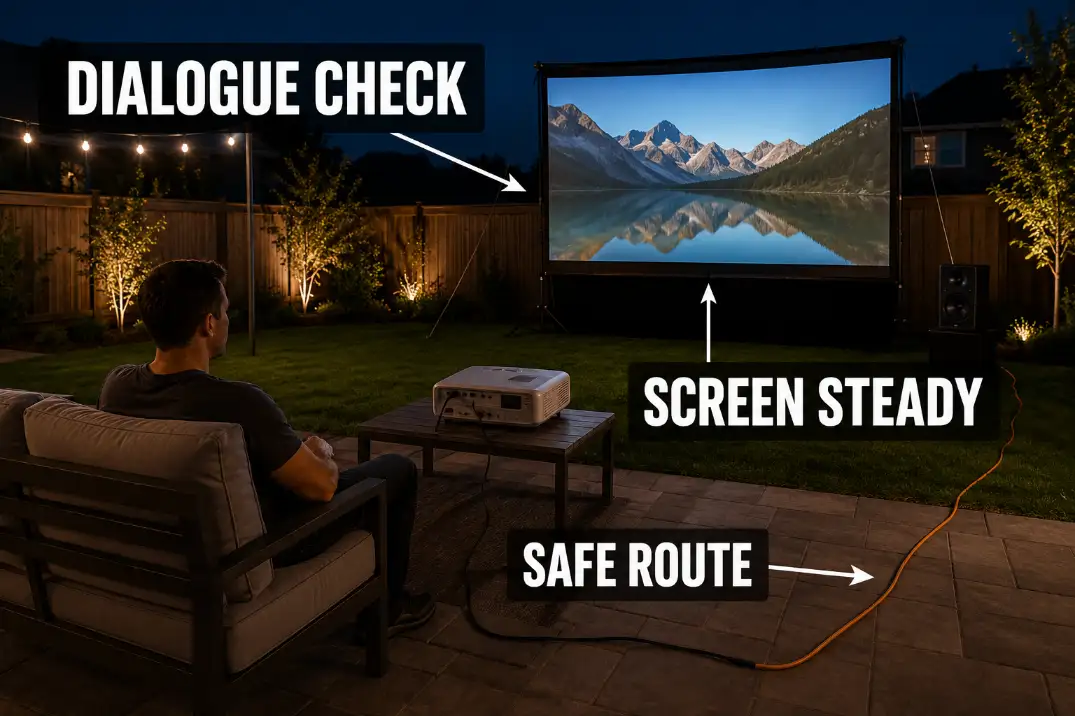
In most backyard setups, a separate speaker near the screen works better than sound coming from the projector behind the audience.
Dialogue should feel like it comes from the picture. If voices come from behind the chairs, the setup may still function, but it feels less natural.
Keep the speaker close enough to the audience that it does not need to blast across the yard. This also helps with neighbors.
Bass travels farther than people expect on quiet nights, especially when the speaker is far from the seating area and turned up to compensate.
Pro Tip: Use a dialogue-heavy scene for testing. Trailers and action clips can hide weak voice clarity.
Power and Cables
Power should be planned before the first guest arrives. The most common mistake is running a cord wherever it reaches and assuming people will watch their step. That may work during setup. It does not work after 90 minutes, when the yard is dark and people are moving with drinks, blankets, and kids.
Route power like people will move
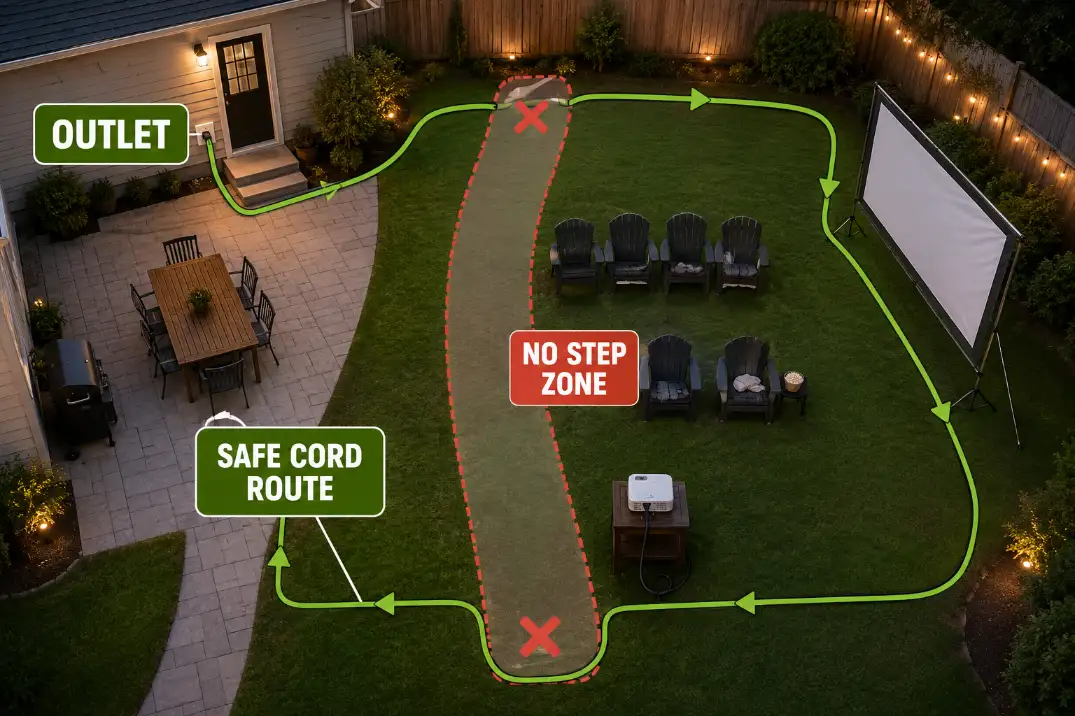
The safest cord path is short, visible, and outside the main walking line. If the outlet is 25 feet away, use a properly rated outdoor extension cord that reaches without being stretched tight.
If the only path crosses the patio doorway, seating area, or main route to the house, change the layout before movie night.
Do not run cords under rugs, through doorways, or across wet low spots. A damp lawn after irrigation or rain is not the same as a dry patio. If a connection point has to sit near grass, keep it elevated and protected rather than leaving it where shoes, sprinklers, or dew can reach it.
Know when a longer cord is the wrong fix
A longer extension cord is not automatically a better setup. Once the route becomes long, exposed, or hard to see, the layout is telling you something. Move the projector table, reduce the screen size, change the screen direction, or use a closer outdoor-rated outlet.
If the entire movie night depends on one cord stretched across 50 to 100 feet of yard traffic, power is controlling the setup in the wrong way. The better fix is usually a cleaner arrangement, not more cord.
Seating Distance
Seating distance is where outdoor movie setups often become uncomfortable even when the image looks impressive. People tend to overestimate how close they want to sit to a large outdoor screen and underestimate how tiring the neck angle becomes over a full movie.
Match screen size to comfort
For a 100-inch screen, many backyard setups feel comfortable with the first row about 8 to 10 feet away. For a 120-inch screen, the main seating area often works better around 10 to 14 feet back. These are practical outdoor ranges, not strict theater rules.
The failing condition is easy to spot. Chairs creep too close because the patio is shallow, then people lean back, look upward, or stop watching carefully. That is not a projector problem. It is viewing geometry.
Keep the projector out of the best seats
If the projector table needs to sit where the best chair should be, do not squeeze both into the same zone. Raise the projector slightly, move the seating back, reduce the screen size, or change the projector type.
A projector table in the middle of the seating area becomes a blocked view, a bump risk, and a distraction every time someone gets up. A small height change of 12 to 24 inches can be enough to clear chair backs without creating an awkward image angle.
The better setup is not always the largest one. It is the one where people can sit naturally, hear clearly, see the full image, and move around without disturbing the picture.
First-Night Test
The first-night test should happen before the first real movie night. Testing at noon does not count. Testing only the projector menu does not count either.
Test at actual movie time
Set everything up at the same time of night you expect to watch. A yard that looks dark at 7:30 p.m. may still be too bright for a lower-brightness projector in June. A porch light that seems harmless during setup may wash out the screen once the movie starts.
In many backyards, the useful test window starts 20 to 30 minutes after sunset. Run at least 10 minutes of real content with dialogue, dark scenes, and motion.
Do not judge brightness from a menu screen; judge it from a dark movie scene after nearby lights are off. Bright trailers, animated clips, and sports highlights can hide weak contrast and poor voice clarity.
Test the source, not just the picture
A clean image for 2 minutes does not prove the night will work. Test the actual source: streaming device, HDMI adapter, laptop, phone connection,
Bluetooth speaker, and Wi-Fi strength. If the movie depends on backyard Wi-Fi, confirm that it plays without buffering from the real projector position.
If possible, download the movie or have a backup source ready. This is especially useful in yards where the projector sits far from the router or behind exterior walls. A great layout still feels broken if the movie buffers every 5 minutes.
Check what fails first
Use the first-night test to find setup problems, not just gear problems.
- Can the back row hear normal dialogue at 60 to 70% speaker volume?
- Does anyone cross between the projector and screen during normal movement?
- Is the cord visible after dark without becoming a trip line?
- Does the screen stay steady during light wind?
- Can people sit for 20 minutes without neck strain?
- Does one porch light, window, or path light reduce screen contrast?
- Can the setup be taken down safely after the movie?
If more than two of these fail, do not solve everything by buying a brighter projector. That is the obvious fix that often wastes money. Brightness helps only after the screen direction, light control, seating geometry, sound placement, source reliability, and power route are basically right.
Questions People Usually Ask
What is the best order to set up a backyard movie night?
The best order is yard, screen, projector, sound, power, seating, then a real night test. That order keeps the setup practical because each step depends on the physical space before it depends on equipment preference.
Can I use a white sheet for backyard movie night?
Yes, but treat it as a casual test surface, not the best long-term screen. A sheet can wrinkle, move in wind, and lose contrast in dark scenes.
If the sheet shifts during a 10-minute test or shows obvious folds in bright scenes, a real outdoor screen will improve the result more than a small projector upgrade.
How dark does the yard need to be?
The yard should be dark enough that faces and dark scenes are clear without pushing projector brightness to the limit. For many homes, that means starting 20 to 30 minutes after sunset and turning off nearby porch, path, or window lights that hit the screen area.
Should I buy the projector or screen first?
In most backyards, choose the screen location first, then match the projector to the real throw distance. Buy the projector first only when the space is fixed, such as a narrow patio, covered seating area, or outlet-limited setup.
What Actually Makes the Night Work
A backyard movie night works when the yard, screen, projector, sound, power, and seating all support the same plan. The yard decides where the screen can stand, where people can sit, where sound should come from, and where power can run safely.
The right order is simple: choose the yard zone, place the screen, match the projector to the real distance, put sound near the image, route power outside the walking line, set seating by comfort, then test everything at movie time.
A calmer screen, cleaner cord route, closer speaker, and tested source usually improve the night more than chasing the biggest possible image. If a fix improves one piece while making movement, sound, safety, or comfort worse, it is not the right fix.
For official household extension cord safety guidance, see the U.S. Consumer Product Safety Commission.