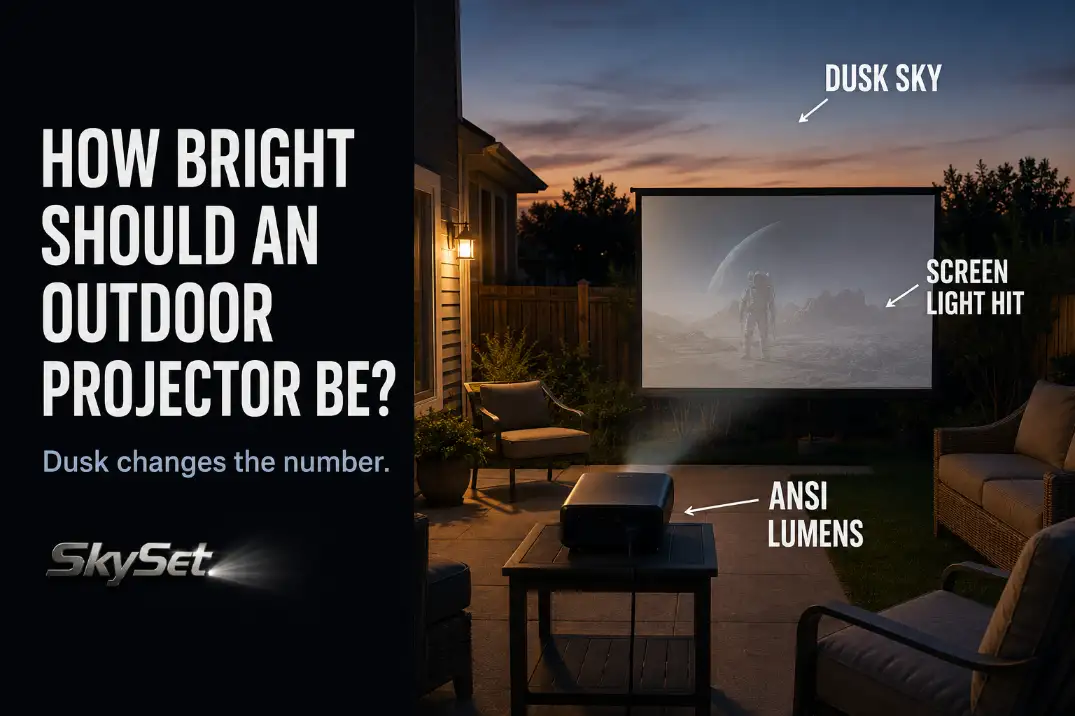
For most backyard movie nights, an outdoor projector should be around 1,500 to 2,500 ANSI lumens for a 100- to 120-inch screen after dark.
If you want to start near dusk, use a screen larger than 120 inches, or keep some patio lighting on, the safer range is usually 2,500 to 3,500 ANSI lumens.
Below about 1,000 ANSI lumens, the setup needs a smaller screen, full darkness, and very little light touching the viewing surface.
The real question is not only “how many lumens?” It is which lumens, at what time of night, on what screen size, with what light landing on the screen.
A projector that looks weak 20 minutes after sunset may look acceptable 45 minutes after sunset without changing the projector at all. A projector that still looks pale after full dark is a different problem.
At that point, screen size, ambient light, or inflated brightness claims may matter more than the number printed in the listing.
Lumens vs Real Brightness
For outdoor projector brightness, compare measured ANSI or ISO lumens, not vague marketing lumen claims. A backyard projector is only as useful as the light it can actually put on the screen under real viewing conditions.
Measured brightness beats advertised brightness
Projector listings often use big lumen numbers that are not measured the same way. A product page may claim “8,000 lumens” or “12,000 lumens,” while the actual measured output behaves more like a much weaker projector.
For backyard buying decisions, ANSI lumens or ISO lumens are safer comparison points because both point to measured projector brightness instead of loose advertising language.
Buying Check: If a projector listing shows a huge lumen number but does not clearly say ANSI lumens or ISO lumens, do not compare it directly with measured projector brightness.
The screen receives light, but viewers see contrast
The projector sends light to the screen. The screen reflects that light back toward the seating area. Any porch light, window glow, string light, or dusk sky glow lowers the difference between the bright and dark parts of the image.
That distinction matters because a weak-looking picture is not always a weak projector. A bright menu screen can look fine while dark movie scenes look gray.
If your image already looks washed out after full dark, the deeper diagnosis may be closer to the setup problems covered in Outdoor Projector Washed Out than a simple lumen shortage.
| Backyard condition | Better brightness target | What matters most |
|---|---|---|
| Full dark, 80–100 inch screen | 1,000–1,500 ANSI lumens | Small screen and dark screen area |
| Full dark, 100–120 inch screen | 1,500–2,500 ANSI lumens | Measured brightness and screen quality |
| Dusk or mild patio lighting | 2,500–3,500 ANSI lumens | Waiting longer and blocking screen-facing light |
| 130–150 inch screen | 3,000–4,000 ANSI lumens | Larger screen area spreading light thinner |
| Small battery projector | Often 300–700 ANSI lumens | Smaller image, full dark, lower expectations |
| Before sunset or bright twilight | Usually not practical | Timing matters more than projector specs |
Dusk Viewing
If you want to start near dusk, brightness needs rise faster than most buyers expect. Early evening is the hardest normal backyard condition because the screen is competing with sky glow before the yard looks fully dark.
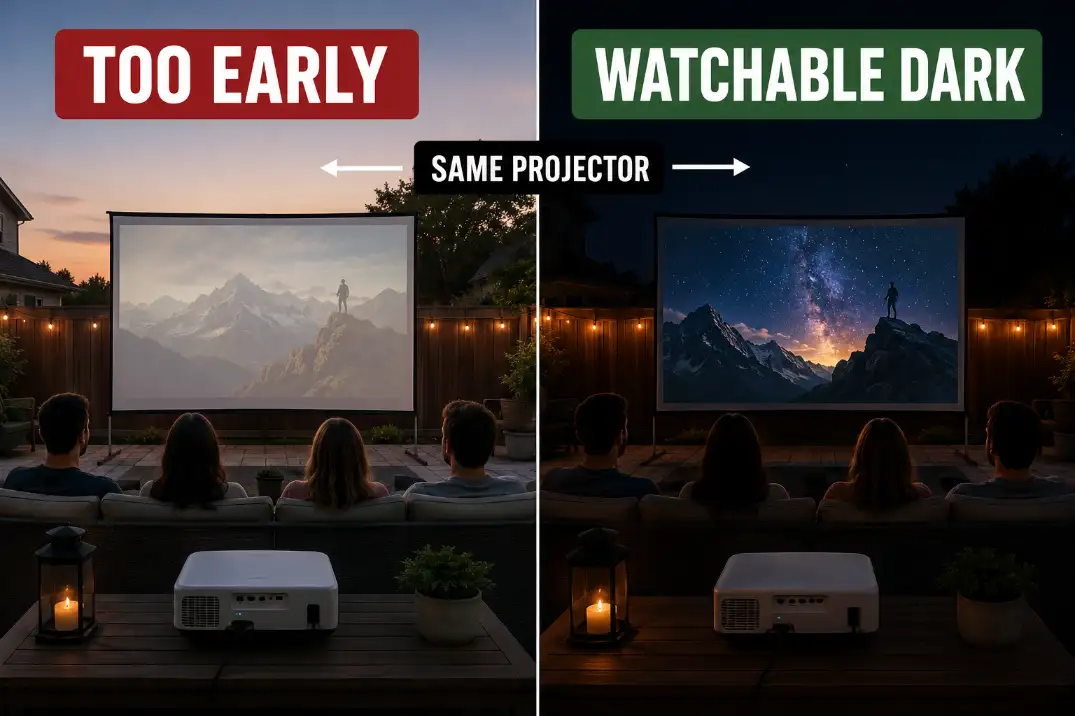
Too early can look like too few lumens
A backyard screen may look ready while people are setting up chairs, but the image can still look flat once the movie begins. This is especially common during the first 20 to 30 minutes after sunset, when the sky is darker than daytime but still bright enough to lift the black parts of the image.
A 30- to 45-minute delay after sunset can improve the picture more than a small projector upgrade. That is why judging a projector too early often leads to the wrong purchase decision.
The projector may not be failing. The screen may simply be fighting the last usable light in the sky.
A brighter projector still has a limit
A 2,500 to 3,500 ANSI lumen projector gives you more flexibility around dusk, but it does not turn open twilight into a theater. If the screen faces a bright western sky or sits near a porch light, the image can still look weak.
The practical fix is layered: start later, move the screen into a darker pocket, keep light off the screen surface, and avoid making the image too large.
The broader layout decisions in Backyard Movie Night Setup are where this planning comes together. After those basics are controlled, brightness becomes much easier to judge fairly.
Dark-Night Viewing
After full dark, many backyard screens need less brightness than buyers assume. Once the sky stops competing with the screen, contrast control and screen size become more important than chasing the largest brightness number.
Full dark lowers the projector requirement
For a typical 100- to 120-inch backyard screen, 1,500 to 2,500 ANSI lumens is often enough when the viewing surface stays dark.
For an 80- to 100-inch image, 1,000 to 1,500 ANSI lumens can be usable if the screen is stable, flat, and not catching nearby light.
This is where “more lumens” can become a lazy answer. A brighter projector helps only when the rest of the setup lets those lumens work.
Bright mode is not always the best movie mode
Many projectors have a high-brightness mode that pushes white output harder but weakens color accuracy and shadow detail. That mode may help during setup or mild dusk. After dark, it can make faces look harsh and dark scenes look thin.
Setup Note: Test brightness with an actual dark movie scene, not only a bright menu screen. Menus can look sharp while nighttime scenes still look gray.
Battery projectors need a smaller promise
Portable battery projectors are useful, but many small models sit around 300 to 700 ANSI lumens, although stronger portable units can go higher.
That does not make them useless outdoors. It means the setup must be stricter: smaller image, full dark, short throw distance, and very little light near the screen.
A battery projector can work for a casual 60- to 80-inch backyard image after dark. It should not be expected to carry a 120- to 150-inch movie night at dusk.
Screen Size
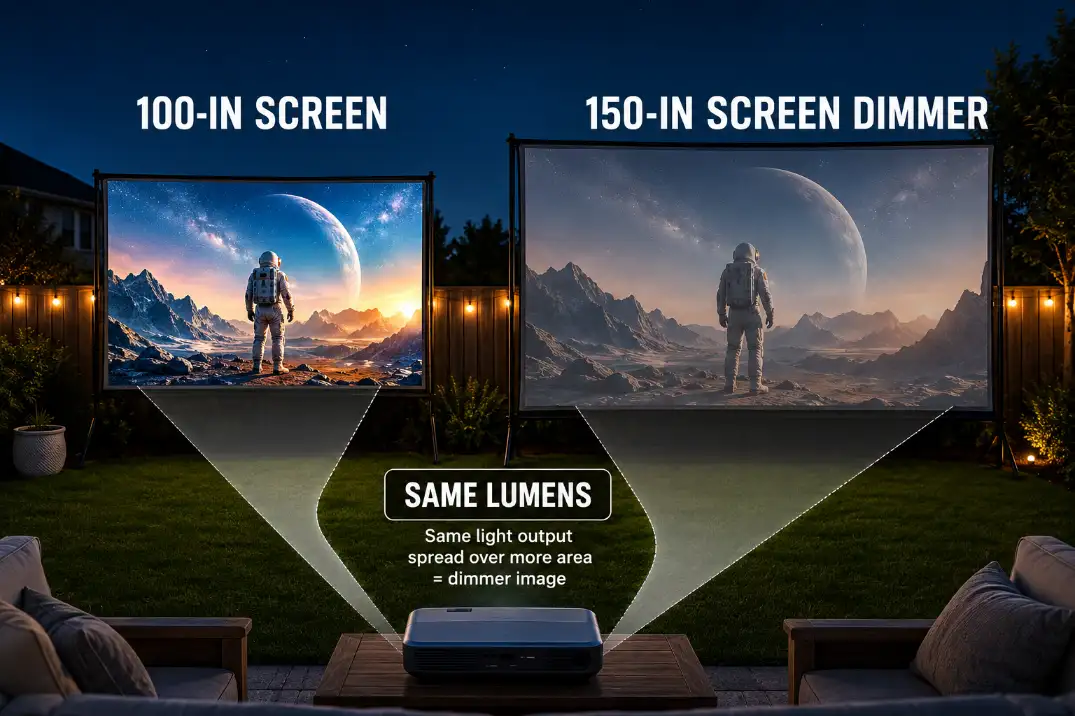
Screen size is the fastest way to make a projector look dim without changing the projector. A bigger screen does not only look larger; it lowers image brightness per square foot.
Bigger screens spread the same light thinner
A projector does not become brighter because the image gets larger. It spreads the same light over more surface area. With the same 16:9 shape, a 150-inch screen has about 2.25 times the area of a 100-inch screen, so the same projector looks much dimmer at 150 inches.
That is why a projector can look strong at 90 inches and disappointing at 130 inches. The underlying problem is not mysterious. It is less light landing on each part of the screen.
When smaller is the better upgrade
If the picture looks weak at 140 or 150 inches, do not immediately buy a brighter projector. First test the same projector at 100 to 120 inches. In many yards, that one change gives a clearer image, stronger contrast, and better viewing from the back row.
A good practical boundary is seating distance. If guests sit roughly 10 to 14 feet from the screen, a 100- to 120-inch image usually feels large enough for a backyard movie without wasting brightness. Go larger only when the projector, screen material, and light control all support it.
Backyard Light Sources
The worst backyard light is not always the brightest light. It is the light that lands on the screen.
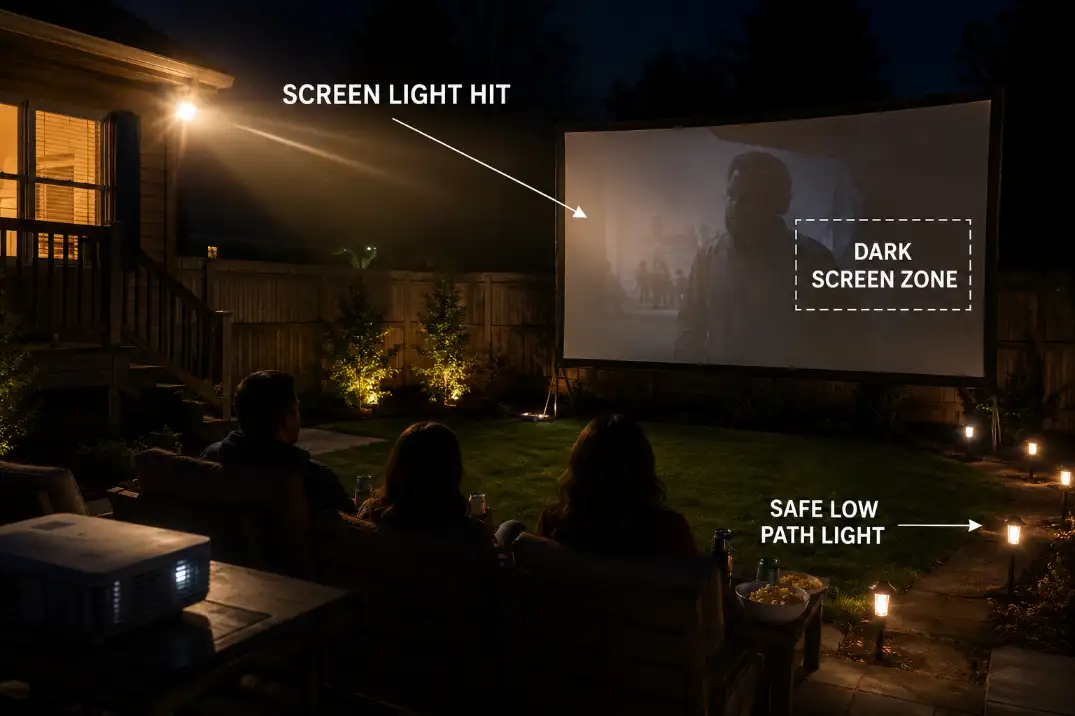
Screen-facing light hurts more than background light
A string light behind the seating area may be visible without ruining the picture. A porch light, window glow, floodlight, or patio fixture aimed toward the screen can damage contrast even if it looks minor from the house.
The useful question is simple: does the light hit the screen? If it does, the projector is fighting that light directly. A porch light only 10 to 20 feet from the screen can flatten dark scenes when the beam lands on the fabric, wall, or inflatable surface.
You do not need a black yard
Turning off every light is not the goal. Keeping light off the screen is the goal. Low path lights, step lights, and small table lights can stay useful if they sit below the screen line and point away from the viewing surface.
A strong backyard movie setup separates three zones: the dark screen zone, the seating zone, and the walking or cable zone. When those zones overlap badly, brightness becomes only one part of the problem.
Brightness Mistakes
Do not replace the projector until timing, screen size, and screen-facing light have been ruled out. Brightness matters, but it should not be used to cover basic setup problems.
Buying more lumens for a light-control problem
The most common wasted fix is buying a brighter projector before checking the yard. If the image looks weak 45 to 60 minutes after sunset, on a 100- to 120-inch screen, with no visible light hitting the screen, then projector brightness may be the real limitation.
If the screen is still catching porch light or the image is stretched to 150 inches, more lumens may only partly hide the mistake. The setup is still leaking contrast.
This is where a weak image can get mixed with other backyard failures. A bad cord route, unstable screen, speaker issue, or light spill can make the whole night feel like the projector failed, so the broader failure patterns in Backyard Movie Setup Mistakes are worth checking before replacing equipment.
Choosing 4K before enough brightness
Another mistake is prioritizing 4K before measured brightness. In a backyard, a dim 4K image can look worse than a brighter 1080p image because the viewer notices weak contrast before fine resolution.
For many outdoor movie nights, native 1080p with solid measured brightness is the smarter baseline.
4K becomes more useful when the projector is already bright enough, the screen is reasonably large, the seating is close enough to see the extra detail, and the screen area is controlled.
Trusting daylight expectations
A backyard projector is not an outdoor TV. It depends on reflected light, and daylight overwhelms reflected projection quickly. Even a bright projector struggles when the screen is competing with open sky.
If early viewing matters, shrink the screen, use the darkest side of the yard, avoid screen-facing lights, and accept that the first part of the evening will look less cinematic. If movie image quality matters more than start time, wait for darkness.
Ignoring the screen itself
The screen surface can also waste brightness. A smooth outdoor projection screen usually reflects light more predictably than a wrinkled sheet, uneven wall, or moving fabric.
A loose white sheet can glow softly, ripple in the wind, and scatter light instead of returning a clean image to the seating area.
That does not mean every backyard needs a premium screen. It means the screen should be stable, flat, reasonably reflective, and placed where light control is possible. If those basics are missing, projector brightness becomes a blunt fix.
Quick brightness check before buying
Use this short check before deciding the projector is not bright enough:
- Wait at least 30 to 45 minutes after sunset before judging final brightness.
- Test the image at 100 to 120 inches before stretching it larger.
- Look for any porch, window, string, or floodlight hitting the screen.
- Compare projectors by ANSI lumens or ISO lumens, not inflated listing numbers.
- Test a dark movie scene, not only a bright home screen or menu.
- If the picture is still dull after full dark with a controlled screen, move up in brightness.
The Practical Answer
For most backyard movie setups, choose 1,500 to 2,500 ANSI lumens for dark-night viewing and 2,500 to 3,500 ANSI lumens if you want more flexibility around dusk, screen size, or unavoidable light.
Move toward 3,000 to 4,000 ANSI lumens when the screen is larger than 120 inches or the yard cannot be fully darkened.
But do not treat higher lumens as a cure for every weak image. The better decision is a matched setup: measured projector brightness, a controlled screen area, a reasonable image size, and a start time that gives the projector a fair chance.
Once those are right, the picture improves without turning the whole purchase into a brightness race.
For a deeper projector-specific explanation of brightness ratings, see ProjectorCentral’s Lumens Explained.