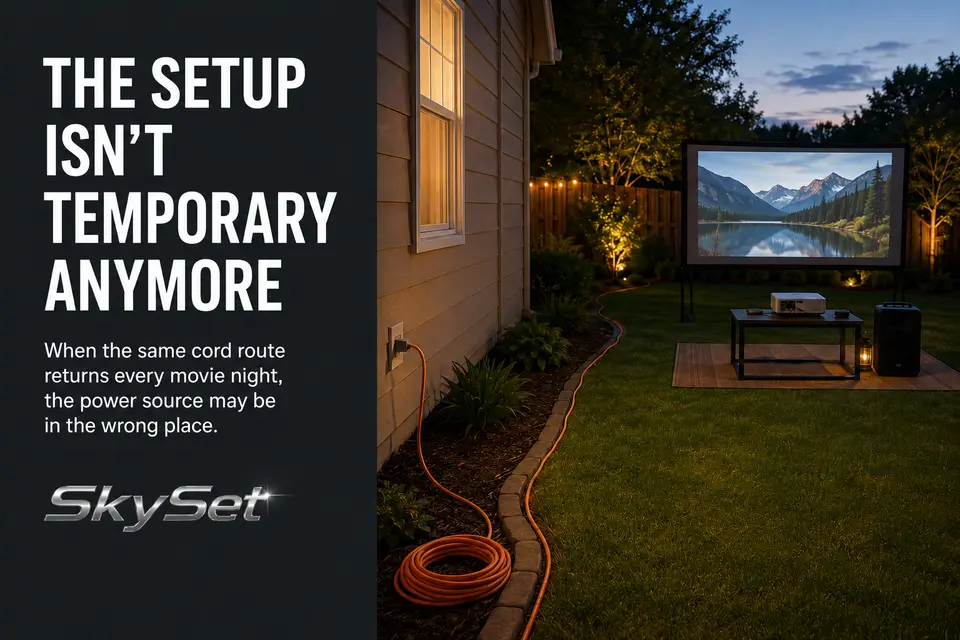
The projector table returns to the same part of the yard. The screen faces the same direction. The speakers occupy the same corners. Yet every movie night still begins with carrying an extension cord from the house, rebuilding its route around the patio, and removing it when the yard returns to normal.
That arrangement is not automatically wrong. A correctly selected outdoor-rated extension cord can remain proportionate to genuinely temporary use. The decision changes when the theater has become permanent in practice while its power path is still being treated as temporary.
No single number of movie nights settles the question. The stronger case develops cumulatively: the same distant viewing zone, the same awkward route, several devices operating together, and outdoor connections repeatedly exposed to changing conditions. At that point, improving the cord arrangement may no longer solve the real problem. The existing power source may simply be in the wrong place.
Repeated Movie Night Use
The first threshold is not frequency by itself. It is predictable reuse of the same powered location.
An occasional movie night behaves like an event. The projector, speaker, screen, and cord arrive together and disappear afterward. Running one suitable cord from an existing outdoor outlet can remain practical when the route is short, protected, and easy to supervise.
A recurring theater behaves differently. The equipment may still be stored indoors, but its operating position has become established. The projector repeatedly returns to the same area, the cable follows the same lawn edge, and every setup works around the same distance from the house outlet. Time is spent recreating infrastructure rather than arranging the movie.
Weekly use in a compact patio with a conveniently positioned receptacle may create little friction. Two monthly movie nights in a distant part of the yard may create much more. Consistency of location therefore matters more than an invented frequency limit.
The practical power station and extension-cord trade-offs can determine how an occasional setup is powered. They do not resolve whether an established theater zone should have professionally planned household power nearby.
Use Check: Frequent use does not prove that a new circuit is required. A stable viewing zone repeatedly dependent on an awkward temporary route is a strong reason to request an electrical assessment.
Too Many Temporary Cords
The important change occurs when one understandable route becomes a small distribution network rebuilt for every event.
One outdoor-rated cord following a controlled path from an existing receptacle to the equipment station remains easy to inspect and remove. The setup becomes harder to manage when distance and device placement introduce additional segments, separate routes, split points, or connections close to the ground.
Projector power may arrive from one direction while a powered speaker or soundbar is supplied from another. Short equipment leads pull connection points toward the lawn. Patio doors, seating paths, and transitions between hardscape and grass begin determining where the cords can go.
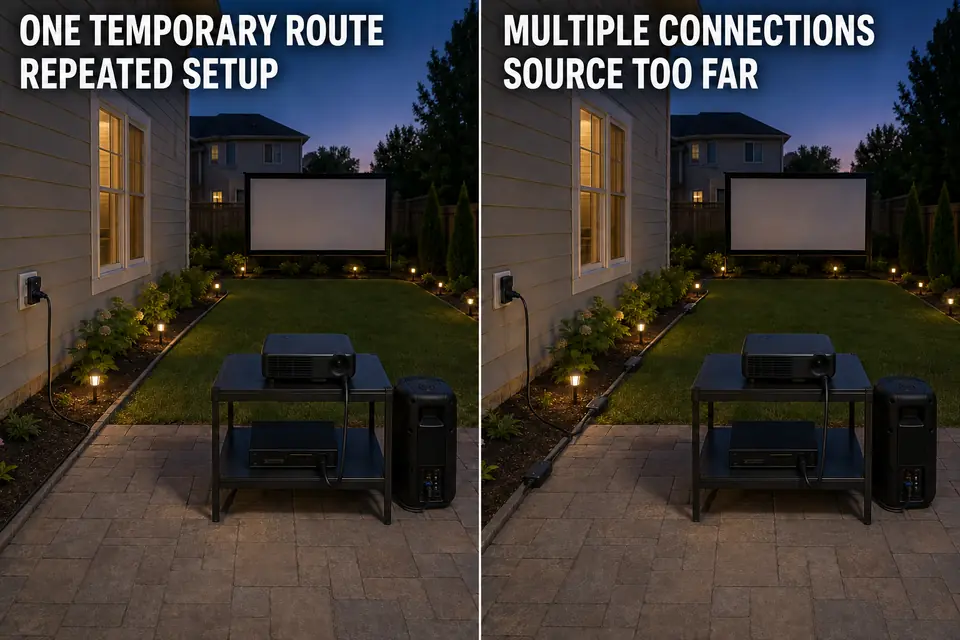
Moving every connection toward the yard perimeter may improve the route, but it does not correct a poorly located source. Adding adapters or chained extensions merely reorganizes the distance between the outlet and equipment.
A protected route should also work when the yard is occupied, not only when it is empty. Guests still need to move between the house, seating, and screen after dark. If every workable route competes with a doorway, circulation area, or vulnerable patch of ground, the problem has moved beyond simple cable tidiness.
Planning a protected outdoor AV cable route remains important for occasional use. When route management becomes a permanent task at every event, further cord-management refinements offer diminishing returns.
Projector and Speaker Load
The visible number of plugs is a poor substitute for understanding what will operate simultaneously.
A projector and several low-draw accessories do not necessarily demand more power than a projector paired with one substantial powered audio component. The useful inventory includes the projector, powered speakers or soundbar, streaming device, network equipment, and any other powered accessories used during the same movie.
Equipment labels and manufacturer documentation provide the ratings needed for planning. They are more meaningful than counting plugs or assuming that every device draws its maximum stated power continuously.
A homeowner can calculate the combined outdoor cinema load to document the setup. That calculation does not determine the final circuit arrangement. An electrician must still consider the existing circuit, other loads already served by it, protective devices, wiring conditions, and proposed receptacle location.
“Dedicated outdoor outlet” can also be misunderstood. A receptacle intended for the recurring theater location does not automatically require a new branch circuit serving nothing else. Whether the project can use a suitable existing circuit or needs a different arrangement is a site-specific determination.
Outlet Location Near the Viewing Zone
A new receptacle solves little if it is installed on the easiest wall but still leaves the projector dependent on a long extension.
The planning reference should be the recurring equipment zone: where the projector remains aligned with the screen, where powered audio normally sits, and where short device leads can leave the equipment station without entering the principal walking route.
“Near” is therefore a functional relationship, not a universal distance. The intended source should reduce the route that must be reconstructed while remaining accessible, appropriately protected, and compatible with normal yard use.
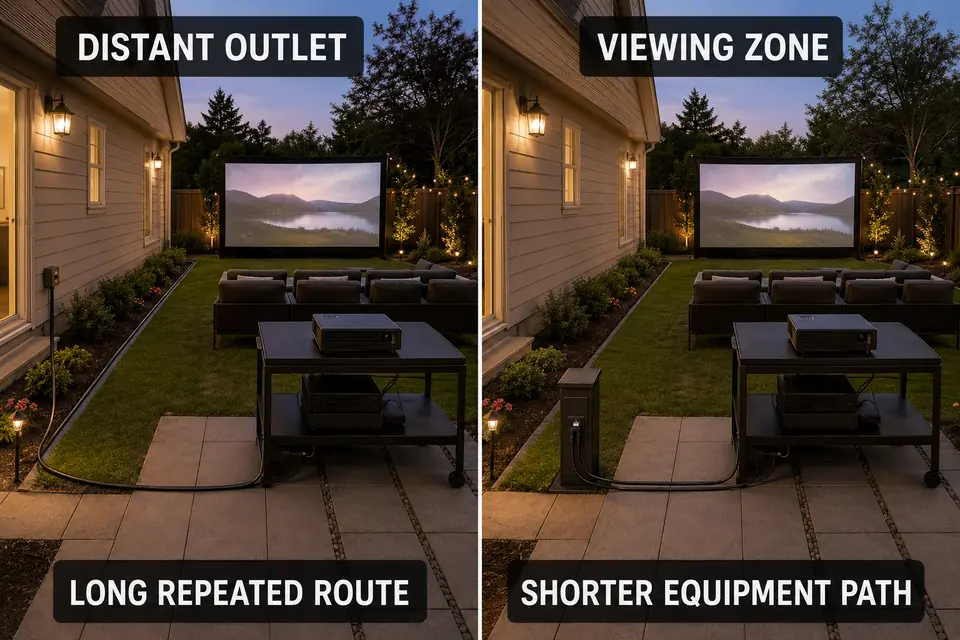
The occupied yard is the better test. Chairs may shift after guests arrive. Someone may walk between the house and seating area for drinks. Children may approach the screen from the side. A position that appears unobtrusive on an empty patio can still direct equipment leads across a frequently used approach.
Screen orientation may also place the projector away from the most obvious exterior wall. That observation does not prescribe an installation point. It gives the electrician the correct problem to assess: providing practical power for the real equipment location rather than adding another receptacle that still requires a substantial extension.
Weatherproof Cover Needs
A shorter route is not a complete solution unless the receptacle and enclosure match the conditions present while the theater is operating.
Outdoor power can encounter rain, irrigation, condensation, damp ground, and overnight dew. Protection when a receptacle is empty and closed is not necessarily the same as protection while cords remain connected. A shallow cover may shield an unused receptacle but fail to provide appropriate protection around plugged-in equipment leads.
Outdoor-rated components, ground-fault protection, enclosure design, and local requirements must be considered together. These are subjects for professional specification rather than conclusions based on the appearance of a cover.
This responsibility is separate from efforts to protect the projector from overnight dew. A dry projector does not make its power connection suitable, and a protected receptacle does not weatherproof the projector, speaker, streaming device, or their connections.
If irrigation reaches the area, water collects near the equipment station, or components are sometimes left connected after the movie, those conditions belong in the electrical assessment. A cover alone does not correct an unsuitable location or protect the complete AV setup.
Electrician Boundary
The homeowner can define the use case; the electrician must define the permanent electrical solution.
Document the recurring projector and speaker positions, list the equipment expected to operate together, photograph the current cord path, and note nearby doors, walking routes, irrigation, low ground, and other exposure conditions. This gives the electrician a realistic picture of the theater without turning the project into a DIY electrical design.
A qualified electrician must determine whether the existing system can support the proposed receptacle, whether a new circuit is appropriate, and which protective devices, enclosure, grounding, installation route, permits, and local requirements apply. Projector wattage and outlet distance alone cannot answer those questions.
Adding a receptacle is not simply the wall-mounted equivalent of an extension cord. It becomes part of the home’s permanent electrical system. The strongest reason to evaluate one appears when a stable theater location repeatedly requires a long or complicated temporary route, multiple devices operate together, and exposure must be managed while those devices remain connected.
There is no universal cord count, wattage figure, or movie-night schedule that settles the decision. Bring the electrician the equipment ratings, photographs of the existing route, the intended viewing-zone location, and observed moisture conditions. The onsite assessment can then determine whether the yard needs a better-positioned receptacle, a different circuit arrangement, or no permanent change.
For supporting guidance on outdoor outlets, weatherproof protection, and ground-fault protection, review the Electrical Safety Foundation International’s outdoor electrical safety guidance.