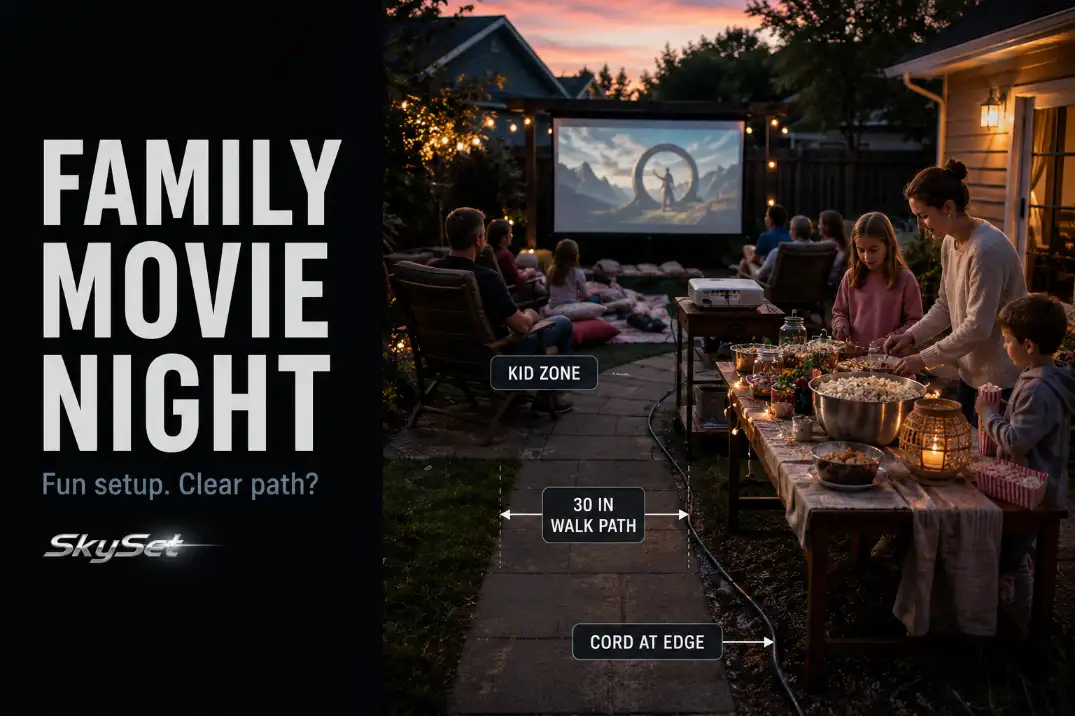
A family backyard movie night usually fails less from bad gear and more from dark movement. Kids cross the beam, adults step around snacks, someone heads back to the bathroom, and a cord that looked harmless at 7:45 p.m. becomes harder to see at 9:15 p.m.
The screen and projector matter, but the first real check is whether people can move from the back door to the seats with at least 30 inches of clear walking space and no cord crossing the route.
The best setup separates three zones before the movie starts: low kid seating near the front, adult chairs behind or slightly wider, and snacks along an edge instead of in the center aisle.
If the yard feels cozy before sunset but confusing after dark, the problem is usually not the projector. It is the layout.
Safe Walking Paths
Build from the back door first
Do not start by centering the screen and then squeezing people around it. For a family setup, start at the back door and trace the routes people will actually use: door to seats, seats to snacks, seats to bathroom, and adults to the projector or speaker.
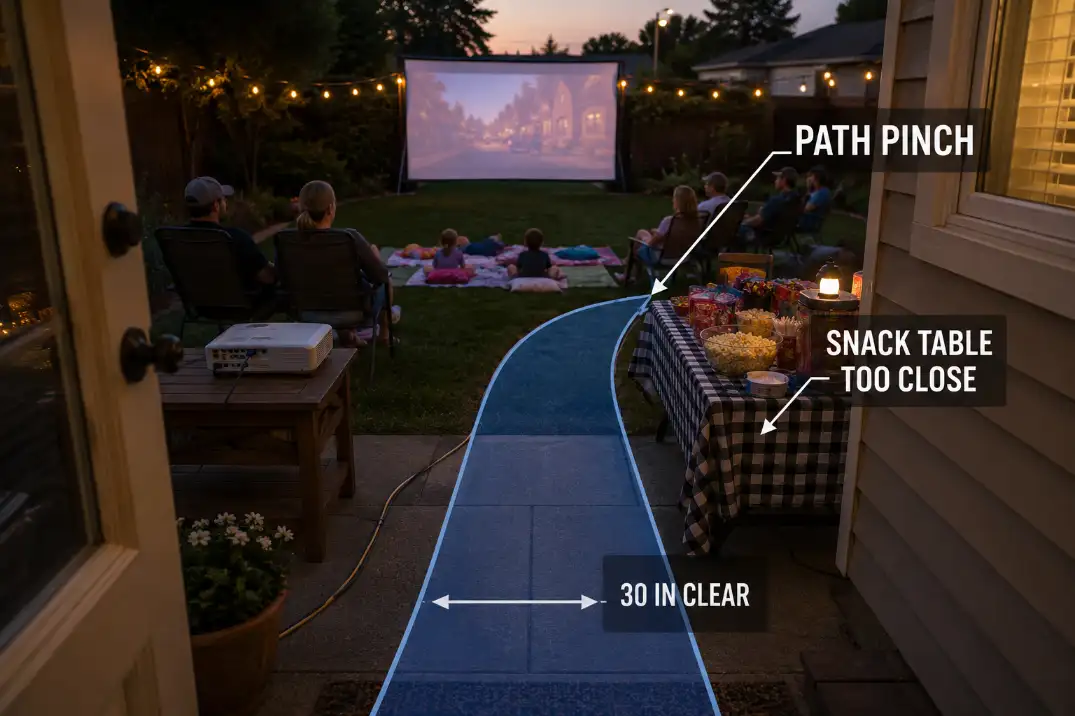
A 30 inch path is the minimum useful target. A 36 inch path is better when kids carry blankets, adults carry trays, or anyone needs a little more room to move.
The route does not need to be formal, paved, or perfectly straight. It just needs to stay obvious once the yard gets dark.
The common misread is thinking a path is clear because there is technically a gap. If someone has to step sideways between a chair leg and snack table, lift a foot over a blanket corner, or pass between the projector and seating, the path is not really clear.
Keep the projector boring and protected
The projector table should not become part of the traffic pattern. A centered table can work, but only if the lens faces the screen cleanly and the table sits outside the main walking route.
If the projector needs power, route the cord along the patio edge or fence side, not across the door-to-seat path.
This is where a family movie setup is stricter than an adult setup. Adults may remember a cord. Kids usually will not.
If the cord crosses a route children will use more than twice during the movie, taping it down is not the fix. Rerouting it is.
For a deeper layout around power placement, Backyard Projector Power Setup and Cable Hazards is the stronger supporting guide, but the family rule is simple: no repeated walking route should depend on people noticing a cord in the dark.
Kid Seating Zones
Kids need a drift buffer
Low seating belongs forward because blankets, foam pads, and low outdoor cushions let kids watch without blocking adults.
The mistake is treating that kid zone like a fixed rectangle. Children move. They lean forward, crawl toward the screen, change blankets, and stand up during snack breaks.
For most modest backyard screens, start the kid floor zone about 6 to 10 feet from the screen. Closer than that, kids may tilt their heads upward or drift into the screen base.
Farther back, they are more likely to stand, block adults, or spread into the chair area.
Leave at least 18 inches between the front edge of the kid zone and the screen stand, inflatable base, hanging frame, or support legs. That buffer prevents the screen area from becoming a play edge.
Adult chairs should control the edges
Adult chairs work best behind the kids or slightly wider than the kid zone. The goal is not to surround the children.
The goal is to keep adults able to see the screen, the snack route, and the main movement path without constantly standing up.
A practical family layout usually has this hierarchy:
| Zone | Best placement | What it prevents |
|---|---|---|
| Kid blankets | Front center, low to ground | Chair blockage and constant seat switching |
| Adult chairs | Behind kids, slightly wider | Poor supervision and blocked views |
| Snack table | Side edge, not center aisle | Mid-movie crowding |
| Projector table | Centered or near center, outside path | Beam interruption and tripping |
| Speaker | Near seating, not beside kids’ ears | Harsh volume and unclear dialogue |
| Trash bin | Near exit route, not in route | Sticky cleanup after dark |
This does not need to look symmetrical. It needs to keep kids, snacks, cords, and adults from competing for the same space.
Simple Sound
Clear dialogue beats louder volume
For family movie nights, sound should be clear at low volume. A speaker placed too far from the seating area often makes adults turn it up, which can bother neighbors while still leaving dialogue hard to hear.
The better fix is usually placement, not power. Keep a small speaker near the seating area and aim it across the listeners rather than blasting from behind the screen.
A distance of 6 to 12 feet from the main seating zone is often more useful than a louder speaker sitting 25 feet away.
People overestimate the screen side because the image comes from there. Outdoors, that logic often fails. Without walls to reflect sound back, voices fade quickly.
If dialogue feels weak, Backyard Movie Sound Weak Outdoors explains why turning the volume up is often the least efficient fix.
Test the real movie, not the loudest trailer
Do the sound check 20 to 30 minutes before the movie starts, while people are still moving around. A yard that sounds fine when empty can feel messy once snack bags open, kids talk, and chairs shift.
Setup Note: Test a quiet dialogue scene, not a music-heavy trailer. Big sound effects can seem fine while normal speech still disappears outdoors.
Snack Area
Central convenience becomes congestion
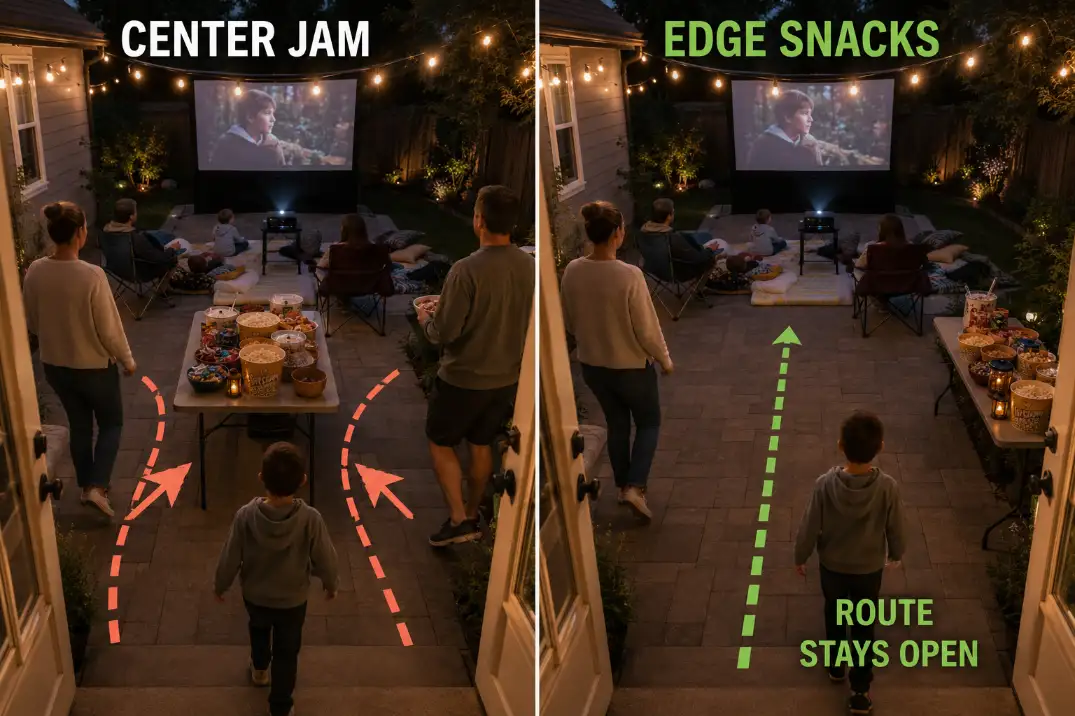
The snack table should be easy to reach, but it should not sit between the door, seats, and screen. A central table feels convenient before everyone sits down.
Once the movie starts, it becomes the place where people bunch up, step backward, block sightlines, and set drinks in unsafe spots.
Place snacks along a patio edge, fence side, or back-door-adjacent wall where people can approach without crossing in front of the screen.
Keep at least 24 inches of serving clearance on the active side of the table. If the serving side is tighter than that, kids crowd the table and adults end up stepping into chairs.
The snack area also needs its own low light. A small light aimed at the table is more useful than a bright patio light that washes the screen.
If the screen turns gray when the snack light comes on, the light is too bright, too high, or aimed toward the screen surface.
Do not combine snacks and projector gear
It is tempting to put the snack table near the projector because both need a stable surface. That usually creates the wrong kind of activity around the most sensitive part of the setup.
People walk near the beam, bump the table, step over cords, or place drinks too close to electronics.
If the yard is tight, simplify the setup instead of forcing every feature into the same small patio. The tighter layout logic in Small Backyard Movie Setup applies well here: give each object one job and keep shared movement routes clean.
Trip Hazards
The hazard is the object in the route
A cord, blanket, cooler, or chair leg is not automatically a problem. It becomes a problem when it sits where people step without looking.
That distinction matters because many families tidy objects that were never in the walking route while leaving the real hazard untouched.
The highest-risk spots are predictable: the back-door threshold, the turn near the snack table, the space between adult chairs, and the route from seating to the bathroom. Check those after the setup is complete, not while the yard is still empty.
Use a quick family reset 10 minutes before pressing play:
- Walk from the door to every seating zone without stepping over anything.
- Confirm the projector cord still follows the edge route.
- Flatten blanket corners or move them out of the walking lane.
- Leave 18 to 24 inches between chair rows so feet do not create a hidden trap.
- Move coolers, toy bins, and extra pillows away from turns.
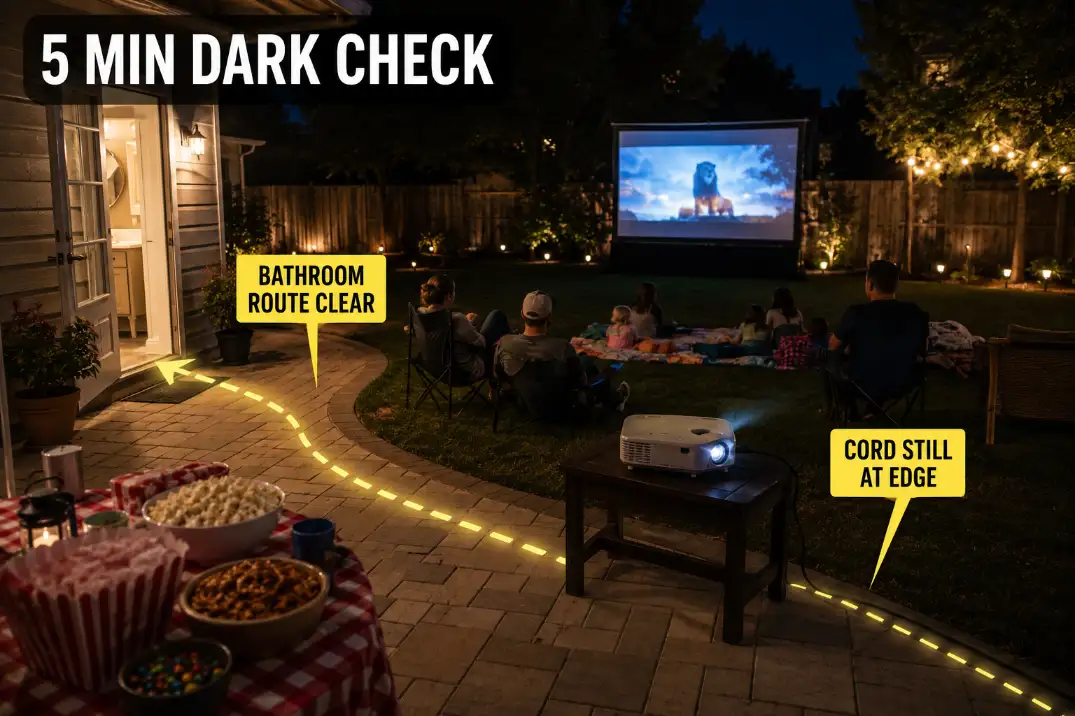
- Test one bathroom route after the yard lights are dimmed.
The 5-minute dark check catches what setup misses
The best time to spot family movie hazards is not always before the movie. It is 5 minutes after the movie starts, once kids have shifted, snacks have moved, and the yard is darker. That is when the “perfect” setup shows whether it actually works.
If a blanket corner has crept into the route, move the whole blanket instead of just folding the corner. If the snack area creates a crowd, slide the table farther to the edge. If the projector cord is suddenly underfoot, pause and reroute it before the yard gets busier.
Damp conditions deserve extra caution. After rain, wet grass, humid Florida evenings, or a damp concrete patio can make casual cord placement less forgiving. When the setup involves extension cords, repeated outdoor use, or damp ground, Weatherproof Cable Management for Outdoor AV is the better place to tighten the power plan.
Easy Cleanup
Cleanup starts before the movie
A family movie setup should come apart in a simple order. If cleanup takes more than 15 minutes just to make the yard safe again, the layout was probably arranged for the picture, not the teardown.
Place one trash bag or lidded bin near the back-door route but not inside it. Put a small tray or bin near the snack table before the movie starts so wrappers and cups do not scatter through the seating area.
If kids use cushions or blankets, choose one soft-gear drop zone instead of letting each seat become its own pile.
Food should clear first. Soft seating should clear second. Projector, speaker, and cords should clear last. That order keeps people from walking around half-packed electronics in the dark.
Leave electronics until traffic is gone
Do not start by pulling the projector cord while people are still walking through the yard. Clear snacks and loose seating first, then shut down the electronics, then remove the cord from the edge route.
If family movie night becomes a repeat event, the setup may need to evolve. A one-night blanket setup should stay simple.
A weekly setup may justify a steadier screen location, cleaner edge power, or better speaker placement. When that shift starts to happen, Portable vs Permanent Backyard Theater can help decide what should stay temporary and what is worth making more stable.
Questions Families Usually Ask
How far should kids sit from the outdoor screen?
Start most kid floor seating about 6 to 10 feet from a modest backyard screen. Move them back if they tilt their heads upward, crowd the screen base, or keep drifting into the front buffer.
Should the snack table be near the screen or near the door?
Near the door or patio edge is usually better. A snack table near the screen pulls people across the viewing area and can create shadows, spills, and screen-side crowding.
Is one speaker enough for a family movie night?
Often, yes. One well-placed speaker near the seating area can outperform a louder speaker placed too far away. The test is clear dialogue at the adult chairs without harsh volume near the kids.
What is the easiest layout rule to remember?
Keep the center boring. Use the center for the screen, viewing line, and clear sightline. Move snacks, cords, coolers, and cleanup bins to the edges.
For broader official safety guidance on extension cords, see the U.S. Consumer Product Safety Commission.