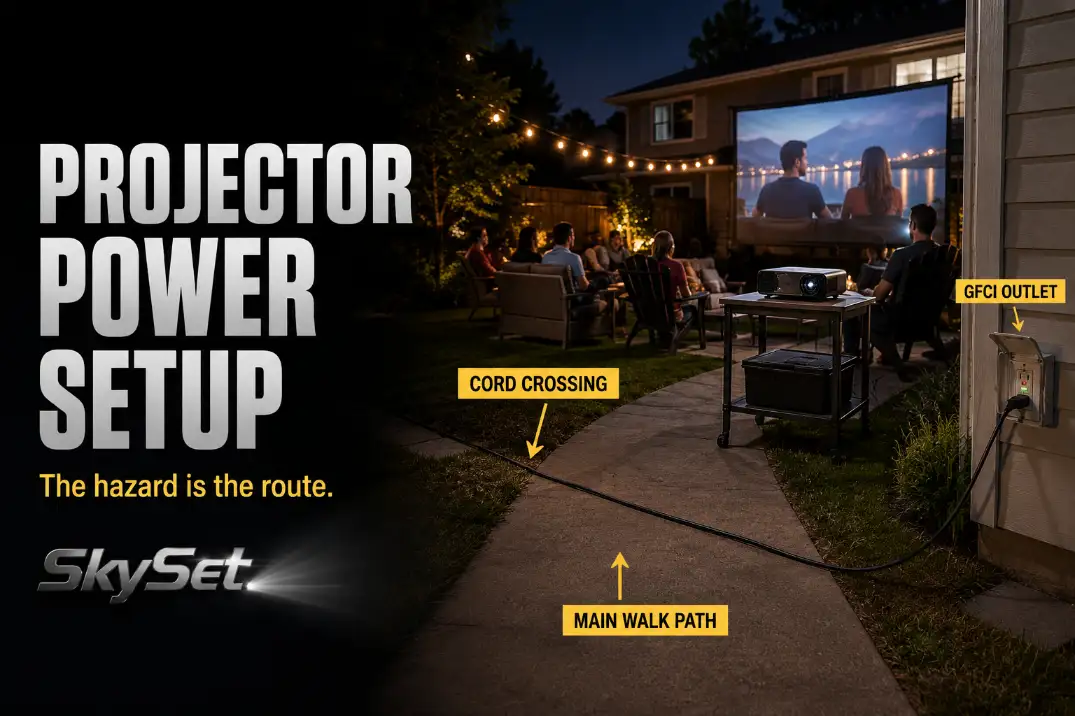
A safe backyard projector power setup starts with the cord route, not the projector.
The usual failure pattern is simple: the outlet is behind the house, the projector needs to sit 8 to 15 feet from the screen, and the cord takes the shortest path across the patio, seating aisle, or grass. That shortcut creates the hazard.
The safest setup is not always the shortest cord. It is the route guests do not have to step over.
Before plugging in, check four things: use an outdoor-rated cord, avoid daisy-chaining extension cords, keep plug connections dry and visible, and test the walking route with the lights down for 30 seconds.
This is different from a picture or sound problem.
If the image looks weak, the fix may involve screen size, projector brightness, or start time, as explained in Outdoor Projector Brightness. If people are stepping over power to reach a chair, the issue is not performance. It is layout safety.
Outlet Location
Start With the Power Source
Most backyard movie layouts are planned from the screen backward. That works for sightlines, but it often fails for power. The better order is outlet, cord route, projector table, walking path, then seating.
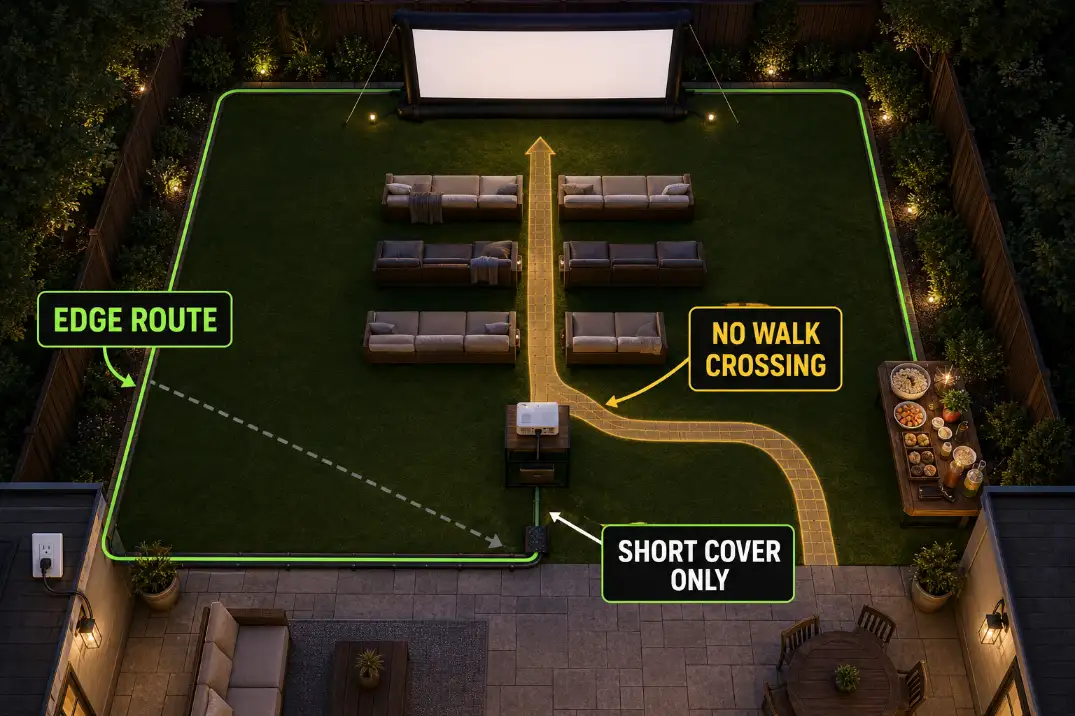
The safest outlet is not simply the closest one. It is the outlet that lets the cord run along a wall, patio edge, fence base, mulched border, or another low-traffic perimeter. A 25-foot cord routed around the patio edge is usually safer than a 15-foot cord pulled diagonally through the audience zone.
For many U.S. homes, the best outdoor power source is near a patio door, garage wall, covered porch, or back entry. If the only usable outlet is 40 to 75 feet away, the question is not just “Can the cord reach?” The better question is “Can the cord reach without crossing the path people will use every 5 to 10 minutes?”
GFCI and Cover Location Matter
Outdoor projector power should come from a GFCI-protected receptacle. That does not mean every outdoor-looking outlet is automatically the right one.
A loose outlet, damaged cover, or plug connection exposed to rain splash can turn a clean-looking setup into a poor one.
The ideal power point is protected, visible, and located where the cord can leave the outlet without hanging across a doorway or step. If the outlet is on the wrong side of the patio, a longer perimeter route is usually better than a tight diagonal shortcut.
For a complete setup sequence, power should be planned alongside screen placement, seating, and projector distance, not added after everything else is already arranged in a Backyard Movie Night Setup.
Cord Length
Shorter Is Not Automatically Safer
A short cord feels tidy, but tidy is not the same as safe. A short cord pulled tight across a patio creates tension, reduces flexibility, and often puts the cable exactly where people walk.
A slightly longer outdoor-rated cord can be safer if it allows the route to follow the edge of the space.
For many backyard projector setups, a 25-foot cord works when the outlet is close to the patio. A 50-foot cord may be needed when the projector sits farther into the yard. Once the normal setup needs 75 to 100 feet every time, the routine fix starts to lose sense.
At that point, a properly installed outdoor outlet closer to the viewing area may be safer than treating a long temporary cord as a permanent system.
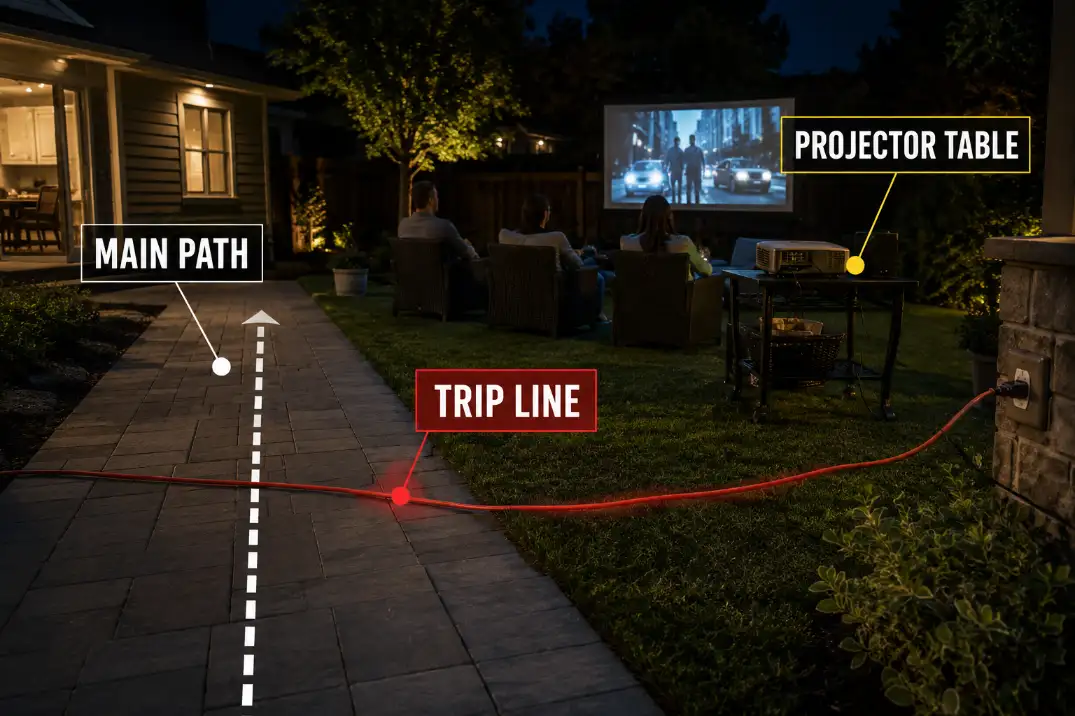
The useful comparison is simple: a healthy setup has slack without loose coils and reaches the projector without crossing the main walking path. A failing setup is tight, diagonal, repeatedly stepped over, or dependent on reminders like “watch the cord.”
What to Look for on the Cord
Use a cord clearly rated for outdoor use. Look for an outdoor-rated cord with a “W” in the cord marking, a durable jacket, and a grounded 3-prong plug when required.
The cord should have no cracked insulation, exposed wire, loose plug end, or crushed section.
Do not daisy-chain extension cords. Do not run an indoor power strip outside. Do not plug the projector, speaker, laptop charger, and decorative lights into a random strip sitting on the patio. Even if the projector turns on, the setup can still be wrong.
A modest projector may use roughly 150 to 400 watts, but the full load can rise when speakers, streaming devices, chargers, or powered accessories are added.
If the cord gets warm, the plug wiggles, the GFCI trips, or the projector cuts out when audio starts, stop treating it as a movie-night annoyance. That is a power setup problem.
Setup Note: Choose the route first, then choose the cord length. A longer cord only helps if it moves power to the perimeter instead of spreading the hazard through the audience zone.
Walking Paths
The Crossing Point Is the Real Problem
A backyard cord is not dangerous just because it exists. It becomes dangerous where it crosses movement. The most common crossing points are the route from the house to the seats, the path to snacks and drinks, the gap between seating rows, and the service path behind the projector table.
This is the part people underestimate. They check whether the cord reaches, not whether the route still makes sense after the movie starts.
Once the screen is on and the yard is darker, a cord that looked obvious during setup can disappear into shadow within 20 or 30 minutes.
Before pressing play, walk the route once with the lights lowered. Move from the house to the seats, from the seats to the food table, and from the back row to the exit path.
If you step over the cord during that 30-second test, guests will probably do the same during the movie.
A Simple Cable Hazard Check
- The cord crosses the only route from the house to the seating area.
- Guests must step over power to reach drinks, snacks, or the back row.
- The cord is pulled tight between the outlet and projector table.
- A plug connection sits on grass, soil, mulch, or a low patio spot.
- A cable cover creates a raised strip in a narrow dark walkway.
- The route would be hard to see after the movie has been running for 30 minutes.
- Someone needs to warn guests about the cord more than once.
If two or more of these are true, the fix is usually rerouting, not taping.
This is why power planning belongs with the whole outdoor layout, not as an afterthought. Many Backyard Movie Setup Mistakes happen because equipment is placed where it works technically but interrupts how people actually move through the space.
GFCI Protection
GFCI Reduces Shock Risk, Not Trip Risk
GFCI protection matters outdoors because moisture, wet grass, bare feet, metal furniture, and damp patio surfaces can change the risk quickly. But GFCI is a safety layer, not a layout fix.
It does not stop someone from tripping over a cord. It does not make an indoor cord outdoor-rated. It does not protect a plug connection sitting in wet grass. It also does not mean you should keep resetting the outlet if it trips repeatedly.
Test the GFCI before guests arrive. The test and reset process takes less than a minute. If the outlet will not reset, trips again under normal load, or feels loose when the plug is inserted, do not build the movie night around that receptacle.
Projector Shutdown Is Often Not a Projector Problem
If the projector randomly shuts off outside, people often blame the projector first. Sometimes that is right, but a backyard-only failure usually points earlier in the chain: loose plug, kicked cord, damp connection, overloaded strip, or GFCI trip.
A true projector defect tends to repeat indoors on a stable outlet. A shutdown that only happens outside after someone walks behind the seats is more likely a power route issue.
Replacing the projector will not fix a cord that is being bumped every time someone passes the table.
Cable Covers
Covers Are for Short Crossings
Cable covers are useful when a cord must cross a short, visible, low-traffic section. They are not a way to make a bad route acceptable.
A low-profile outdoor cable cover can help across a small patio transition, a doorway edge, or a short crossing near the perimeter. A 3-foot crossing near the patio edge is manageable. A 14-foot covered cord through the middle aisle is still a layout problem.
The common misread is thinking the cover removes the hazard. It usually changes the hazard from “loose cord” to “raised strip.” In low light, that raised strip still needs to be visible and outside the main traffic line.
Tape Is Usually a Weak Fix Outdoors
Tape is one of the most common wasted fixes. It can look convincing during setup, then fail because of textured concrete, dust, grass moisture, temperature change, or foot traffic. Once tape lifts at the edge, it becomes its own trip point.
Use tape only as a minor visibility or strain-control aid where it makes sense. Do not use it as the main reason a bad cord route becomes “safe enough.” If the route depends on tape to work, the route is probably wrong.
| Setup condition | Better choice | Why it works |
|---|---|---|
| Cord can run along a patio edge | Edge route with light slack | Keeps power away from repeated foot traffic |
| Short crossing is unavoidable | Low-profile outdoor cable cover | Makes one small crossing more visible and controlled |
| Cord crosses the center aisle | Reroute before covering | The route itself is the hazard |
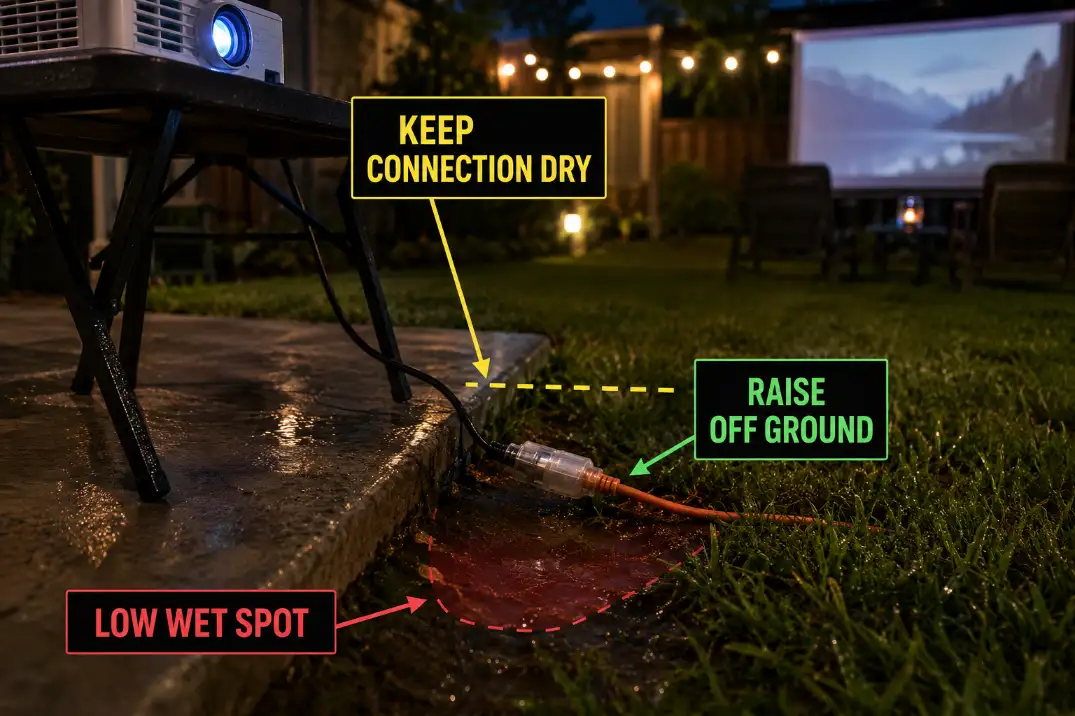
| Plug connection sits on grass | Move or elevate the connection point | Moisture risk is not solved by neat routing |
| Setup needs 75–100 ft every time | Consider a closer outdoor outlet | Temporary cords stop making sense as a routine system |
Rain Risk
Damp Is Enough to Change the Decision
Rain risk is not only about heavy rain. Dew, sprinkler overspray, wet grass, coastal moisture, and a low patio spot can all make an outdoor power setup less forgiving.
In humid areas like Florida, a surface that looked dry at sunset can feel damp later in the evening. In coastal parts of California, moisture can settle even without obvious rain.
The practical rule is direct: keep plug connections dry, elevated, visible, and away from places where water can collect. A connection resting on grass, soil, mulch, or a low patio joint is a poor condition even if the sky looks clear.
Do not rely on plastic bags, towels, bowls, or improvised covers around live plug connections. Those fixes often trap moisture, hide the condition of the connection, or make the setup look protected when it is not.
When to Stop Instead of Adjusting
If rain is expected during the movie window, the cleaner decision is to move the event, shorten it, or use a properly protected covered location. If the cord route crosses damp ground, depends on a plug connection near wet grass, or requires improvised covering, the setup has moved beyond a normal adjustment.
A useful threshold is simple: if you would not want a guest stepping barefoot in that area, do not leave a power connection there.
When Temporary Power Stops Making Sense
Weekend Repetition Changes the Standard
A temporary cord can be reasonable for an occasional backyard movie. It becomes less reasonable when the same route is used every weekend, crosses the same walking path, needs multiple cable covers, or requires repeated warnings to guests.
That is the point where accessories stop solving the real issue. More tape, another cover, or a longer cord may only make the setup look more organized while leaving the movement problem in place.
If your projector, speakers, streaming device, and chargers all depend on one awkward route, simplify the layout first. In some setups, moving the projector table 3 to 6 feet closer to the perimeter solves more than buying new gear.
In others, a properly installed outdoor receptacle closer to the viewing area is the clean long-term fix.
The same logic applies to audio. If the power route forces speakers into the wrong place, the sound problem may appear to be weak equipment when it is really a layout problem.
For that side of the setup, Backyard Movie Sound Weak Outdoors explains why placement often matters more than simply turning the volume up.
Questions People Usually Ask
Can I use an indoor extension cord for one backyard movie?
No. Use an extension cord clearly rated for outdoor use. The problem is not whether the projector turns on. The problem is insulation, moisture exposure, durability, and the outdoor environment around the cord.
Is a cable cover enough if the cord crosses the patio?
Only for a short, visible, low-traffic crossing. If the cord crosses the main walking route, the better fix is usually a perimeter route, not a cover.
Should the projector plug be off the ground?
Yes, especially where grass, soil, dew, sprinklers, or rain may be involved. Keep connections dry, visible, and away from low spots where water can collect.
Can a portable power station avoid cable hazards?
Sometimes. A portable power station can reduce long cord runs if it is rated for the projector load and placed safely near the projector table.
It still needs dry placement, stable footing, and enough runtime for the movie. It should not become another obstacle in the walking path.
When should I stop using extension cords and add an outlet?
If your normal setup repeatedly needs a 75- to 100-foot cord, crosses walking paths, depends on covers, or requires guest warnings, a properly installed outdoor outlet closer to the viewing area is the cleaner long-term solution.
For broader official guidance on extension cord safety, see the CPSC extension cord safety guidance.