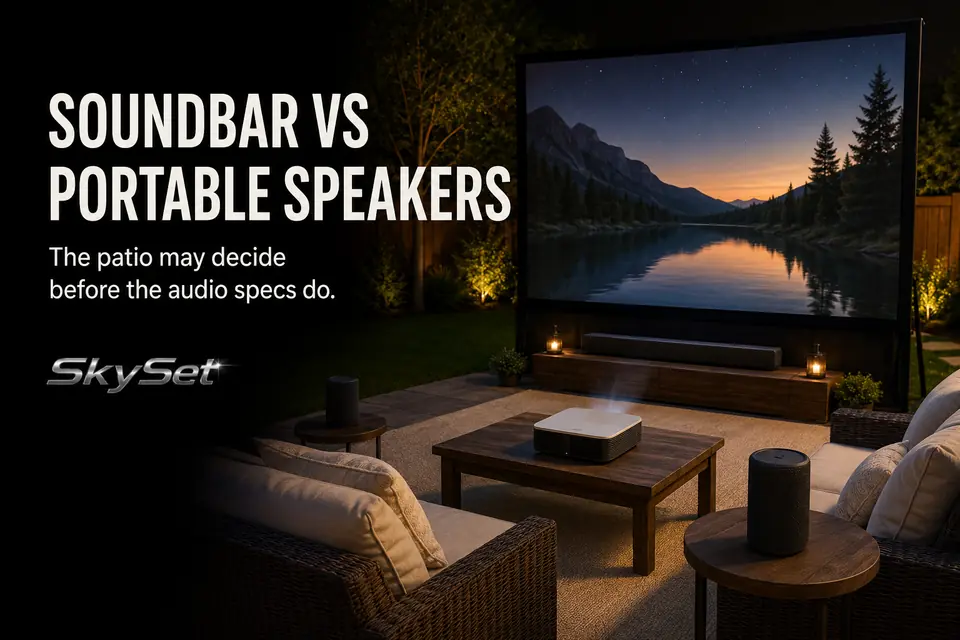
This is not mainly a sound-quality comparison. It is a placement-and-coverage decision.
A soundbar concentrates the audible source near the screen, which can keep voices connected to the picture. Portable speakers let you move sound closer to the audience or spread it across a wider seating area. Either advantage disappears if the equipment has no stable position, blocks the image, crowds a walkway, or creates a difficult power route.
Outdoor use makes those physical constraints more important. There are no room walls helping contain the sound, and equipment must share the patio with chairs, tables, the projector, cables, and changing weather.
The stronger choice is therefore the format that makes dialogue intelligible from the real seats while creating the fewest placement, power, and exposure problems—not the option with the more impressive specification sheet.
Centered Dialogue vs Wider Sound
Start by deciding where dialogue should appear to come from and how many seats the audio must cover.
A soundbar has its clearest advantage when it can sit directly below or close to the screen. Speech then remains visually connected to the picture instead of pulling attention toward a speaker beside the audience. This is especially useful for dialogue-heavy movies and seats grouped along the screen’s centerline.
The principle resembles the center speaker’s role in a conventional theater layout. Dolby’s speaker setup guidance identifies the center speaker as the primary dialogue source and places it close to the display. A soundbar is not automatically equivalent to a dedicated center channel, but its screen-aligned position can support the same basic connection between voice and image.
Portable speakers become more useful when the audience is too wide for one distant source. A compatible pair can bring sound closer to the outer seats, while a single portable speaker may outperform a soundbar forced into a remote or obstructed location.
That flexibility creates a new failure point: uneven proximity. A guest beside one speaker may hear that side much more strongly than everyone else. Excessive separation can also make voices feel detached from the screen, particularly outside the central listening position.
Quick judgment: If the seats are compact and centered, do not create a wide speaker layout merely because the equipment permits one. Wider sound is useful only when the seating area actually requires wider coverage.
If voices remain difficult to understand even from a sensible speaker position, why movie dialogue is hard to hear outside can help separate a coverage problem from a broader intelligibility problem.
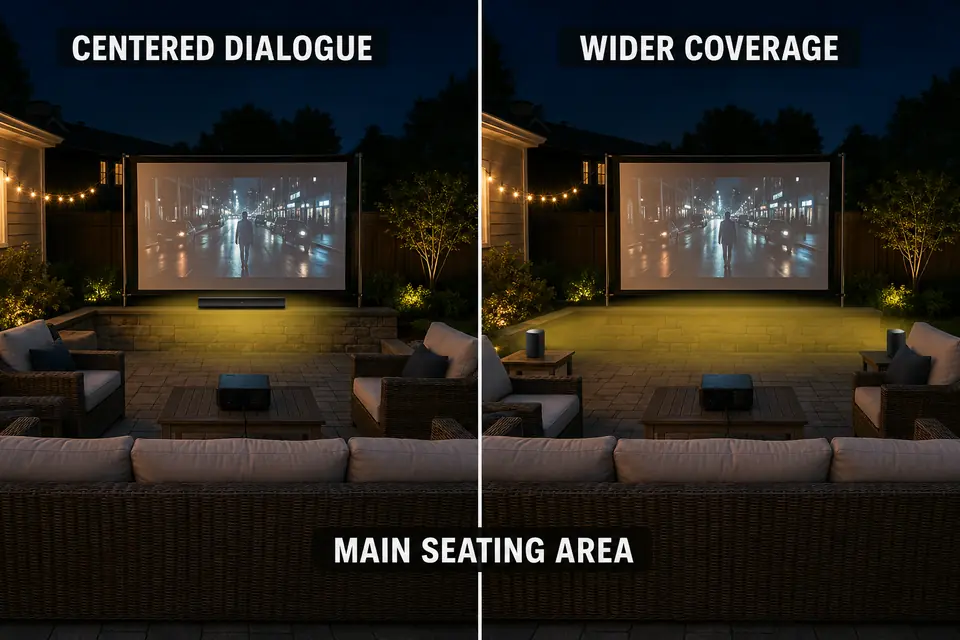
Choose the soundbar when the audience is relatively centered and dialogue should stay anchored to the picture. Favor portable speakers when the seating width genuinely needs broader coverage and the patio provides balanced positions for them.
Table Placement Limits
Reject any audio format that lacks a stable, unobstructed position before comparing its theoretical sound advantages.
A soundbar needs a surface wide enough to support the complete enclosure without fabric, screen framing, or decorations blocking its drivers. It must also remain outside the projected image. That combination can be difficult with a freestanding screen that has little usable space below it.
A low table may conflict with the screen base or occupy the route to the seats. Moving the bar onto the projector table behind the audience solves the furniture conflict but gives up its screen-centered advantage.
Portable speakers require less width at any one location. They may fit on existing side tables, stable stands, or protected surfaces closer to the audience. That flexibility counts only when those positions are safe. A speaker balanced on an armrest or placed in a walkway is not a workable alternative.
Separate positions can also produce unequal listening distances. Moving the speakers toward the patio’s extreme edges may look symmetrical while leaving one chair much closer to a speaker than another. The useful position is the one that covers the main seats evenly, not necessarily the one that creates the widest arrangement.
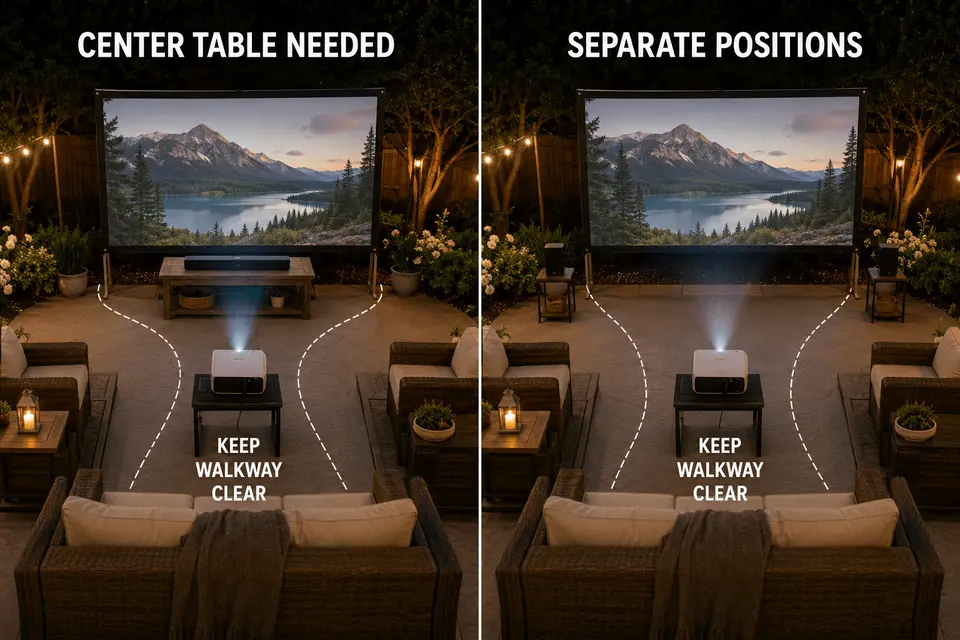
The soundbar is simpler when a stable central surface already exists and serves no conflicting purpose. Portable speakers fit better when central space is unavailable but safe side positions already exist. Neither format can compensate for a poor furniture route.
Battery and Power Needs
Power should decide this comparison only when it materially changes the cable route or the reliability of the movie-night setup.
Many portable speakers can operate from internal batteries, removing the need for a live power cable between the outlet and listening area. That is a meaningful advantage on a patio where the only powered route would cross circulation.
Battery operation is simpler only when the available charge covers the entire event. Compare the manufacturer’s stated runtime with the movie, setup period, and any music played beforehand. Playback level, battery condition, and active features may reduce real runtime, so a partial charge is a weak foundation for the setup.
A soundbar commonly needs continuous power. Depending on the connection path, it may also require another powered component or an audio cable between the source and bar. This is manageable when a suitable outlet is near the screen and the route stays outside the seating path.
Portable does not mean connection-free. Bluetooth pairing, stereo linking, transmitters, and projector audio behavior remain separate variables. If voices and mouth movements do not arrive together, use the Bluetooth audio-delay diagnosis instead of expecting a different speaker shape to correct the timing.
Battery-powered speakers are stronger when they eliminate a difficult cable route. The soundbar remains practical when continuous power is easy to provide and its centered position offers a greater benefit than battery freedom.
Weather Exposure During Setup
Exposure can overrule every audio advantage: equipment that cannot remain dry does not have a usable outdoor position.
Neither “soundbar” nor “portable speaker” is a weather rating. The device instructions determine what exposure it can tolerate, and temporary backyard use does not make ordinary electronics suitable for rain or prolonged dampness.
A soundbar’s long enclosure can be awkward to shelter. Moving it far under a roof may separate sound from the screen, while wrapping or covering it during operation can obstruct sound or trap heat. It also needs a dry surface along its full length.
A smaller portable speaker may be easier to place beneath cover or carry inside quickly. Some are designed for limited water exposure, but that protection must be confirmed from the stated rating and manufacturer instructions. Charging ports, open covers, adapters, and linked accessories may have different limitations from the speaker enclosure.
Dew matters even when rain is not forecast. Equipment may become damp as surfaces cool after dark, while wet tables, sprinklers, and water left by an earlier shower create additional exposure routes. The guidance on how to protect outdoor AV equipment from dew covers that moisture boundary in greater depth.
Powered setups need a dry, suitable electrical route. The Electrical Safety Foundation International advises using outdoor-rated extension cords, inspecting them for damage, keeping them away from standing water, and using proper GFCI protection where electricity and moisture may meet. Its extension-cord safety guidance also warns against joining extension cords together.
Portable speakers often win when rapid retrieval is the controlling condition. A soundbar remains viable when it has a protected screen-side position, a suitable dry power route, and a clear plan for bringing it indoors before moisture develops.
Small Patio Use
On a small patio, count usable equipment positions rather than assuming the smallest device creates the simplest layout.
When chairs form a compact group facing the screen, one soundbar below the image can serve the area from a single footprint. It also avoids placing a speaker beside one chair, where that listener may receive disproportionately loud sound.
That advantage disappears if the bar needs the only table available for the projector, drinks, or snacks. A long enclosure can also obstruct the lower part of a screen positioned close to the patio surface.
Portable speakers fit better when stable side surfaces already exist. Bringing them closer to the listeners may improve dialogue clarity without raising the overall volume. However, two compact speakers still create two objects to position, protect, and balance. They are not space-saving if either one intrudes into seating or circulation.
The small backyard movie setup should establish the usable seating route before audio positions are finalized. A speaker does not belong in that route merely because the location creates a visually symmetrical arrangement.
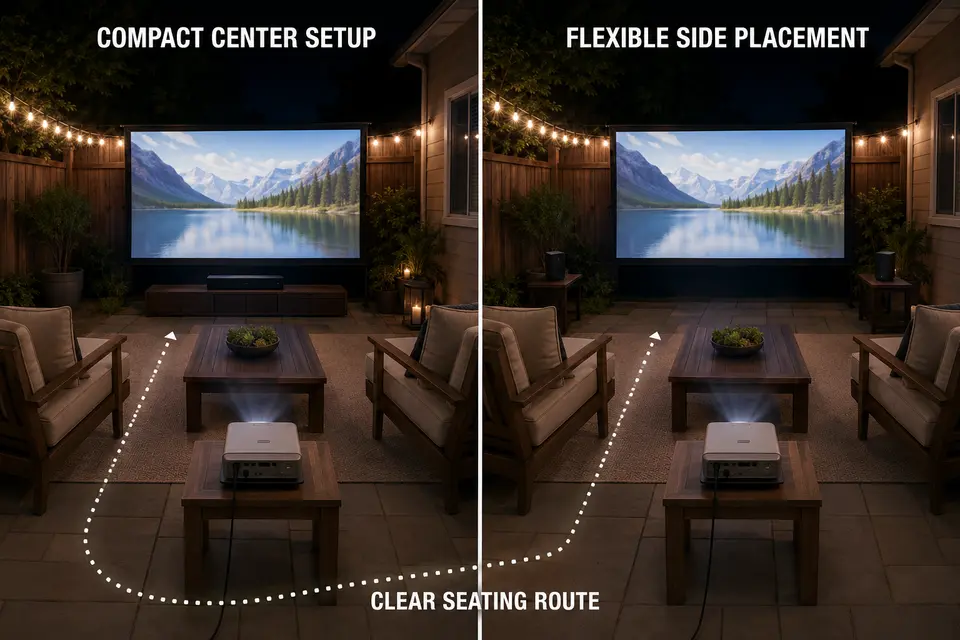
On a narrow patio with centered seats and an available screen-side surface, the soundbar is usually the cleaner arrangement. Portable speakers are stronger when the center zone is unavailable and balanced side positions can reach the audience without consuming the walkway.
When a Soundbar Makes Sense
A soundbar earns its place when the patio can preserve its main advantage: a stable, protected position near the screen.
It fits best when the audience occupies a reasonably centered zone, dialogue localization matters, continuous power is practical, and the enclosure does not interfere with the projected image. If the bar must move behind the audience or onto an unstable surface, its apparent simplicity has already been lost.
Portable speakers are the stronger fit when existing side positions serve a wider seating area or battery operation removes a difficult cable route. They become weaker when one speaker must sit close to a guest, pairing complicates the signal path, or the only available positions pull dialogue away from the screen.
| Setup condition | Soundbar fit | Portable speaker fit |
|---|---|---|
| Seats grouped near the screen center | Strong; one centered source keeps dialogue connected to the image | Works, but extra separation may add little |
| Wide seating area | Outer seats may receive weaker coverage | Stronger when balanced positions distribute sound evenly |
| No wide surface below the screen | Weak unless another safe centered support exists | Stronger when smaller side surfaces already exist |
| No practical power route near the screen | Weak if continuous power is required | Strong when battery runtime covers the event |
| Fast removal from changing weather | Longer enclosure and powered route may slow retrieval | Smaller battery-powered units are often easier to move |
| Very compact patio | Strong when one footprint preserves circulation | Strong only when separate positions do not crowd the seats |
Make the final decision from the chairs, not from beside the equipment. Play a dialogue-heavy scene at the expected volume, then listen from the central and farthest intended seats. Speech should remain clear without overwhelming the nearest listener, and the equipment should leave the image and walking routes unobstructed.
If one protected, screen-centered source passes that test, the soundbar is the simpler fit. If the central position fails physically or coverage falls away at the outer seats, portable speakers provide the flexibility the patio actually needs.