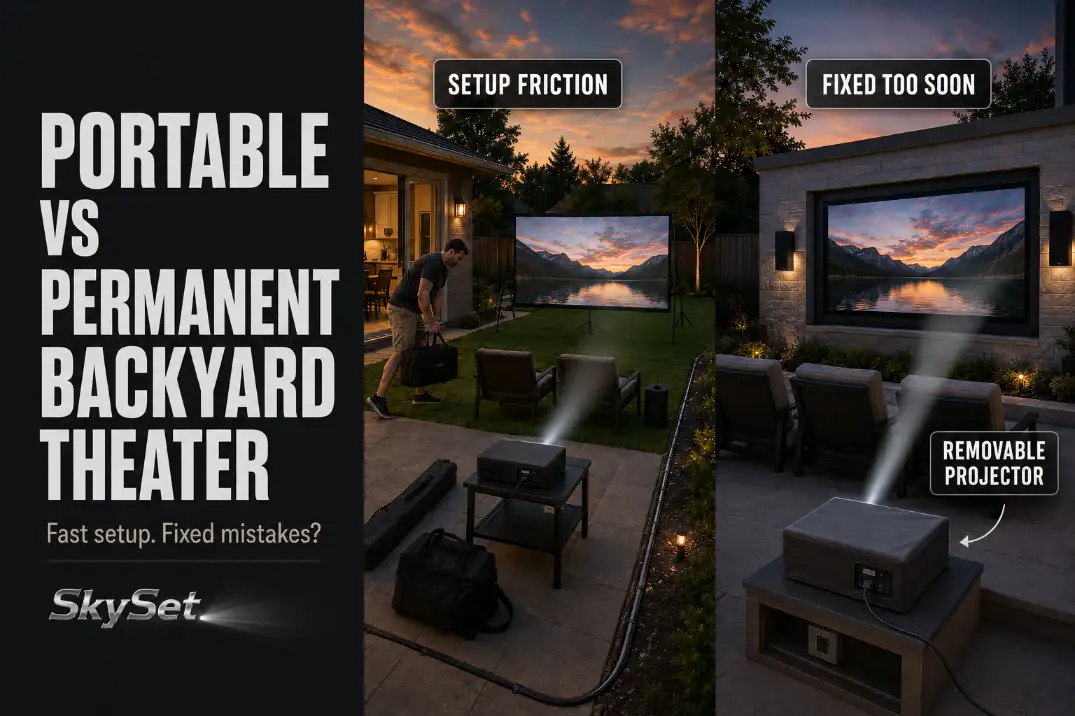
Portable vs permanent backyard theater setups usually come down to one practical question: do you want a movie night you assemble in 10–20 minutes, or a yard feature that is ready in 2–5 minutes but can lock in weather, wiring, sound, and placement mistakes?
The wrong choice is rarely about screen size alone. It is more often about storage distance, wind exposure, outlet location, and how often the setup will actually be used.
A portable setup makes sense when you watch movies a few times a month, need the patio back the next morning, or want to test projector placement before committing.
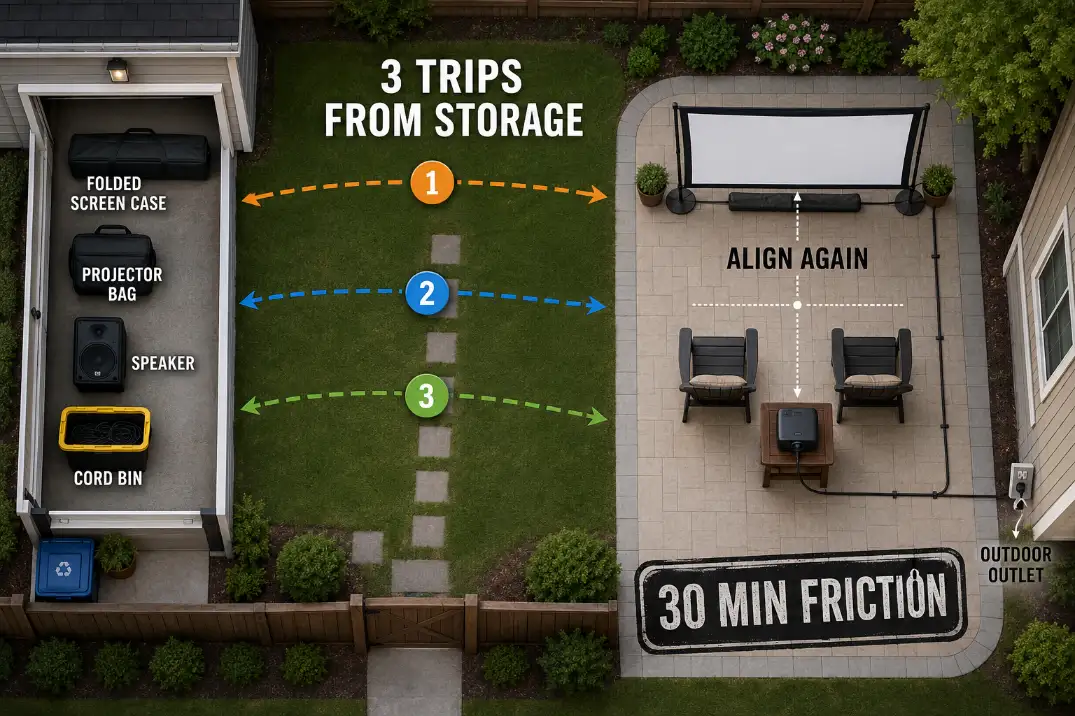
A permanent setup starts to make sense when the same screen, seating, speaker position, and power route are used every week during the season. The warning sign is simple: if setup takes 30 minutes often enough that you skip movie nights, portability is no longer flexibility. It has become friction.
The Best Middle Ground Is Usually Semi-Permanent
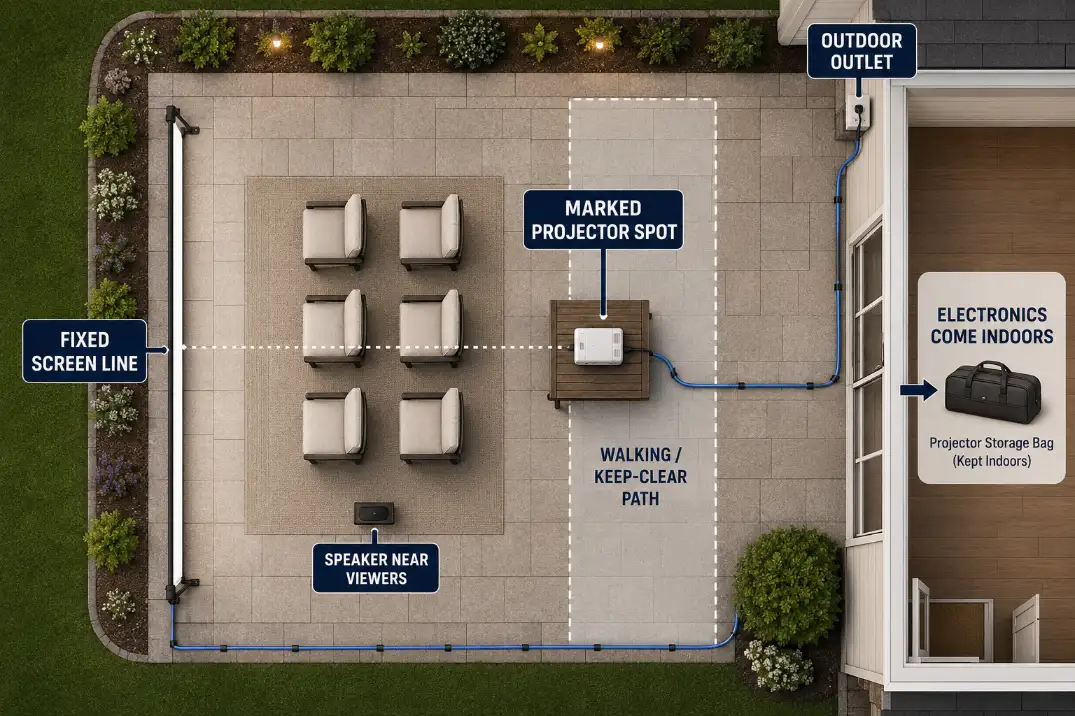
For many U.S. backyards, the strongest answer is not fully portable or fully permanent. It is semi-permanent: a fixed screen line, a repeatable projector position, a planned speaker spot, a safe temporary power route, and electronics that still come indoors after the movie.
This distinction matters because “permanent” does not mean every component stays outside. The screen line may be fixed, the outlet may be permanent, and the speakers may be mounted, while the projector still gets stored inside. That keeps the routine fast without treating delicate electronics like patio furniture.
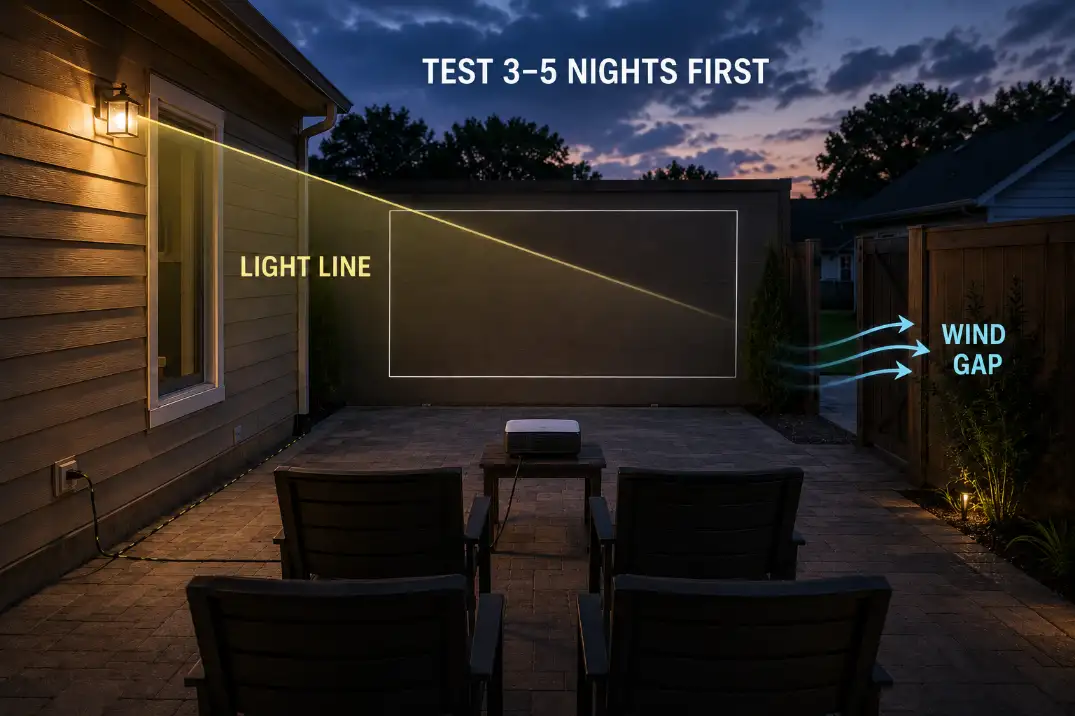
The smartest path is to test the yard first. If the same layout works for 3–5 movie nights in a row, with no cord crossing the path, no screen shake, no porch-light wash, and no weak dialogue at the seats, then a more permanent plan has evidence behind it.
Setup Time
Setup time is really pre-movie friction
A portable backyard theater usually needs the screen, projector, speaker, power cord, media device, and seating brought out each time. Under 10 minutes is excellent.
Around 10–20 minutes is normal. Once setup regularly passes 30 minutes, the system is probably too scattered, too large, or too dependent on small adjustments.
That is why the largest portable setup is not always the best one. The better setup is the one that can be carried, placed, powered, and aligned without turning movie night into a small project.
If the viewing area is tight, setup time is often affected by clearance more than by the projector itself. The placement limits in Outdoor Movie Setup for Small Patios are useful when the real question is whether the screen, chairs, and projector can repeat the same layout without blocking the patio.
Permanent setups remove steps but add inspection
A permanent backyard theater can be ready in under 5 minutes if the screen stays mounted, speakers remain aimed, and power access is protected.
But faster startup does not mean no upkeep. A fixed screen surface can collect pollen, sprinkler mist, dust, or coastal moisture. Mounted speakers can shift after storms. Hardware, covers, brackets, and outdoor outlets still need seasonal checks.
In northern states with freezing winters, anything left outside should be treated as seasonal outdoor equipment, not indoor AV gear that happens to be in the yard.
Storage Needs
Portable gear needs one clean landing zone
Portable setups fail quietly when storage is scattered. A foldable screen, projector, extension cord, speaker, remote, tripod, and media adapter should live in one predictable zone. If the gear requires three trips from the garage, basement, or closet, the setup will feel heavier than it is.
For most small backyard systems, plan for at least a 3 ft by 2 ft storage footprint for the main screen case, gear bag, and cord container. A 100-inch screen is often easier to repeat than a larger 120-inch screen that technically fits but becomes annoying to pack, dry, fold, and store.
Damp gear changes the decision
Portable gear is often packed after dark, when dew, sprinkler mist, humid air, or damp grass can leave the screen fabric slightly wet. If that screen is folded tightly before drying, it becomes harder to keep clean and may smell musty after storage.
This is one reason semi-permanent can beat fully portable. The screen location can be repeatable, while the projector and speaker still come indoors. In Florida or Gulf Coast humidity, removable electronics matter more than people expect. In coastal California, moisture and salt air can also be rough on exposed brackets, connectors, and speaker hardware.
Setup Note: If drying and repacking the screen takes longer than setting it up, the setup is probably oversized for casual use.
Wind Stability
Portable screens fail before they fall
Wind does not need to knock a screen over to ruin the movie. A breeze that feels harmless at ground level can make a lightweight screen ripple, twist, or lean. Once wind reaches the 10–15 mph range, many freestanding screens become noticeably less pleasant, especially when placed in an open lawn or side yard.
The real failure is image stability. Small screen movement softens focus and makes the picture feel unstable. People often overestimate how much movement they can tolerate and underestimate how quickly a screen frame becomes a sail.
For compact yards, placement can matter more than screen strength. A screen near a fence corner, wall edge, or planted boundary may behave better than the same screen in the middle of an open lawn.
The same hidden-fit issue appears in Small Patio Projector Placement Problems, where the setup technically fits but the working zone does not.
Permanent screens need structure, not just weight
A permanent screen should not rely on the logic of a portable stand. Weight helps only up to a point. The better question is whether the screen surface, frame, and mounting points can handle repeated gusts without twisting, loosening, or transferring stress into a weak fence panel.
A common wasted fix is adding heavier bases to a screen that is simply too exposed. If the surface continues to shake, the problem is not the base alone; it is the wind load on the screen.
At that point, reducing screen size, moving into a more sheltered line, or choosing a fixed wall-mounted surface may solve more than adding more weight.
Power Access
Temporary cords must stay temporary
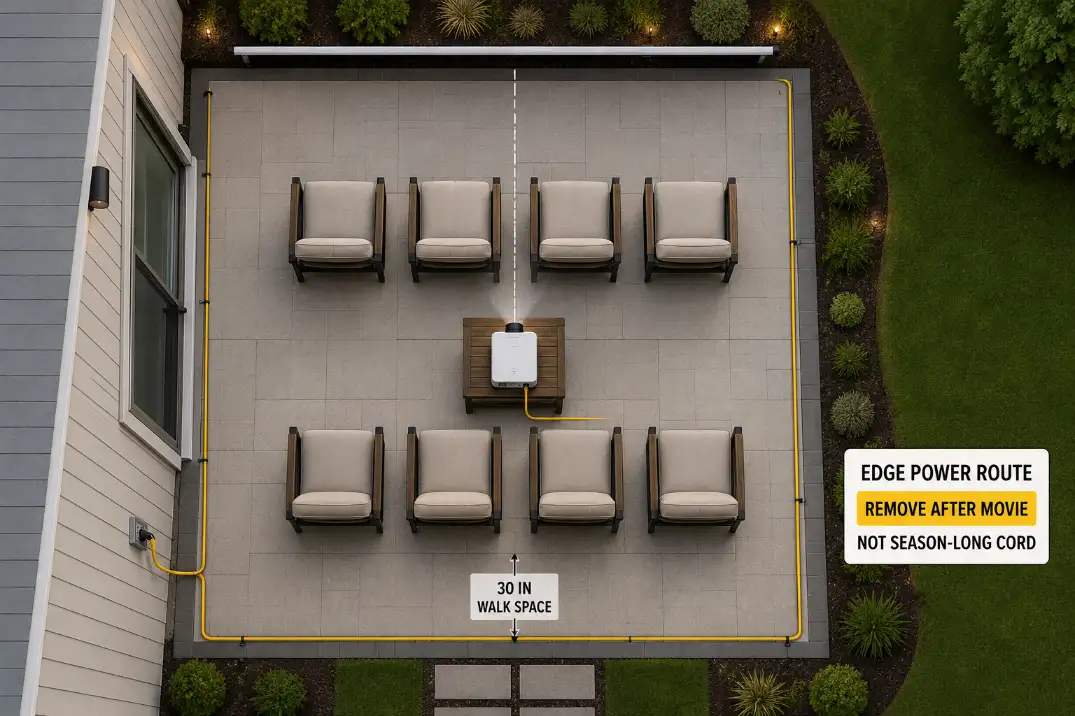
Portable systems usually depend on outdoor-rated extension cords. That can work when the outlet is close, the cord follows an edge, and the walking path remains clear. A practical threshold is keeping at least 30 inches of walk space between the house, seats, table, and screen area.
The problem is that cord hazards often look harmless during setup and become obvious only after dark. A cord crossing a sliding door threshold or the path between seats becomes a trip line once people start moving around with lights low.
The safest portable layouts begin with the outlet, not the screen. Decide where power can run without crossing a walking path, then place the projector within that working zone.
Backyard Projector Power Setup and Cable Hazards is the better next read when the real problem is not the projector but the route people walk through after the lights go down.
A cord left in place changes the category
A permanent backyard theater should not be built around a cord that stays outside indefinitely. That is where a routine portable fix stops making sense. Extension cords are for temporary use; permanent power access usually means an outdoor-rated outlet, proper cover, protected route, and code-aware installation.
A cord that is acceptable for a 3-hour movie night is not automatically acceptable as a seasonal wiring solution. If a cord would stay in place between movie nights, the setup has moved out of portable territory and into outdoor electrical planning.
For semi-permanent systems, the practical compromise is a planned cord route used only during movie nights, then removed and stored dry.
If the cord must stay staged near the patio, the weatherproofing details in Weatherproof Cable Management for Outdoor AV become more important than buying another projector accessory.
Cost Difference
Portable looks cheaper until it becomes an upgrade chain
Portable setups usually have the lower entry cost. The problem is that many portable systems turn into upgrade chains: a bigger screen, heavier stand, brighter projector, better speaker, longer cord, storage bag, ground stakes, and weather covers.
This is the best point to slow down before buying. If you are still choosing your first portable setup, do not buy the screen, projector, speaker, and cord as separate guesses.
The buying sequence in Best Backyard Movie Setup is the better next step when you want a repeatable portable system instead of a pile of disconnected upgrades.
The first purchase is not the full cost if the setup is uncomfortable to repeat. A slightly smaller, sturdier screen may be the better buy if it reduces the number of things you fight every time.
Permanent costs more because the yard becomes part of the system
A permanent setup adds cost through mounting, weather protection, power access, speaker placement, and sometimes patio or landscape changes.
The screen itself may not be the most expensive part. The real cost is making the yard support the theater without creating hazards, glare, neighbor noise, or ugly hardware.
Sound is a good example. A permanent screen does not automatically make the theater feel better if dialogue still misses the seats. The speaker logic in Outdoor Speaker Placement for Backyard Theater can prevent a fixed build from becoming a louder version of the same weak setup.
Best Use Case
Choose portable when the yard has multiple jobs
Portable is the better choice when the backyard is also used for dining, pets, kids, gardening, grilling, or weekend hosting. It keeps the theater from taking over the yard and works well for renters, small patios, and HOA-limited homes.
It also wins when the viewing season is short. In northern climates, a setup used heavily for 8–12 summer weekends may not justify permanent outdoor hardware. The key is repeatability: one storage zone, a safe 25–50 ft cord route if needed, and alignment that stays under 20 minutes.
Choose permanent only after the layout proves itself
Permanent is better when the same space is used often and the yard can support a fixed theater line. That means a stable screen location, predictable seating distance, manageable wind, controlled power access, and sound aimed at the seats.
A permanent system also locks in decisions. If the screen faces the wrong light source, the speakers aim across the neighbor’s fence, or the seating lands in a wind path, the problem is harder to change later. That is why the 3–5 night test matters.
Choose semi-permanent when you want speed without regret
Semi-permanent is usually the safest upgrade path. It gives you the speed of a repeatable layout without pretending the whole system belongs outside permanently.
If you later discover that a porch light washes the screen, wind hits one corner, or the projector throw distance feels awkward, you can adjust before drilling hardware into the wrong place. That flexibility is worth more than it seems during the buying stage.
Quick Decision Guide
| Choose This Setup | When It Makes Sense | Watch Out For |
|---|---|---|
| Portable | Occasional movie nights, renters, shared patios | Long setup time, scattered storage, cord hazards |
| Semi-permanent | Weekly seasonal use with a repeatable layout | Covers, dry storage, removable electronics |
| Permanent | Frequent use in one proven yard zone | Higher cost, fixed mistakes, weather exposure |
| Do not build yet | You have not tested the setup at night | Glare, weak sound, unsafe power routes |
Questions People Usually Ask
Is a permanent backyard theater always better?
No. Permanent is better only when the same layout works repeatedly. If the yard still has glare, wind, outlet problems, or awkward seating distance, permanence locks those problems in.
Should the projector stay outside in a permanent setup?
Usually no. The screen, brackets, or speaker mounts may stay outside if designed for it, but the projector is often the part worth removing because moisture, heat, dust, insects, and theft risk make permanent exposure a poor tradeoff.
When does portable stop making sense?
Portable stops making sense when the repeated setup is the reason you skip movie nights. If the same gear comes out every week, takes 30 minutes to assemble, and always lands in the same place, the yard is asking for at least a semi-permanent plan.
For broader official safety guidance on extension cords, see the CPSC extension cord safety guidance.