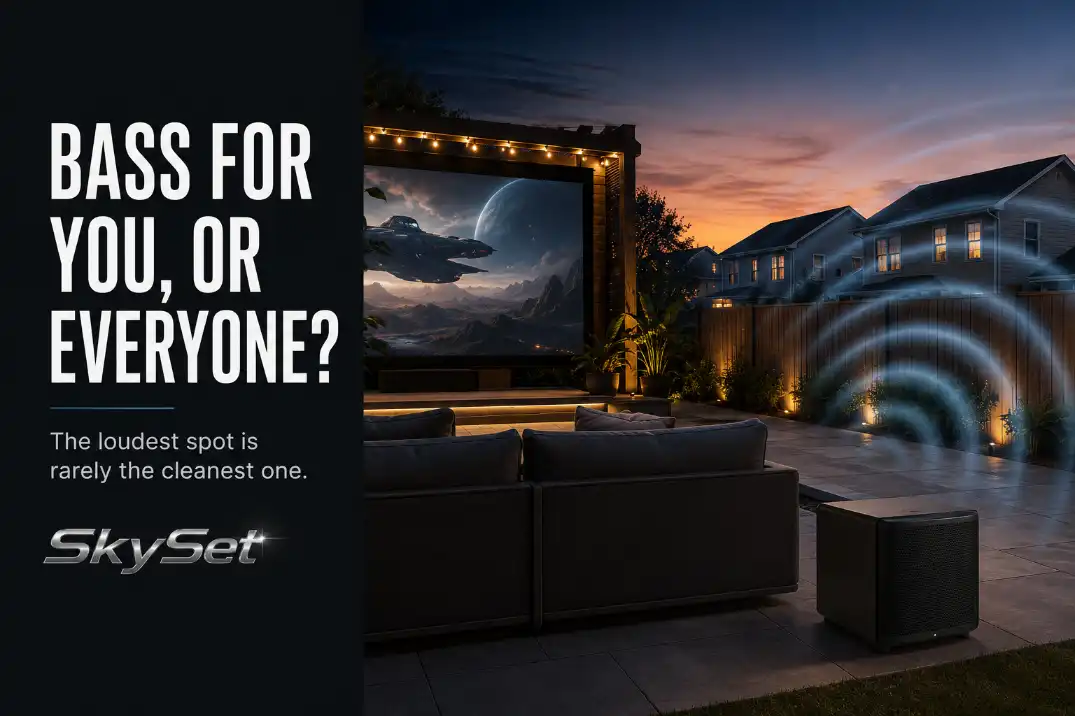
An outdoor subwoofer is not a simple “make the movie louder” fix. In a backyard, it becomes a boundary decision.
Put it in the wrong spot, and the bass may miss the seats, build up in a patio corner, shake a deck, or carry toward the neighbor side of the fence. Put it in the right spot, and it adds weight under the movie without taking over the yard.
That is the real placement test: not where the subwoofer sounds biggest, but where it supports the people watching while staying controlled at the edges.
Inside a room, walls, floors, and corners contain bass. Outside, the same subwoofer has fewer boundaries to push against. It can feel weak at the chairs, too heavy near the house, and still travel farther than expected through open yard space.
For backyard movies, controlled bass is usually better than bigger bass.
Why Bass Travels Farther Outdoors
Judge outdoor bass from the seats first, not from beside the subwoofer.
Bass is low-frequency energy, so it behaves differently from dialogue. Voices give you a clearer sense of direction. Bass feels broader, heavier, and less tied to one exact point in the yard.
That makes setup misleading. Standing beside the subwoofer, you may think it is not doing enough. Walk toward the fence, side yard, or back of the property, and that same low end may still be noticeable. Outdoor space does not trap bass the way a living room does, so the subwoofer can feel underwhelming near the patio while still spilling past the movie area.
A better first placement is usually close enough to support the audience at a lower level. If the subwoofer has to be turned up high just to be felt at the chairs, it may already be sitting in the wrong part of the layout.
In the full backyard movie night setup, picture, power, seating, and sound all compete for clean placement. The subwoofer should not be treated as a leftover object that goes wherever there is space.
Test From the Audience Position
Set the subwoofer where it seems practical, then sit where people will actually watch the movie. Use that seat as the reference point.
If bass disappears at the seats but stays obvious near the fence, move the subwoofer inward or lower the level. If it shakes the patio more than it supports the soundtrack, the surface is doing too much work. If voices become harder to understand, the bass is no longer helping the movie.
The audience area is the target. Everything beyond it is a control problem.
Patio Corners Can Boost Too Much Bass
A patio corner can make a weak placement sound impressive for the wrong reason.
House walls, privacy walls, deck edges, and solid corners can reinforce low frequencies. That reinforcement may make the subwoofer feel stronger during the first test, but it can also turn the bass thick, uneven, or one-note.
Corner-loaded bass often feels exciting for a few seconds and tiring over a full movie. Instead of adding weight under the soundtrack, it blurs explosions, music, and low effects into a patio rumble. A corner near the house can also send vibration into siding, sliding doors, window frames, or lightweight furniture.
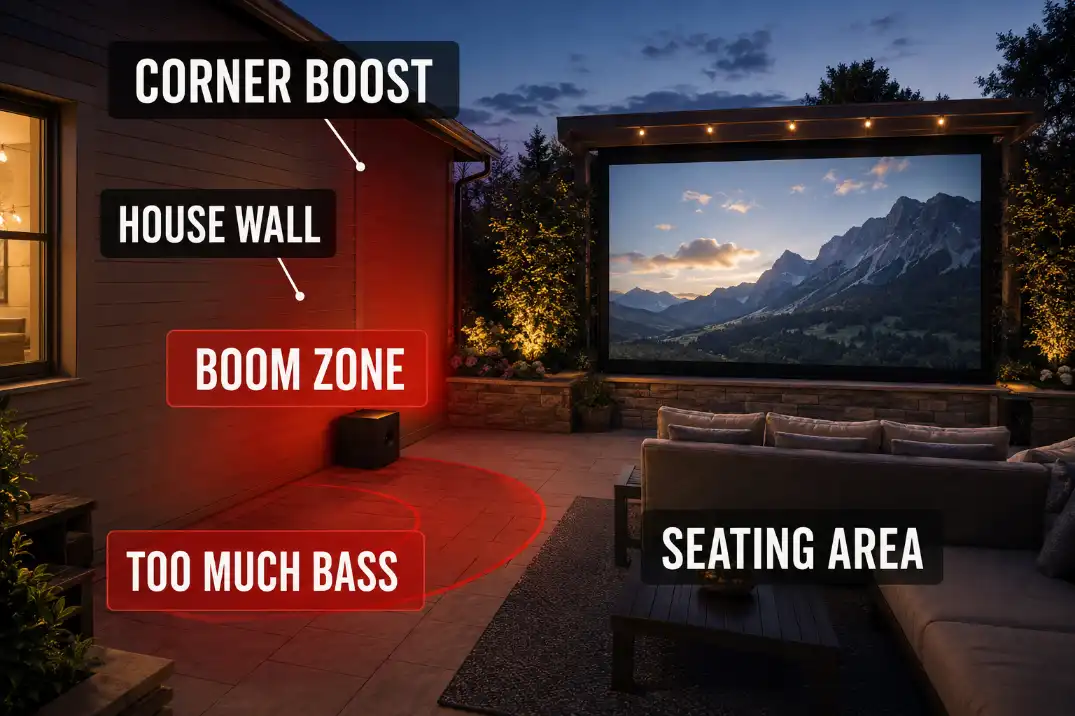
The issue is not that every corner is unusable. The issue is that a corner can hide poor placement by making bass louder before it makes the movie clearer.
The Loudest Corner Is Not the Cleanest Corner
If the subwoofer sounds powerful only when it is jammed into a corner, pull it slightly away from the walls and test again from the chairs. The bass may become less dramatic up close but cleaner where people are watching.
A useful outdoor subwoofer location usually sits near the audience side of the setup, not buried in the deepest patio corner. It should support the screen and seating zone without turning the house wall into an amplifier.
| Common subwoofer spot | What happens | Main risk | Better use |
|---|---|---|---|
| Tight patio corner | Bass feels bigger fast | Boomy, uneven low end | Pull slightly out and retest from seats |
| Against house wall | Adds surface reinforcement | Door, window, or siding vibration | Lower level and check for rattles |
| Near fence line | Bass carries outward | Neighbor-side spill | Move inward toward audience |
| Beside seating area | Bass reaches viewers sooner | Can feel too local if too loud | Use lower level and blend carefully |
| On deck boards | Adds physical vibration | Buzzing or shaking structure | Use a stable base or move to a firmer spot |
Keep the Subwoofer Away From Neighbor Lines
Do not place the subwoofer where the yard has the least forgiveness.
Fence lines, side returns, shared walls, and open rear boundaries are spill-risk zones. Even when the movie feels acceptable from the patio, low-frequency sound can move into nearby outdoor spaces without needing a clear line of sight.
That is why fence-side placement is risky. It may seem convenient because the subwoofer is out of the walking route, but the low end is now closer to the place where you have the least control.
A stronger move is to bring the subwoofer closer to the audience at a lower setting. The seats get more usable bass, and the property edge receives less leftover energy.
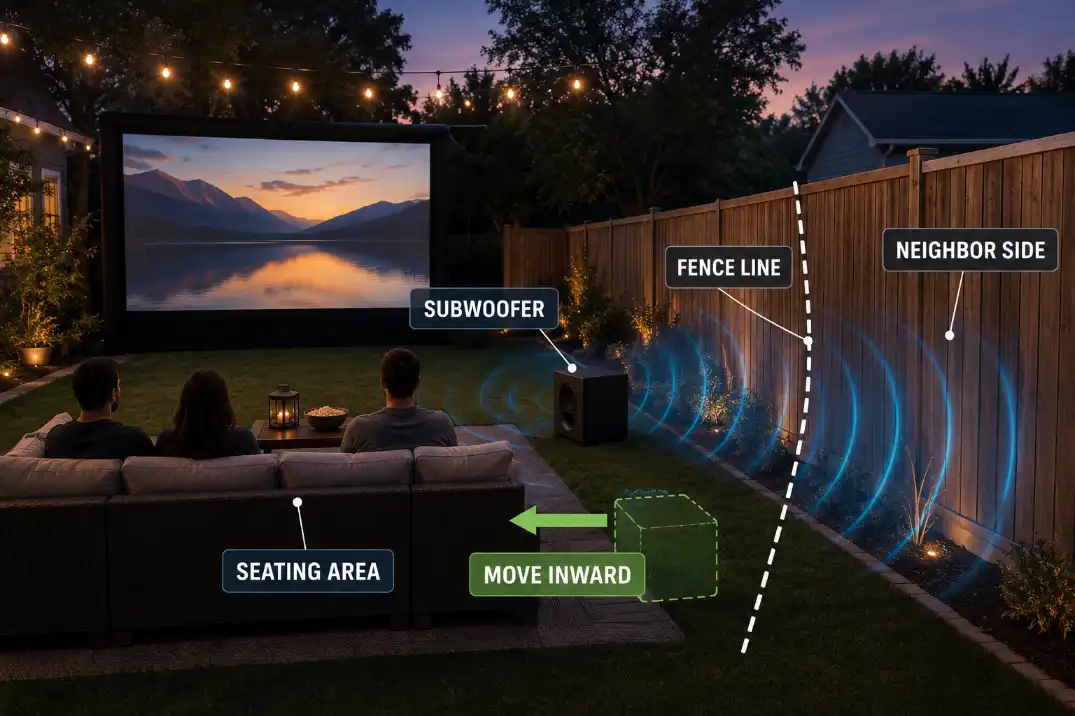
Avoid placing the subwoofer directly against a shared fence, behind the seating area aimed outward, or in a narrow side yard where sound can funnel between structures. In small lots, the cleanest answer may be less bass, not a stronger bass position.
If neighbor impact is already part of the setup problem, treat the subwoofer as only one piece of keeping backyard movie sound under control. Main speaker direction, seating distance, movie timing, and overall volume often matter just as much.
Late-night viewing needs an even stricter decision. Bass that feels fun earlier in the evening may feel intrusive later, especially in close suburban yards. If the subwoofer cannot stay low and still add value, leave it out for that session.
Reduce Vibration on Hard Surfaces
A subwoofer sitting on the wrong surface can make vibration feel like better bass.
Concrete, pavers, and deck boards all change how low frequencies behave. A hard surface may reflect or carry vibration, making the patio feel more active without actually improving the movie sound at the seats.
Wood decks are the clearest warning zone. Deck boards, railings, storage boxes, planters, and lightweight furniture can buzz when low frequencies hit them. Concrete is usually more stable, but it can still make the low end feel harder than the seating area needs.
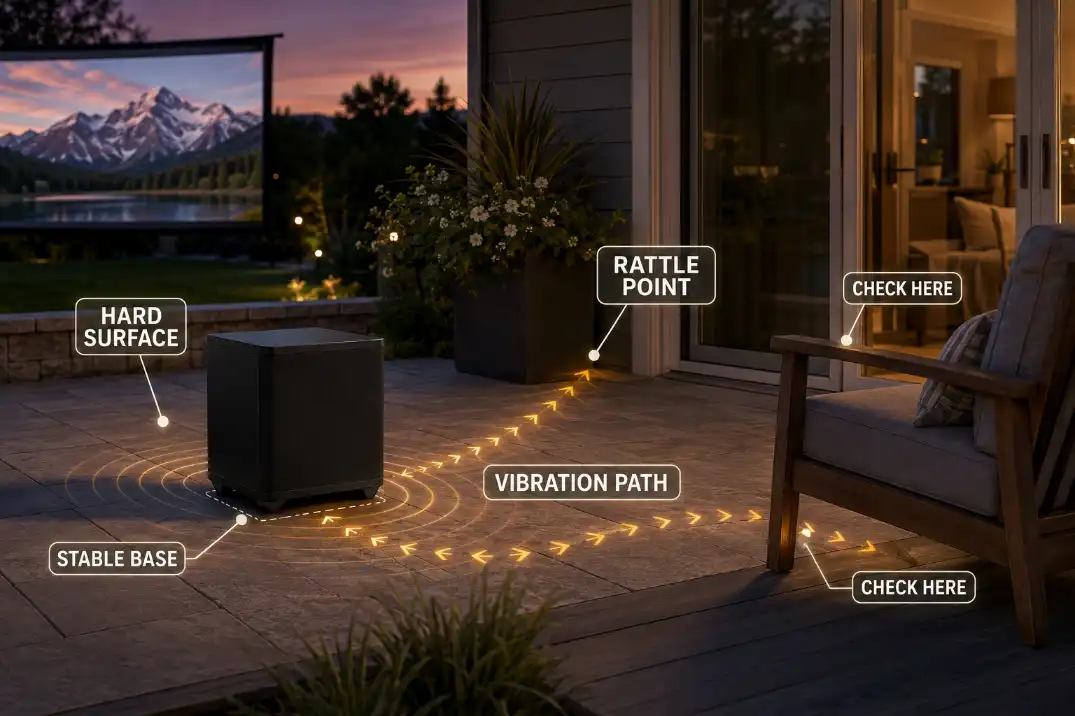
Before deciding the bass level is right, walk around the patio and listen for rattles. Check the sliding door, deck boards, railings, metal furniture, empty planters, storage bins, and anything touching the house wall.
If the sound changes from bass to buzz, placement is the problem.
The fix should stay simple. Move the subwoofer off the most resonant surface, place it on a steadier base, or isolate the feet from the surface. The goal is not to make the patio shake. It is to keep low-end support under the movie without letting nearby objects join the soundtrack.
Balance Bass With Dialogue
The best subwoofer position is the one that lets people hear voices without raising the whole system.
Dialogue carries the story. Bass should sit underneath it. If the subwoofer makes action scenes exciting but turns ordinary conversation into a muddy layer, the setup is not balanced for backyard viewing.
Test placement with a dialogue-heavy scene before testing explosions or music. Sit in the main viewing position. If voices are clear with the subwoofer off but harder to follow with it on, the low end is masking the sound instead of supporting it.
Use the Dialogue Scene as the Real Test
A good bass test is not the loudest trailer you can find. It is a normal scene with voices, background music, and a little low-end activity.
Start with the subwoofer lower than you think you need. Raise it only until it gives the movie some weight. If the main speakers have to be turned up sharply after the subwoofer comes on, reduce the subwoofer first rather than chasing the voices with more overall volume.
For a wider sound layout, speaker placement around the seating area matters more than pushing bass from one corner. Clear voices near the audience usually make a backyard movie feel better than heavy bass coming from the edge of the patio.
| If this happens | Best next move | Why it works |
|---|---|---|
| Bass feels weak at the chairs | Move the subwoofer closer to the audience | Less output is needed to support the seats |
| Bass sounds boomy | Pull it away from corners or walls | Reduces accidental surface boost |
| Fence-side bass is obvious | Move the subwoofer inward and lower it | Keeps more energy near the movie area |
| Voices become harder to follow | Lower or skip the subwoofer | Dialogue clarity matters more than impact |
Do not tune the whole movie night around the subwoofer. Tune the subwoofer around the movie night.
If people keep asking for the volume to go up, pause before blaming the main speakers. Bass masking, seating distance, screen direction, and outdoor background noise can all make movie dialogue hard to hear outside, even when the system is technically loud enough.
When to Skip the Subwoofer
Some backyard movie layouts are cleaner without a subwoofer.
Skip it when the yard is tight and neighbor lines are close. Skip it when the movie starts late. Skip it when the only available placement is a deck corner that rattles. Skip it when the bass makes voices harder to follow. Skip it when a simple speaker near the audience gives you better control at a lower volume.
This is not a downgrade. Outdoors, controlled sound usually beats bigger sound.
A subwoofer earns its place only when it improves the experience at the seats without creating problems at the edges. If it needs a corner to feel powerful, shakes the patio, pushes low-end sound toward the fence, or forces you to raise the dialogue, it is no longer helping the layout.
Place it for the people watching the movie, not for the empty parts of the yard. Bass should support the scene, stay inside the useful listening zone as much as possible, and disappear when it starts making the setup harder to live with.
For a neutral technical reference on how outdoor sound propagation is affected by source, receiver, reflections, and attenuation, see ETH Zürich’s Sound propagation outdoors.