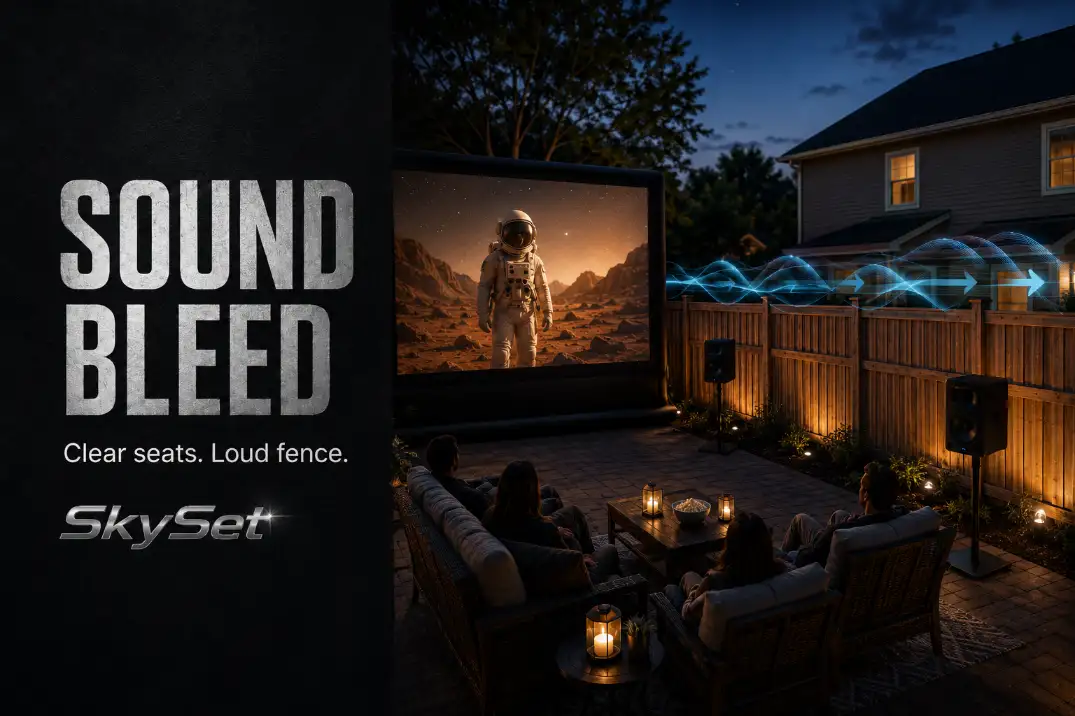
Sound bleed to neighbors is usually not a “too much speaker” problem first. It is usually a direction, bass, and distance problem.
A backyard movie can sound comfortable in the seats while still sending clear voices or low thumps across a fence because the speaker path is aimed beyond the audience.
Start with three checks: where the speakers point, whether bass is still obvious 30–50 feet away, and whether dialogue stays clear at the seats below about 65–70 dB.
If someone near the neighbor-side fence can recognize words during a normal dialogue scene, the issue is not just volume. It is sound energy traveling to the wrong place.
That is different from weak outdoor sound. Weak sound means the viewers cannot hear enough. Sound bleed means the wrong part of the yard hears too much.
The best fix is not to keep turning the movie up and down. It is to aim the sound tighter, reduce bass travel, and test from the side of the yard where the problem is actually heard.
Point Sound Toward the Seating Zone
Aim at ears, not open yard
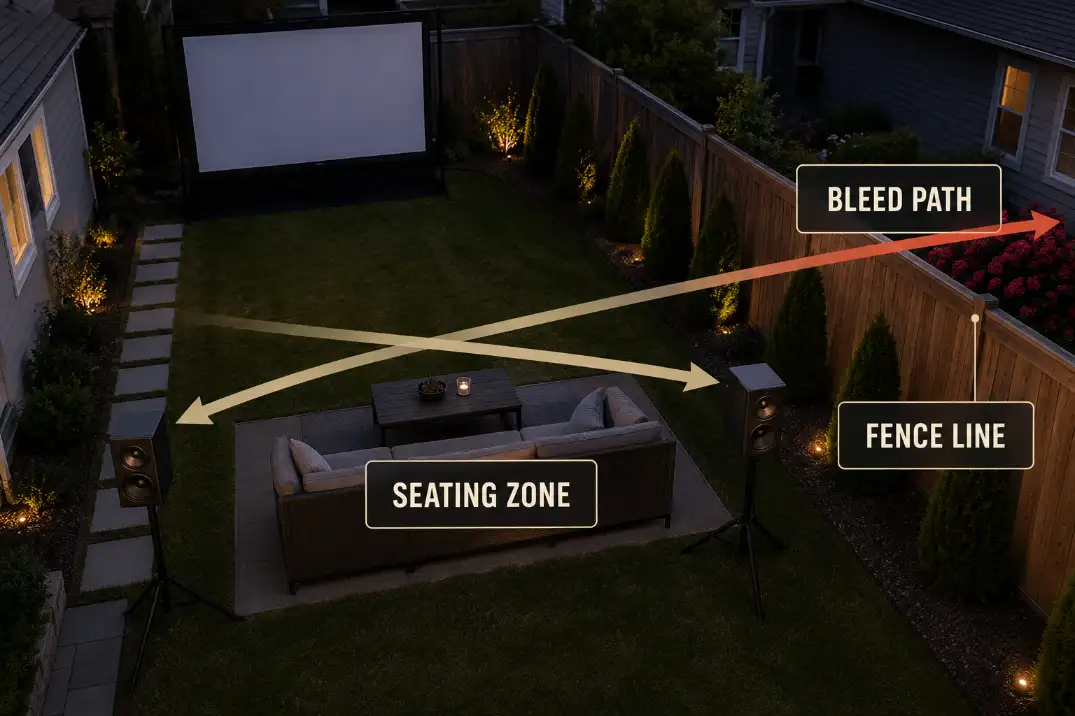
The most common sound bleed mistake is simple: the speakers are aimed at the backyard instead of the listening zone. Many setups place speakers near the screen and fire them straight outward.
That feels logical because the movie is in front, but it often sends the strongest sound path over the seats and toward the fence.
The better target is narrower. For seated viewers, the useful sound zone is usually about 3–4 feet above the ground, centered across the chairs or blankets.
If the audience sits 10–16 feet from the screen, the speakers usually need a slight inward angle so the strongest part of the sound crosses the seating area instead of the property line.
This is why adding volume often makes the neighbor problem worse without making the movie much clearer.
You are not only increasing the sound that reaches the audience. You are also increasing the sound that misses them.
The speaker placement logic in Outdoor Speaker Placement for Backyard Theater is a better starting point than treating loudness as the main control.
Closer can be quieter
A speaker closer to the audience can usually run lower than a speaker pushing sound across the yard. That is the part many backyard setups get backward.
They put the speaker far away, raise the volume to reach the seats, and then wonder why the fence hears the movie too.
Moving a speaker from 18 feet away to about 6–8 feet from the viewers can make dialogue feel clearer at a lower output. Outdoors, there are no room walls helping the sound fill in. Distance matters quickly.
A fix that often wastes time is adding more speakers around the yard for “coverage.” Unless the system is carefully balanced, scattered speakers can create more spill, more uneven volume, and more neighbor-side sound.
For most family movie nights, fewer speakers aimed better are more useful than more speakers spread wider.
Keep Bass From Traveling Too Far
Bass is the part fences handle poorly
Bass is usually the sound that travels farthest. Voices may become muffled at the fence, but low-frequency thumps from music, explosions, and action scenes can still carry through open air, over planting, and around fence gaps.
That is why a neighbor may complain about “booming” even when they cannot clearly hear the dialogue.
Do not start by lowering everything equally. First reduce bass energy. If your speaker, soundbar, or projector audio menu has bass control, lower it by 2–4 steps and replay the same scene.
If you use a subwoofer, turn it off for one test scene before deciding the whole movie is too loud.
This matters even more after dark. At 8:00 p.m., traffic, kids, HVAC units, and general neighborhood activity can mask some sound.
By 10:00 p.m., the same volume may feel much more obvious because the background noise has dropped. The system did not necessarily get louder. The neighborhood got quieter.
Dialogue and bass need different fixes
One reason people raise outdoor volume too high is that dialogue gets lost first. They turn up the master volume to understand speech, but the bass and music rise with it.
That creates a neighbor problem while still not fully solving the speech problem.
| Sound signal | More likely cause | Better first fix |
|---|---|---|
| Words clear at fence | Speaker aim too wide | Turn speakers inward |
| Bass thump carries far | Too much low-frequency output | Lower bass or remove subwoofer |
| Viewers miss dialogue | Speakers too far or poorly aimed | Move speakers closer to seats |
| Loud scenes jump suddenly | Wide dynamic range | Try night mode or compression |
| Same volume feels worse late | Lower background noise | Retest after 10 minutes outdoors |
If speech is the reason you keep raising the volume, the problem overlaps with the diagnosis in Why Movie Dialogue Is Hard to Hear Outside. Clearer voices usually come from placement and balance before they come from more power.
Use Speaker Height Carefully
Height helps until it clears the audience
Raising speakers can help because chairs, tables, people, and patio furniture no longer block as much sound.
But height turns against you when the speaker begins projecting over the listeners and toward the next yard.
For most backyard movie nights, seated ear level or slightly above is enough. That usually means around 3–5 feet high.
A speaker mounted 7–8 feet high on a wall, pergola, or post can work only if it is angled down toward the seats.
A high speaker aimed flat behaves less like a theater speaker and more like a small public-address system.
This is one of the most common overestimated fixes. People assume higher means clearer. Sometimes it does.
But once the sound path clears the heads of the audience and the top of the seating area, it can carry farther than it needs to.
Use the last-row test
Stand behind the last row of seats during a normal dialogue scene. If the speaker sounds brighter, sharper, or more direct behind the audience than it does in the main seating position, it is probably aimed too far back.
The clearest sound should land inside the seating zone. The fence should not be getting the best version of the soundtrack.
A small downward tilt is often enough. You are not trying to blast the ground. You are trying to make the center of the speaker’s output cross the middle of the viewers instead of the property edge.
Let Fences and Planting Help, Not Echo
A fence is not an outdoor wall
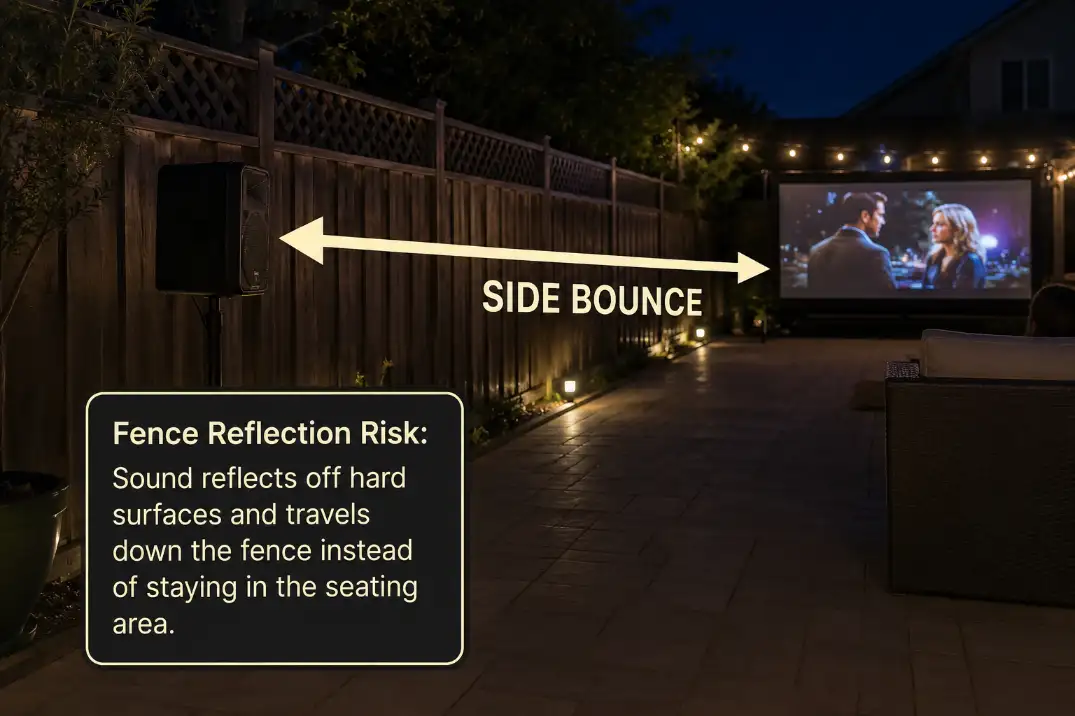
A fence can help, but it is not a mute button. This is a common misread. A wood or vinyl fence may reduce some direct sound, but it will not erase bass, and it may reflect midrange sound sideways if the speaker is aimed into it.
Backyards do not behave like indoor rooms. Indoors, walls contain and reflect sound within a space.
Outdoors, sound escapes through open air, over the top of barriers, around corners, and through gaps. A fence can interrupt part of the path, but it cannot fix poor speaker direction by itself.
Hard surfaces can also create a side-bounce problem. Vinyl fences, stucco walls, concrete patios, bare side yards, and narrow passages can push sound along the property line.
In a small yard, even a 10-degree sideways aim error can matter because the fence may be only 6–10 feet away.
Planting helps most when it breaks a hard path
Dense planting can soften reflections, especially in the voice range, but thin planting does little. A few pots or narrow ornamental grasses will not meaningfully stop a bass-heavy speaker.
A layered hedge, dense shrubs, or a mixed planting bed along the fence is more useful because it breaks up a clean reflective surface.
The useful question is not “Do I have plants?” It is “Is the speaker facing a hard, open path?” If the answer is yes, planting may help the edge, but speaker aim still comes first.
Small yards need even tighter control because there is less distance between the sound path and the fence.
The layout principles in Small Backyard Movie Setup become especially important when the seating area, screen, and property line are all close together.
Lower the Volume Without Losing Dialogue
Volume should be the final trim, not the first fix
Turning the volume down is the obvious answer, but it often disappoints. The audience loses dialogue before the neighbor loses bass.
Then someone raises the volume again during a quiet scene, and the next loud scene spills across the fence.
A better order is:
- Turn speakers toward the seating zone.
- Lower bass or remove the subwoofer.
- Improve dialogue clarity.
- Use night mode if available.
- Then lower master volume.
This order matters because the goal is not simply a lower number. The goal is a cleaner distribution of sound. You want voices to remain understandable at the seats while becoming indistinct near the fence.
Night mode, voice mode, or dynamic range compression can help because it reduces the jump between quiet dialogue and loud effects.
It is usually more neighbor-friendly than constant manual volume changes. But it cannot rescue a bad layout. If the speaker points at the fence, clearer dialogue still travels in the wrong direction.
If your current setup only works when everything is turned up, the better move may be changing the whole audio layout instead of adding more output.
The equipment mix in Best Backyard Movie Setup is a cleaner place to rethink that choice because a calmer, closer, more balanced setup usually creates less sound bleed than a louder one.
Know when the standard fix stops working
There is a point where volume reduction stops making sense. If lowering the system enough to protect the fence makes speech hard to understand in the seats, the problem is no longer the volume setting. It is the layout.
That is the decision line. Move speakers closer. Use smaller near-field speakers. Skip the subwoofer. Bring the seating zone forward.
Reduce the distance between speaker and listener before reducing the movie into a muffled soundtrack.
The mistake is trying to solve a layout problem with a remote control. That only creates a cycle of raising and lowering the same flawed setup.
Do a Neighbor-Side Sound Check
Test from the escape point
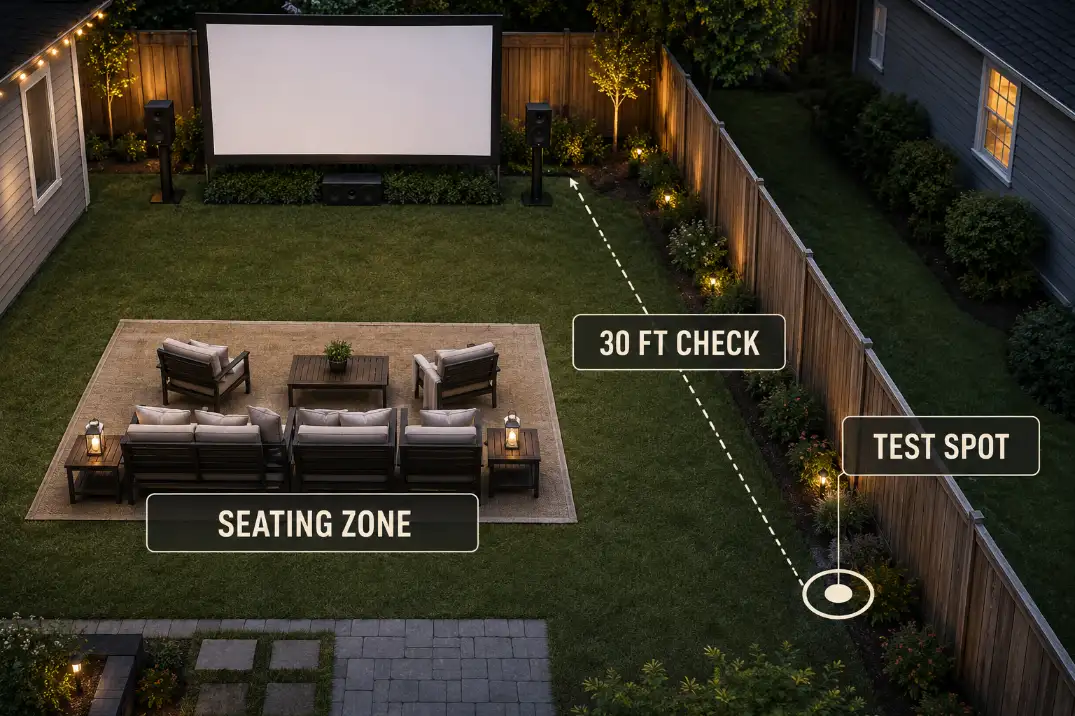
The only useful sound bleed test is from where the sound escapes. Do not judge the setup only from the couch, patio chair, or projector table.
Stand near the side fence, back corner, sidewalk side, or neighbor-facing edge of the yard.
Play one normal dialogue scene for 60–90 seconds. Then play one louder scene for about 30 seconds. Use the same scenes after each adjustment so the comparison is fair.
You are listening for three different failures:
- Recognizable words mean the speaker path or volume is too exposed.
- Bass thump after lowering volume means low-frequency output is still the problem.
- Sudden loud peaks mean night mode or dynamic range control may help.
A phone decibel app is not a professional sound meter, but it can still help with before-and-after comparison.
If the same scene drops from around 62 dB to 55 dB at the fence after changing aim and bass, that is a useful improvement even if the exact reading is not perfect.
Repeat after real playback
Do not test only during the first quiet minute of a movie. Outdoor sound changes as the soundtrack moves between speech, music, and action.
A setup that seems polite during opening dialogue may become obvious during the first loud scene.
After making changes, let the movie play normally for 10 minutes and check again from the neighbor-side edge. This second test catches the problem that a quick volume check misses.
Use this short baseline:
- Play 60–90 seconds of normal dialogue.
- Play 30 seconds of a louder scene.
- Stand near the side fence or property edge.
- Listen for words, bass thump, and sudden peaks.
- Lower bass before lowering everything.
- Repeat the same test after 10 minutes of real playback.
The best neighbor-friendly backyard movie setup does not feel silent. It feels controlled. Dialogue is clear in the seats, bass is restrained at the fence, and the loudest scenes do not suddenly announce themselves across the property line.
Aim first. Control bass second. Use volume last. That order solves more sound bleed than buying a bigger speaker, raising everything higher, or hoping the fence will do the work.
For broader official guidance on noise and hearing health, see the National Institute on Deafness and Other Communication Disorders.