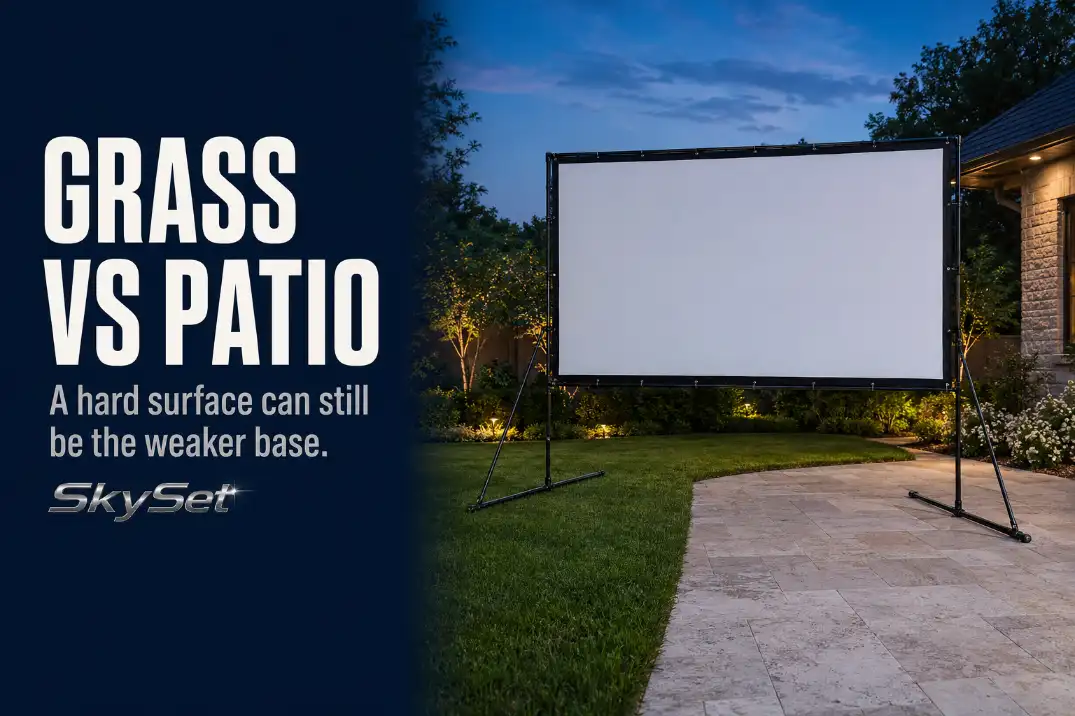
The real decision is not grass versus concrete. It is whether one location can support the screen’s full base and restraint system without creating movement or blocking the route around it.
Patio looks like the obvious winner because it is hard, clean, and unlikely to let the feet sink. Yet a drainage slope, paver joint, or slab edge can leave part of the base unsupported. Patio may also prevent the screen from using the stakes specified for it.
Grass solves that staking problem and often offers more open space, but one hidden soft patch can lower a foot and twist an otherwise square frame. Firm-looking turf can also compress only after the screen has been standing under load.
Choose the location that provides consistent contact, accepts the intended restraint method, and keeps every foot, stake, line, and approved weight outside the walking route. Make that decision with the complete screen assembled in daylight. An empty surface can look suitable and still fail once the frame, fabric tension, and restraints begin applying load.
Level Surface Problems
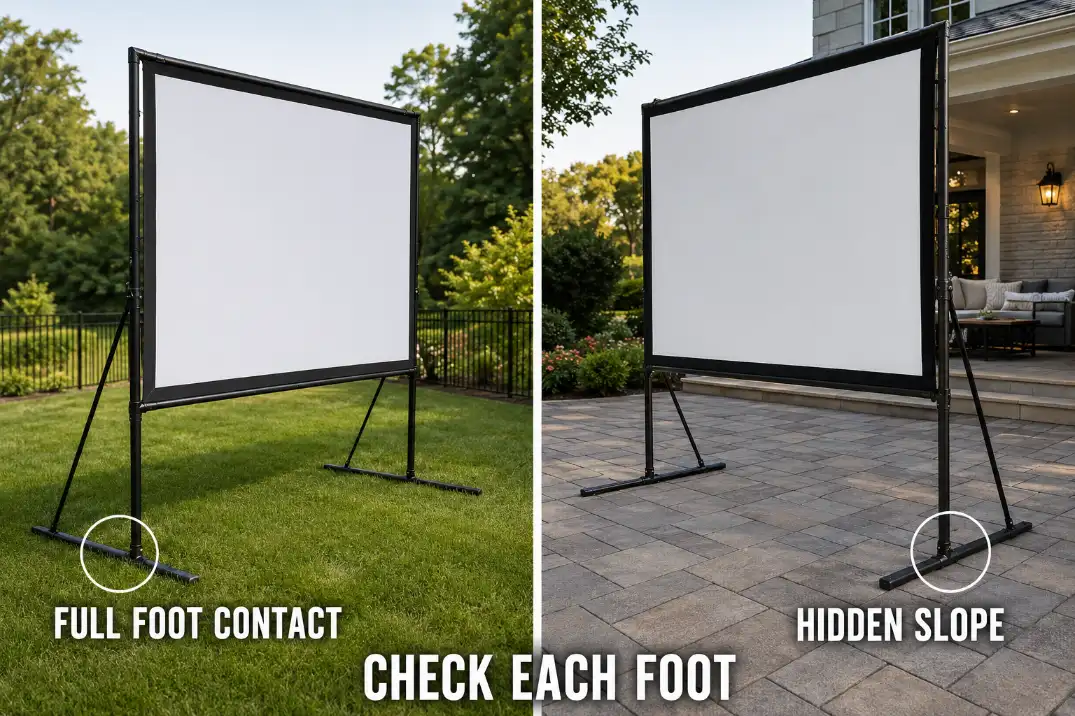
Do not choose a surface until the assembled base shows stable contact at every support point. Patio hardness and a visually smooth lawn are both weak substitutes for that test.
Many patios are intentionally pitched to move water away from the house. The grade may be unnoticeable beneath a chair but still place more load on one screen foot. Individual pavers can settle differently, while joints or cracks may fall directly beneath a narrow support.
Grass creates the opposite uncertainty. The broader area may look level while roots, thick thatch, shallow depressions, or old wheel tracks change the height beneath individual feet. A screen can appear straight from the front while the lower frame rocks under pressure.
The top bar is not enough to judge the base. If one foot is barely touching, partially suspended, or forcing the frame to twist, the location has failed the level test.
| Surface check | Grass works when | Patio works when | Reject the location when |
|---|---|---|---|
| Foot contact | Every foot reaches firm ground | Every foot sits flat on the paving | One foot rocks or remains partly unsupported |
| Surface change | Compression stays even | Slope does not twist the frame | The base changes angle under light pressure |
| Frame position | Feet avoid roots and depressions | Feet avoid joints and broken edges | Leveling requires unstable stacked pieces |
| Full footprint | Base and stakes fit the open lawn | Base remains fully inside the hard surface | Part of the system must bridge two surfaces |
Do not correct poor contact with a loose stack of wood scraps, pavers, or household objects. A height correction is not useful if the material can slide or tilt as the screen moves.
Feet and Stake Placement
A surface qualifies only when it can support both the feet and the restraint method the screen was designed to use. Checking the feet while ignoring the anchors evaluates only half the base.
Grass usually has the advantage for screens supplied with ground stakes and guy lines. Stakes can be positioned around the frame as instructed, but that advantage disappears if the feet sink or the required lines extend through seating access. Soil that accepts a stake is not necessarily firm enough to hold a narrow foot.
Patio performs better beneath broad, flat feet because the base is less likely to settle after assembly. The trade-off is that ordinary ground stakes cannot be driven into concrete, stone, or pavers. A hard-surface restraint may work, but only when it uses the screen manufacturer’s approved attachment points and method.
Screen format also changes the contact and anchoring pattern. The comparison between fixed-frame and portable screen footprints is useful when the available surface fits one frame style but not the other.
Do not assume that adding weight anywhere near the frame replaces the specified stakes. Restraint depends on the designated connection points, direction, and spread. A heavy object in the wrong position can consume space without controlling the movement the original system was designed to resist.
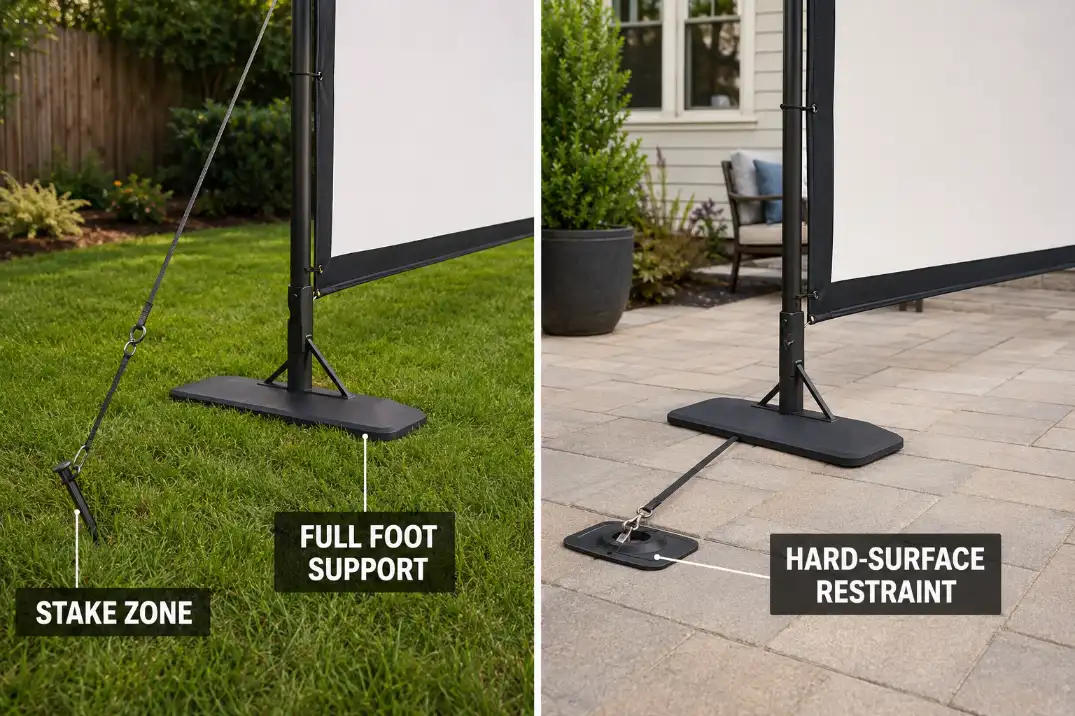
If the location cannot accommodate the feet and intended restraints together, the base is mismatched to the surface. That is the point to consider a backyard setup matched to the available surface rather than forcing the existing frame into a location it cannot fully use.
Patio Edge Gaps
Reject a patio position that leaves even one support point crossing the edge. Partial hard-surface contact is often less dependable than complete contact on firm grass.
The conflict usually appears where a narrow patio ends. The screen may fit visually, but a rear foot, crossbar, restraint point, or approved weight reaches the lawn. One side then rests on rigid paving while the other can compress into soil, so the two sides no longer respond to load in the same way.
Paver borders, step edges, drainage channels, and gaps between a slab and the lawn create similar problems. A foot placed partly over an edge loses usable contact area even when most of it remains on concrete.
Move the complete base inward rather than bridging the transition. If that leaves too little room for the screen and normal patio use, resolve the broader decisions in a space-limited patio setup before finalizing the screen position.
Field Judgment: A hard surface can still be the weaker base when it supports only part of the system. Consistent support matters more than the material beneath one or two feet.
Lawn Soft Spots
Firm grass can outperform a cramped patio, but only if every foot holds its depth after assembly. One support that continues settling is enough to change the frame angle.
Recent rain and irrigation are obvious causes, but soft spots can also come from thick thatch, concealed depressions, disturbed soil, shallow animal tunnels, or areas around roots. The entire lawn does not need to be wet for one contact point to weaken the frame.
Press the ground at every planned foot position before assembly. After the screen has been standing for about 10–15 minutes, inspect the contacts again. A narrow leg may slowly compress turf and soil even when it felt stable during the first check.
Grass remains practical when the feet hold their position and the stakes can be placed as intended. Reject it when one support keeps sinking, the frame develops a twist, or correction requires a slippery stack of loose pieces.
A manufacturer-approved broad support may distribute the load where appropriate, but moving the complete screen a few feet is usually the simpler response to an isolated soft patch. The objective is firm ground, not preserving a predetermined position.
Trip Zones Around the Base
A location fails even after the screen stands securely if its feet and restraints consume the route people will use after dark.
On grass, stakes and guy lines expand the base beyond the visible frame. They can disappear against turf as the light fades, especially when guests approach from the side instead of looking directly at the screen.
Patio installations may remove ground stakes, but an approved hard-surface restraint can occupy just as much horizontal space. Placing it behind a chair, beside a doorway, or across the normal approach simply trades a support problem for a movement problem.
Judge the full operational footprint: every foot, stake, line, connection point, and restraint belongs to the screen-base zone. Chairs and normal access should remain outside it.
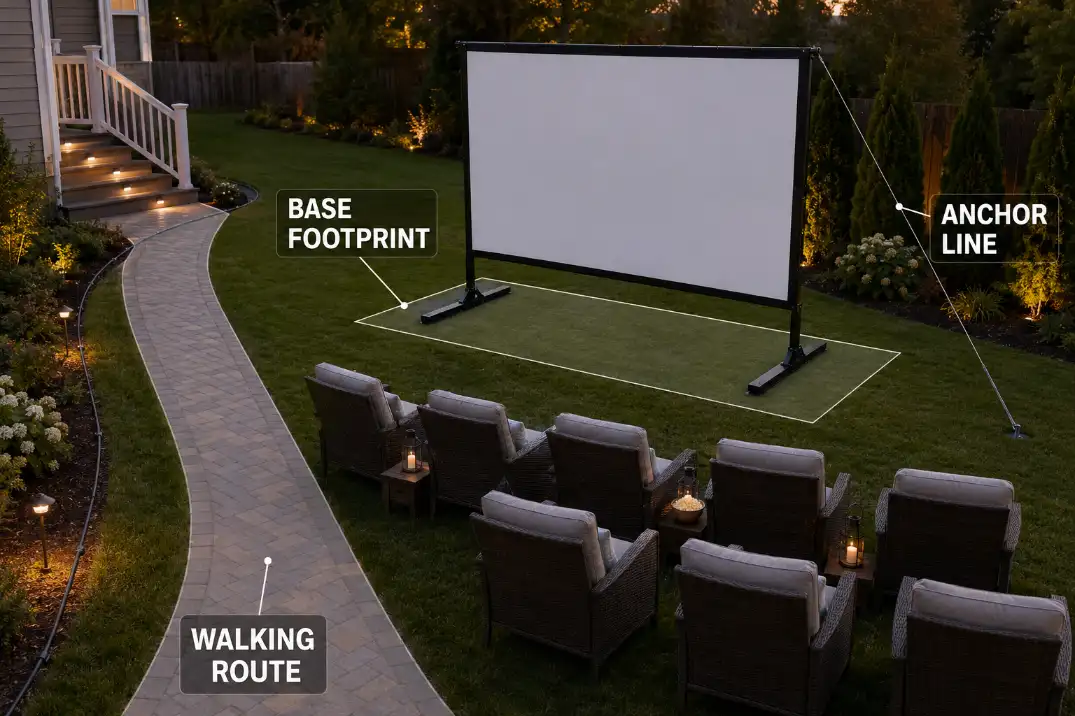
Electrical routes require their own plan. Use outdoor AV cable routes that avoid walking paths for the cable side rather than allowing a stable screen base to create an unsafe cord crossing.
Stability Test Before Dark
Use the final test to disqualify a weak position, not to confirm the location you already prefer. The complete screen must be assembled, restrained as instructed, and left standing long enough to reveal surface movement.
Apply restrained hand pressure at more than one point on the frame. The goal is not to reproduce wind load or force the screen to move. It is to expose a rocking foot, changing contact point, loose restraint, or frame twist that was not visible during assembly.
Then approach the screen from the doorway and seating area. A restraint that looks obvious beside the frame may be nearly invisible from the direction guests will actually walk.
Use this six-point check before darkness:
- Confirm that every foot has complete surface contact.
- Check that no foot rocks, sinks, or crosses a patio edge.
- Verify that stakes or hard-surface restraints match the screen instructions.
- Apply light hand pressure at multiple frame points and watch the base.
- Walk the real seating and access routes around the complete footprint.
- Recheck grass contacts after the assembled screen has stood for 10–15 minutes.
If the screen moves only when air begins pushing the frame or fabric, surface contact is no longer the whole diagnosis. Evaluate screen movement caused by outdoor wind exposure before tightening the frame or adding improvised weight.
Patio wins when the entire system fits on the hard surface, the slope does not create rocking, and the intended restraint stays outside the route. Grass wins when every foot remains firm, the stakes can be positioned correctly, and the expanded anchor footprint stays clear.
Do not decide by surface material alone. The stronger location is the one that passes all three tests—consistent support, compatible restraint, and clear movement—while there is still enough daylight to see the failure points.