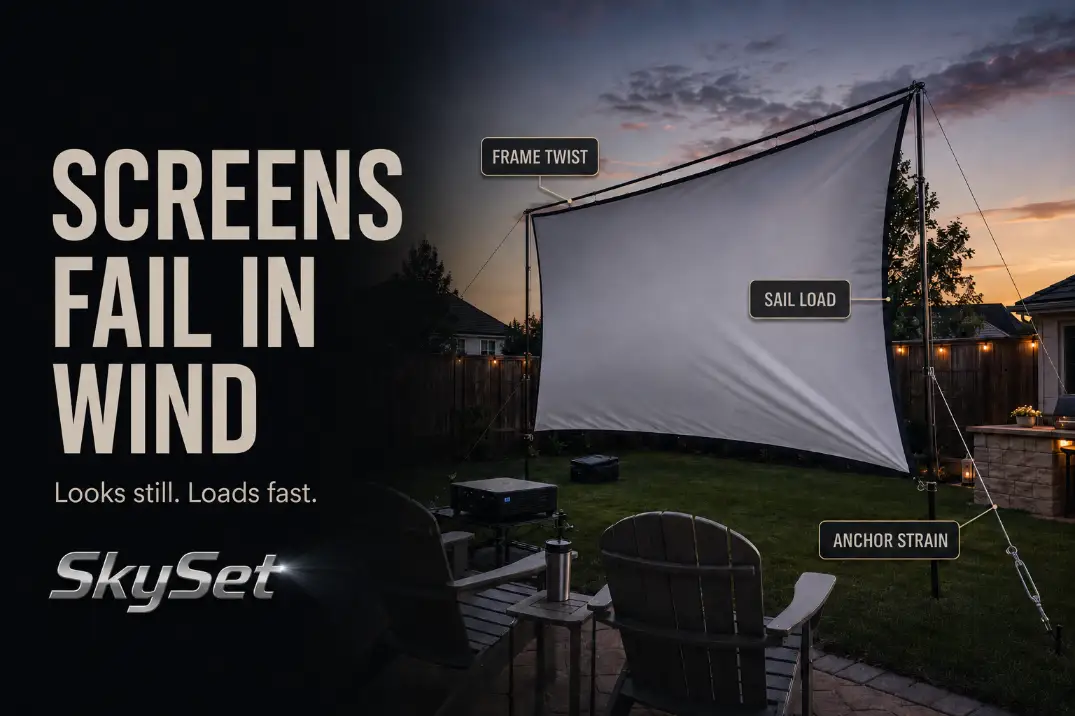
Outdoor movie screens fail in wind when the screen surface loads faster than the frame, fabric, anchors, and ground can distribute that force.
The first checks are simple: fabric bowing more than 2–3 inches, a frame that no longer stays square, and anchor lines that pull almost straight upward instead of outward. Around 10–15 mph gusts, a large portable screen can start showing early warning signs.
Around 20 mph gusts, many casual backyard screens should come down unless the manufacturer clearly rates them for that condition.
This is not the same as a projector placement or image problem. A dim screen, crooked image, or weak focus usually points back to equipment position.
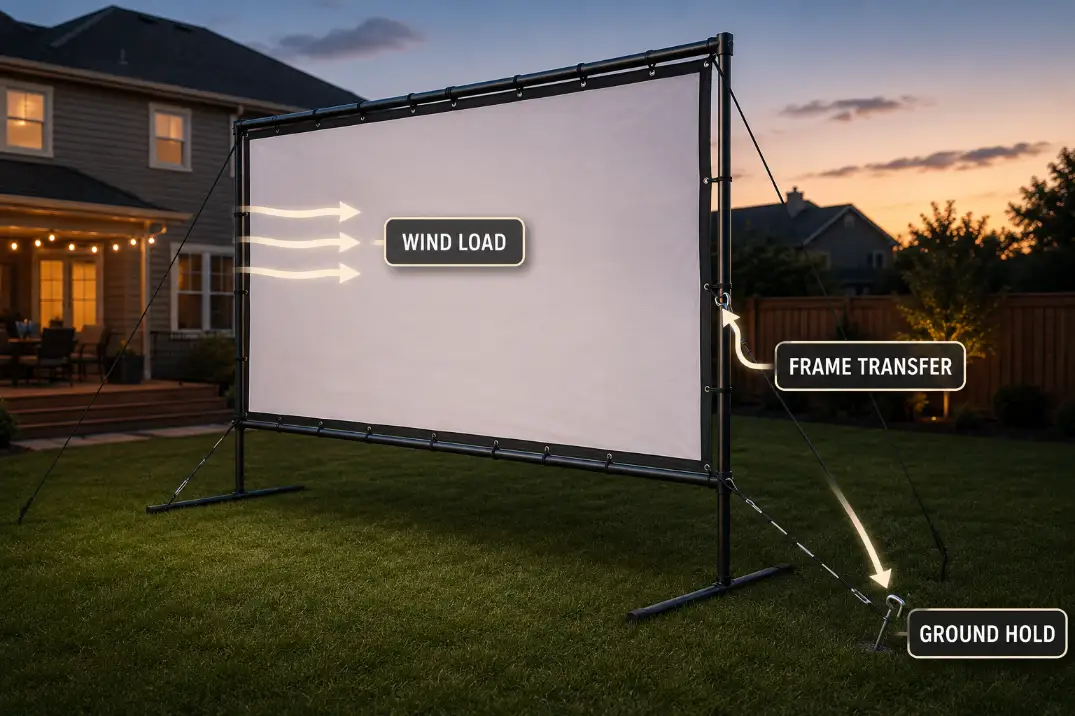
Wind failure is different. The symptom is movement, but the mechanism is load transfer: wind hits the fabric, the fabric pulls the frame, the frame loads the anchors, and the ground decides whether the setup holds.
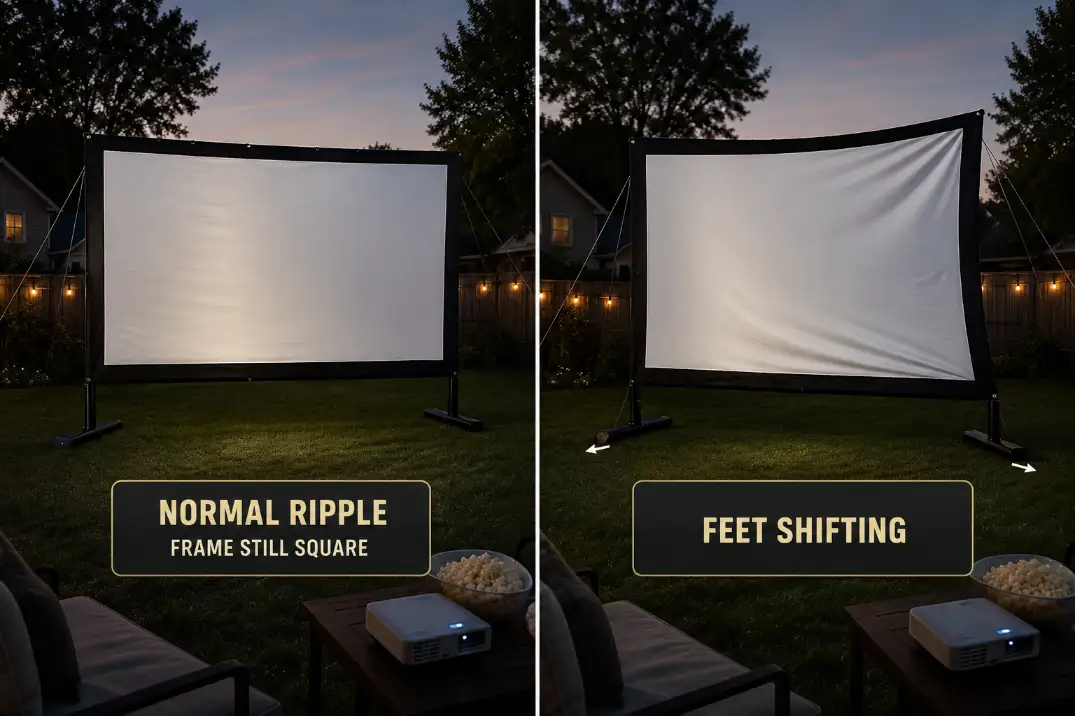
Quick Wind Decision Before Setup
The screen should pass a short movement test
A backyard screen can look stable while you assemble it and still fail once evening gusts start cycling through the yard. Do not judge it from a still moment. Watch it for at least 20 minutes before guests arrive, especially if the forecast shows gusts increasing after sunset.
The setup is in the healthier range when the fabric only ripples lightly, the frame stays square, and the feet do not walk across the ground. It is in the problem range when the screen needs to be corrected more than once during that same 20-minute test window.
| Signal | What it usually means | First useful move |
|---|---|---|
| Fabric bows 2–3 inches | Wind is loading the screen surface | Reduce exposure or retension evenly |
| Frame rocks at the feet | Base contact or frame geometry is weak | Level and widen support before anchoring |
| One corner snaps repeatedly | Fabric tension is uneven | Fix tension before adding more stakes |
| Stake line pulls upward | Anchor angle is wrong | Move stake farther out and lower the pull |
| Screen twists sideways | Side gusts are winning | Add side restraint or relocate |
The biggest mistake is treating the screen like a flat picture surface. Outdoors, it behaves more like a temporary shade panel or sign. A 120-inch screen has enough surface area to catch a surprising amount of moving air, even when the breeze feels mild from the seating row.
If the full layout is still being built, screen stability should be decided before seating, power, and projector positions are locked in.
The same planning logic used in a Backyard Theater Planning Checklist applies here: the screen controls the setup, not the other way around.
Screen Sail Effect
The visible symptom is movement
The sail effect starts when wind cannot pass through the screen surface. Solid projection fabric, inflatable screens, and tight white panels all catch air.
The viewer sees rippling, leaning, or shaking, but the underlying mechanism is pressure across a wide vertical surface.
A small wrinkle is not the real problem. Repeated loading is. If a gust pushes the screen every 20–30 seconds, the frame and anchors are being cycled again and again.
That movement loosens joints, widens holes around stakes, and turns a stable-looking setup into a weak one during the first hour of the movie.
Weight helps less than people think
People often overestimate screen weight. A heavier frame helps only when that weight is connected to a stable base and correct anchor geometry.
Once the fabric catches enough wind to twist the frame, extra weight in the wrong place does not solve the load path.
They also overestimate backyard shelter. A fence, garage wall, or row of shrubs may block steady wind while still creating side gusts around openings. A screen placed in a “protected” corner can fail faster if wind funnels between the house and fence.
Setup Note: If the screen moves when no one is touching it, do not start the movie and hope it settles. Wind-loaded screens usually get worse after fabric and joints loosen.
Screen Types Behave Differently in Wind
The right screen is not always the biggest screen
A larger screen feels more cinematic, but it also gives wind more surface to grab. In breezy yards, dropping from a 120-inch screen to a 100-inch screen can make the whole setup easier to control because the fabric area, frame height, and leverage are all reduced.
| Screen type | Common wind weakness | Better fit when |
|---|---|---|
| Lightweight freestanding screen | Narrow feet and twisting joints | Calm lawns and short sessions |
| Inflatable screen | Broad sail area and blower movement | Anchor space is wide and clear |
| DIY PVC screen | Joint flex and fabric flap | Very calm nights only |
| Wall or garage-mounted screen | Fixed load concentrates at the mount | The wall is sheltered and the mount is rated |
| Smaller portable screen | Less visual size, lower wind load | Evening breeze is likely |
This is where buying by screen size alone backfires. The stronger choice is the screen that fits the wind exposure, anchor space, and ground surface. A huge screen in a narrow side yard may be less useful than a smaller screen that stays flat and square.
Weak Frames
Most frame failures start at the joints
Weak frames do not always look flimsy when assembled. The weak point is often the joint where a pole section, corner elbow, push button, or plastic connector transfers load. Wind pushes the fabric, the fabric pulls the frame, and the joint absorbs the twist.
A rigid-looking frame that leans 1 inch at the top may still be manageable. A frame that twists at the corners or rocks diagonally is different. That means the structure is no longer staying square, and tightening the fabric may make the load worse.
For portable setups, aluminum tube frames with wide feet usually behave better than thin poles with narrow tripod-style legs. Inflatable screens can absorb some motion, but they still depend on blower stability, tie-down direction, and clear space behind the screen.
More anchors cannot fix a twisting frame
Adding more stakes to a weak frame often wastes time. If the frame bends, rotates, or collapses inward before the anchors move, the anchor system is not the first failure point.
The better decision is a lower screen, a smaller screen, a frame with wider base geometry, or a more permanent mounting method.
That is why the portable-versus-fixed decision matters more for wind than it does for storage convenience.
A screen that is fine for occasional calm nights may not be the right structure for a yard that regularly sees evening gusts, which makes the tradeoff in Portable vs Permanent Backyard Theater especially relevant here.
Loose Fabric
Flapping is a load problem, not just a noise problem
Loose fabric makes wind failure more likely because it allows the screen to pulse. Instead of one steady load, the frame receives sharp pulls from different points.
That movement also hurts the image: focus looks uneven, subtitles shake, and darker scenes become harder to watch.
A useful field check is simple. If a corner flap repeats every few seconds, or if the fabric snaps hard during each small gust, retension the screen before adjusting anything else.
Fabric that stays flat under light breeze is healthier than fabric that repeatedly pops and relaxes, even if both screens look acceptable in a still photo.
Pulling every corner tighter can make things worse
More tension is not always better. Overtightening one side can pull a lightweight frame out of square before wind even arrives.
The goal is even tension, not maximum tension. The fabric should sit smooth enough to project cleanly but not so tight that the frame bows under its own setup pressure.
For small patios, loose fabric often becomes worse because the screen is squeezed close to a wall, railing, or corner. Wind can curl around those edges and hit the screen from the side instead of flowing cleanly across the yard.
That makes screen placement similar to other Outdoor Movie Setup Small Patios decisions: the tightest available spot is not always the most stable spot.
Bad Anchors
Anchor geometry matters more than anchor quantity
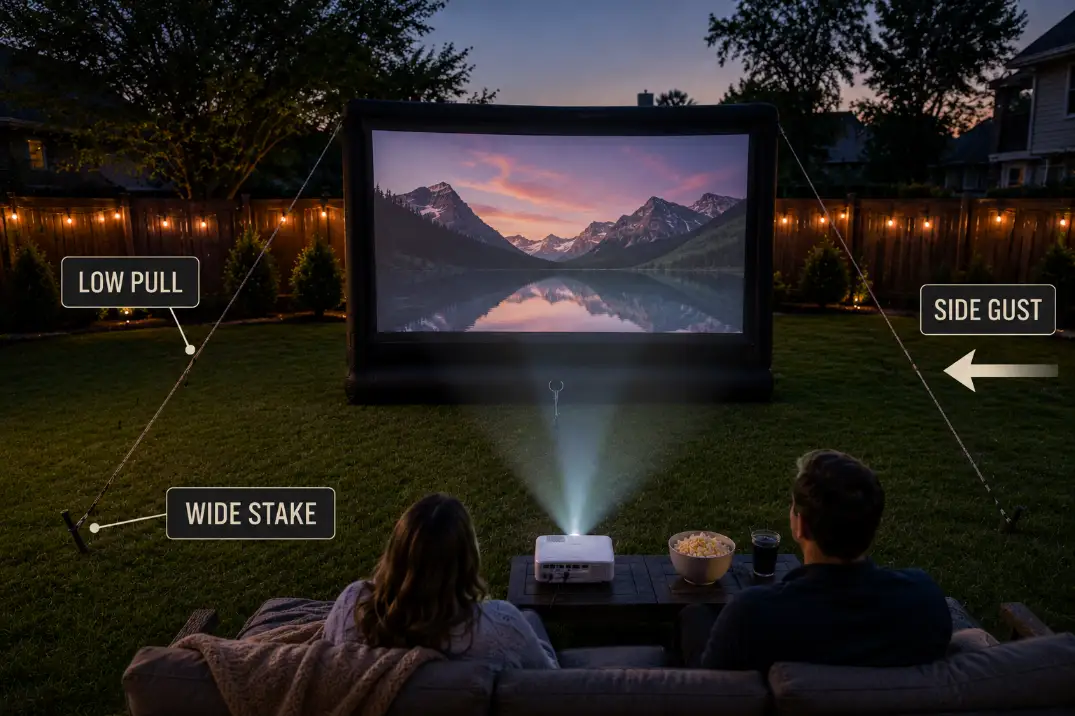
Bad anchors usually fail because they resist the wrong direction of force. A stake placed close to the screen and tied nearly vertical can pull upward in a gust. That is a weak angle.
A better line runs lower and farther out so the stake resists sideways pull instead of lifting straight out of the soil.
On lawn, anchor points should be placed far enough from the frame to create a stable triangle. For many portable screens, that means several feet out from the legs, not tucked directly beside them.
In soft soil after rain, even good stakes can loosen within 15–30 minutes because each gust widens the hole around the stake.
One rear tie-down does not stop side gusts
A common setup error is anchoring only the rear of the screen because wind is expected from the front. Real backyard wind shifts. If the screen can twist from a side gust, rear tie-downs will not stop the frame from rotating.
The stronger setup uses balanced restraint: rear support, side resistance, and secure foot contact. The screen does not need to be over-rigged, but it does need enough geometry that one changing gust cannot turn the whole frame.
Power and cable runs also matter here. Anchor lines and extension cords should not share the same walking lane, because one guest stepping through a cord or tie-down can loosen the system.
That overlap is part of the same safety logic covered in Backyard Projector Power Setup and Cable Hazards.
Uneven Ground
A crooked base becomes a wind problem
Uneven ground is underestimated because it looks like a comfort issue, not a screen issue. But a frame with one foot lower than the other starts with a twist already built in. Wind then exaggerates that twist.
A difference of even 1–2 inches across the base can matter on lightweight screens. The taller the screen, the more that small base error shows up at the top. On sloped lawns, the frame may look vertical from the seating area while one leg is barely carrying load.
Level first, then anchor
Do not use tie-downs to force a crooked screen into position. That creates stress before wind arrives. Level the feet first, widen the base contact if the design allows it, and then anchor the frame so the tie-downs support a square structure.
Hard surfaces create a different problem. On concrete patios, you may not have soil stakes, so weights or sandbags need to resist sliding, not just add mass.
A weight sitting beside the leg is weaker than a weight connected low to the frame. If the base slides more than 1 inch during a test tug or light gust, the setup is not ready for a full movie night.
When the Standard Fix Stops Working
Stop correcting the screen and change the plan
There is a point where routine fixes stop making sense. Retensioning fabric, resetting stakes, or adding a sandbag helps only when the frame remains square and the anchors still hold.
If the screen leans repeatedly, the fabric snaps hard, or stakes keep loosening, the safe fix is to take the screen down and wait for calmer conditions.
A practical rule works well: if you have to correct the screen twice in the same 20-minute test window, the setup has already failed for that night.
That does not mean the screen is bad. It means that screen, that yard, and that wind condition do not match.
For most casual backyard movie nights, sustained wind near 15 mph deserves caution. Gusts around 20 mph are a strong reason to bring down a large portable screen unless it is specifically built and rated for that exposure.
The exact limit depends on screen size, frame design, soil condition, and shelter, but the decision should be based on movement, not optimism.
Better Setup Order for Windy Yards
Start with location before accessories
The best wind fix is often placement. Choose a spot where the screen has a lower wind profile, cleaner anchor angles, and fewer side-funnel effects.
Avoid placing the screen at the end of a driveway, between two structures, or broadside to the most common evening wind direction.
Then match the screen to the night. A calm summer evening can support a lightweight portable setup. A breezy fall evening may need a smaller screen, lower frame, wider anchor layout, or a different movie plan.
Readers comparing screen size, frame stability, and accessories before buying can use the broader Best Backyard Movie Setup guide so the screen choice supports the whole yard instead of fighting one windy-night problem.
The strongest setup is the one that stays boring
A good screen setup should not need attention once the movie starts. The fabric may show a little movement, but the frame should stay square, the anchors should stay quiet, and the feet should remain where they started.
That is the real test. Not whether the screen looks impressive in a product photo. Not whether it survived one still-air setup.
Outdoor screens fail when the wind finds the weakest part of the chain: fabric, frame, anchor, or ground. Fix that chain in order, and the movie night becomes much easier to trust.
For broader official wind-safety guidance, see the National Weather Service.