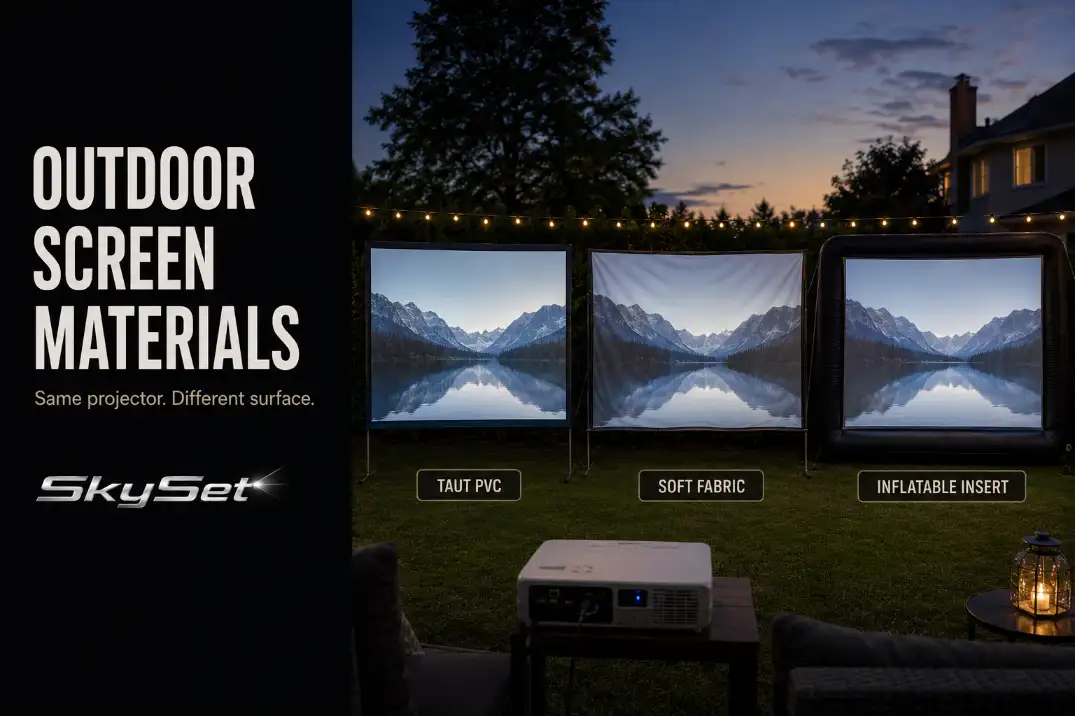
Outdoor movie screen material matters most when it changes surface flatness, reflected brightness, backing control, setup stability, or storage recovery. The better screen is not always the most expensive or the biggest one.
It is the material system that stays flat enough after real backyard handling: folding, drying, staking, packing, and reopening for the next movie night.
Start with three practical checks. Does the surface stay smooth across a 100- to 120-inch image? Do wrinkles relax after 10–20 minutes of even tension?
Does the screen have enough backing to stop light or background color from bleeding through? A slight edge wave on an unlit screen may be cosmetic.
A crease through the center third of a projected image is different because it cuts through faces, subtitles, sports graphics, and bright sky scenes.
PVC Screens
PVC is best when you want a flatter, sharper-looking image and you can protect the screen from hard folds. It is not automatically better than fabric. It becomes better when the frame, tension points, and storage method allow the surface to stay smooth.
Why PVC can look sharper
PVC has more body than many lightweight fabric screens, so it can hold a cleaner projection plane when pulled evenly. That helps on larger outdoor images where small waves become more visible.
At 90 inches, a minor ripple may disappear from normal seating distance. At 120–150 inches, the same ripple can become visible during bright scenes or camera movement.
PVC is also useful when the projector is already close to its outdoor limit. The screen will not rescue a weak projector at dusk, but a smoother surface can prevent the image from losing more perceived contrast through texture and wrinkles.
That matters when you are already balancing image size, ambient light, and projector output, which is why screen material should be considered alongside Outdoor Projector Brightness for Backyard Movies.
Where PVC stops making sense
PVC disappoints when it is folded tightly, stored hot, or packed before it is fully dry. A hard crease left compressed for several weeks can remain visible even after the screen is tensioned again.
Pulling one corner harder usually wastes time because it moves the stress line instead of removing it.
The better fix is to reset the screen square on the frame, tension opposite sides evenly, and wait 10–15 minutes before judging the surface.
If the crease still runs through the center viewing area after that, the issue is no longer normal setup behavior. It is a storage or material memory problem.
Fabric Screens
Fabric is usually the most practical choice for casual backyard movie nights because it is light, easy to fold, and quick to carry inside. But “fabric screen” is too broad to judge as one category.
A polyester-style screen, a stretchy fabric screen, and a thin sheet-style screen do not behave the same outdoors.
Not all fabric screens behave the same
Polyester-style portable screens are often the best general-purpose fabric option because they balance foldability with enough surface structure to hold tension.
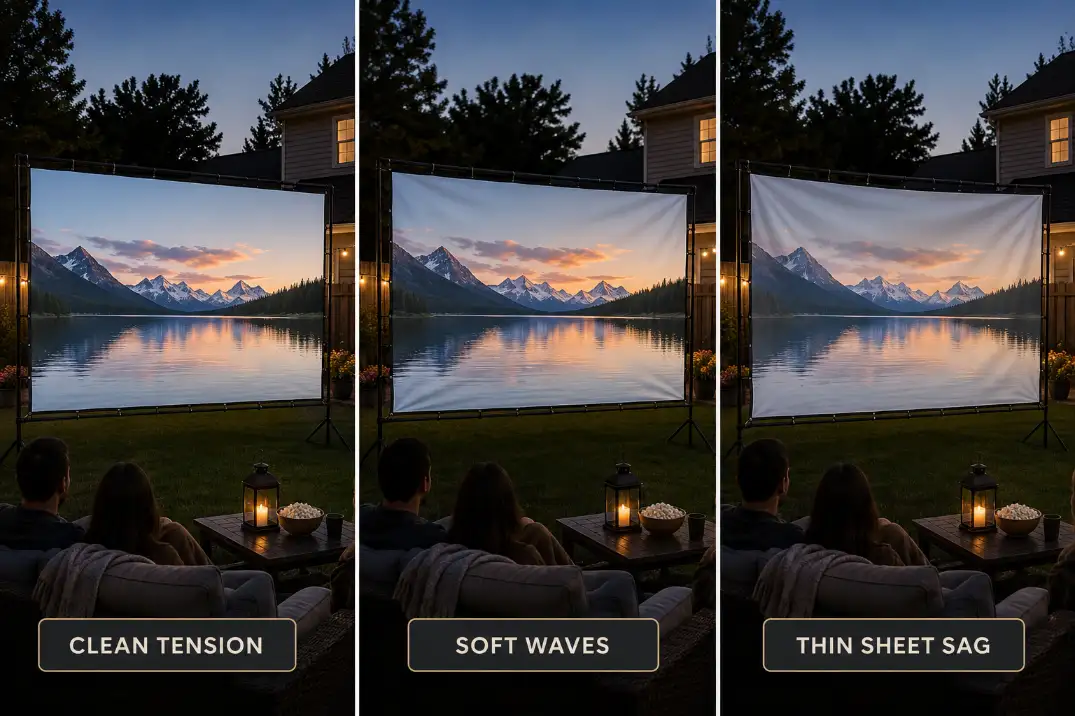
Stretchy fabric can forgive some handling wrinkles, but it may distort if the corners pull unevenly. Thin sheet-style fabric is the riskiest version because it may look acceptable before projection but show sag, texture, and edge curl once the image appears.
This is the mistake people often misread first: they blame wrinkles when the real issue is support. If the top edge sags or the side clips pull unevenly, changing to another fabric may not solve the problem. The screen needs a stable frame and tension across all four sides.
Polyester-style screens are usually easier to shake out and dry than heavy PVC, but they still need to be fully dry before storage.
When fabric is the smarter buy
Fabric is the smarter choice when setup speed, compact storage, and family use matter more than maximum sharpness. A screen that folds quickly, dries easily, and fits on a shelf is more realistic for many households than a heavier material that becomes annoying after the first few uses.
The practical threshold is recovery. If a fabric screen still shows strong center creases after 20 minutes of proper tension, it is not just settling.
It may be too thin, folded too sharply, or supported poorly. Minor edge waves are normal outdoors. Wrinkles through the viewing center are not.
For small yards or patios, fabric can also be easier to place because the frame is usually lighter and less bulky.
Before buying a larger screen than your space can comfortably support, check the placement limits in Small Backyard Movie Setup Ideas.
Pro Tip: Tension the top edge first, then the sides, then the bottom. Pulling the bottom tight too early often creates diagonal waves across the image.
Inflatable Screens
Inflatable screens are size solutions, not picture-quality shortcuts. They make sense when you want a large event screen without building a fixed frame. They make less sense when quiet operation, compact storage, and perfect flatness matter more.
What inflatable screens solve
Inflatable screens solve scale. A 14- to 20-foot inflatable frame can create a party-size image that a small folding frame cannot. For a one-night gathering, that can matter more than perfect surface precision.
Many inflatable models use a removable white screen insert attached to the air frame. The insert matters as much as the frame. If it is centered and tightened evenly, the image can look good.
If it sags, wrinkles, or pulls unevenly, the large screen size makes every flaw easier to see.
Rear-projection compatibility is useful only if your yard has enough space behind the screen for the projector distance and a safe cable route.
What inflatable screens add
The added costs are blower noise, footprint, wind exposure, and drying time. A blower 6–10 feet from seating can be noticeable during quiet movie scenes.
The frame, blower, stakes, ropes, and screen insert also take more storage space than many buyers expect.
Wind is the bigger boundary. A tall inflatable screen has more sail area than a low framed screen. Once the surface starts shifting, material quality becomes secondary because the entire image is moving.
If your yard is exposed or gusty, Outdoor Movie Screens and Wind Failure should influence the screen decision before size does.
Black Backing and Rear Light Bleed
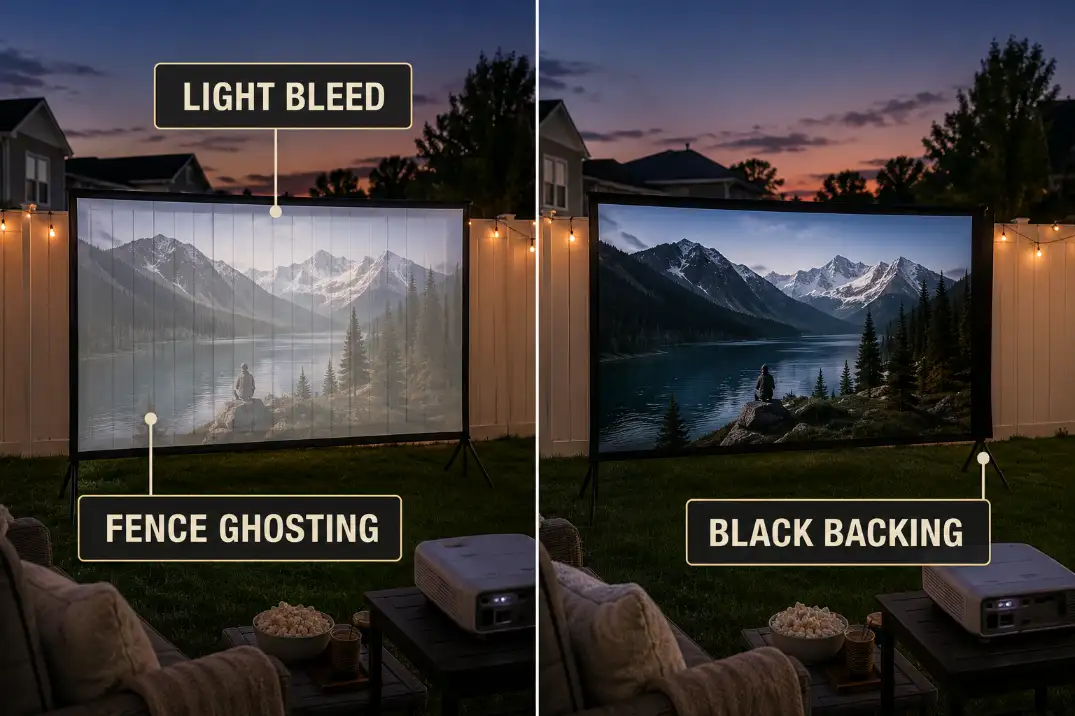
A good outdoor screen is not just a white surface. Backing matters because outdoor setups often sit near fences, windows, patio lights, siding, or pale walls. If light or background color bleeds through a thin screen, the projected image can lose contrast even when the front surface looks clean.
When backing matters most
Black backing or a denser double-layer material helps when the screen is placed in front of a bright fence, a light-colored wall, or a yard area with stray light behind it.
It also helps when the projector image looks slightly gray instead of clean white and black. That is not always a projector problem. Sometimes the screen is allowing the background to participate in the image.
Thin sheet-style screens are most vulnerable here. They may be fine for a small temporary setup, but they are less reliable when stretched in front of a pale fence or window glow.
If the background is visible through the screen before projection, expect weaker contrast after projection.
When backing is less important
Backing matters less when the screen sits against a dark, controlled background and the image size is modest. In that case, surface flatness and projector brightness may matter more.
This is why buying the heaviest or darkest-backed screen is not always the smartest move. The right material depends on what sits behind the screen as much as what shines onto it.
Wrinkle Risk
Wrinkle risk comes from material behavior, tension, storage, and moisture. PVC can hold hard creases. Fabric can sag. Inflatable inserts can wrinkle at attachment points.
The material name matters less than whether the screen returns to a usable surface after normal handling.
Cosmetic wrinkle or image problem?
A wrinkle near the edge is usually cosmetic if it stays outside the main viewing area. A wrinkle through the center third is different. That is where faces, subtitles, and bright highlights usually land.
The best test is not how the screen looks in daylight while empty. Judge it during a bright projected scene.
Wrinkles that disappear in dark scenes but show during bright sky, snow, animation, or sports footage are image problems, not just surface imperfections.
When more tension stops helping
More tension is not always the fix. Over-pulling can twist a lightweight frame, bend corner joints, or create diagonal stress lines. Once the frame is no longer square, the standard fix has stopped making sense.
At that point, the better move is a stronger frame, a smaller screen, or a material that suits the support system.
This becomes especially important with short-throw projectors, because steep projection angles can make surface waves more visible.
If your projector sits close to the screen, Short Throw Projectors and Backyard Distance can change how forgiving the screen material feels.
Brightness Impact
Screen material changes perceived brightness, but it cannot replace a brighter projector, a smaller image, darker timing, or better light control. People often overestimate screen gain and underestimate ambient light.
Gain, viewing angle, and hotspot risk
Many backyard screens sit near a neutral gain range of about 1.0 to 1.3. That range is usually safer for family seating because it keeps brightness more even across the viewing area. Higher gain can look brighter from the center seat, but it may narrow the viewing angle or create a hotspot.
The healthier condition is a screen that looks evenly bright across most chairs. The failing condition is a screen that looks punchy from the center but dull from seats 25–35 degrees off-axis.
That is not necessarily a bad projector. It may be a screen gain and viewing-angle tradeoff.
If people sit wide across a patio, a neutral surface is usually safer than chasing higher gain. If everyone sits close to the center line, a slightly higher-gain surface may be acceptable.
Material is not the first brightness fix
If the image looks washed out, check time of night, image size, projector output, and nearby lights before blaming the screen.
A better material helps most after those basics are under control. If the same projector looks acceptable at 90 inches but weak at 135 inches, the size jump is probably more important than the material.
This is where product specs can mislead buyers. A screen upgrade should not be used to cover for an underpowered projector or an oversized image.
Before spending more on material, compare the projector claims against real outdoor use in Projector Specs That Mislead Backyard Buyers.
Storage Needs
Storage is where many outdoor screen materials reveal their real quality. A screen should not be judged only on the first night.
Judge it after 5–10 setup cycles, after it has been folded or rolled, carried outside, exposed to dew, dried, and packed again.
Best storage match by material
| Material Type | Best Use Case | Storage Risk | Practical Rule |
|---|---|---|---|
| PVC screen | Sharper semi-regular setup | Hard creases from tight folds | Roll loosely when possible |
| Polyester-style fabric | Casual family setup | Soft waves from uneven tension | Fold wide and dry fully |
| Thin sheet-style fabric | Budget occasional use | Sag, edge curl, weak backing | Keep image size modest |
| Inflatable screen | Large party screen | Bulky damp packing | Dry frame and insert separately |
| Tensioned frame screen | Best image consistency | Larger storage footprint | Choose only if space allows |
A damp screen packed overnight may seem harmless, but moisture trapped for 24–48 hours can leave odor, spotting, or stubborn fold marks. In humid parts of Florida or the Southeast, drying time matters more than it does in a dry Arizona backyard. In northern states, cold garage storage can also make plastic-based materials stiffer during setup.
If a screen collects grass marks, fingerprints, or dew residue after every use, easy wipe-down matters more than a slightly higher gain number.
Which material should most people choose?
For most backyard movie nights, a polyester-style fabric screen is the most practical starting point because it balances storage, setup speed, and acceptable image quality.
PVC makes sense when you care more about a flatter image and can store it carefully. Inflatable screens make sense for large gatherings, not for the cleanest everyday setup.
The least useful purchase is the biggest screen your budget allows without checking storage, wind, projector brightness, backing, and seating distance.
A smaller 100- to 120-inch screen that stays flat usually beats a larger screen that waves, sags, or looks dim. If this screen is part of a bigger buying decision, Best Backyard Movie Setup Ideas is the better next step than choosing material in isolation.
Quick Material Decision Checklist
- Choose PVC if you want a flatter image and can avoid sharp folds during storage.
- Choose polyester-style fabric if setup speed and practical storage matter most.
- Avoid thin sheet-style fabric for large screens unless the background is dark and controlled.
- Choose inflatable only when event size matters more than blower noise and compact storage.
- Treat center-screen wrinkles as image problems, not cosmetic details.
- Look for backing if the screen sits in front of a pale fence, wall, window, or stray light.
- Do not use screen gain to compensate for an oversized image or too much ambient light.
- Dry the screen fully before packing, especially if it will stay stored for more than 24 hours.
Questions People Usually Ask
Is PVC better than fabric for outdoor movie screens?
PVC can look sharper when it is tensioned well and stored carefully. Fabric is often easier for regular casual use because it folds, dries, and packs faster. PVC is the cleaner image choice only when storage and frame support are controlled.
Does black backing really matter outdoors?
It matters when the screen sits in front of a pale fence, bright wall, window glow, or stray yard light. If the background can show through the screen before projection, it can weaken contrast during the movie.
Do inflatable screens have worse picture quality?
Not automatically. The weak point is usually the removable screen insert. If the insert is centered and tight, the image can look good. If it sags or wrinkles, the large screen size makes the flaw obvious.
What is the biggest mistake when comparing screen materials?
The biggest mistake is judging the screen only when it is new. A backyard screen should be judged after repeated setup, storage, drying, and tensioning. Material that looks good once but stores badly may become frustrating within a few uses.
For broader technical context on projection image standards, see the SMPTE standards index.