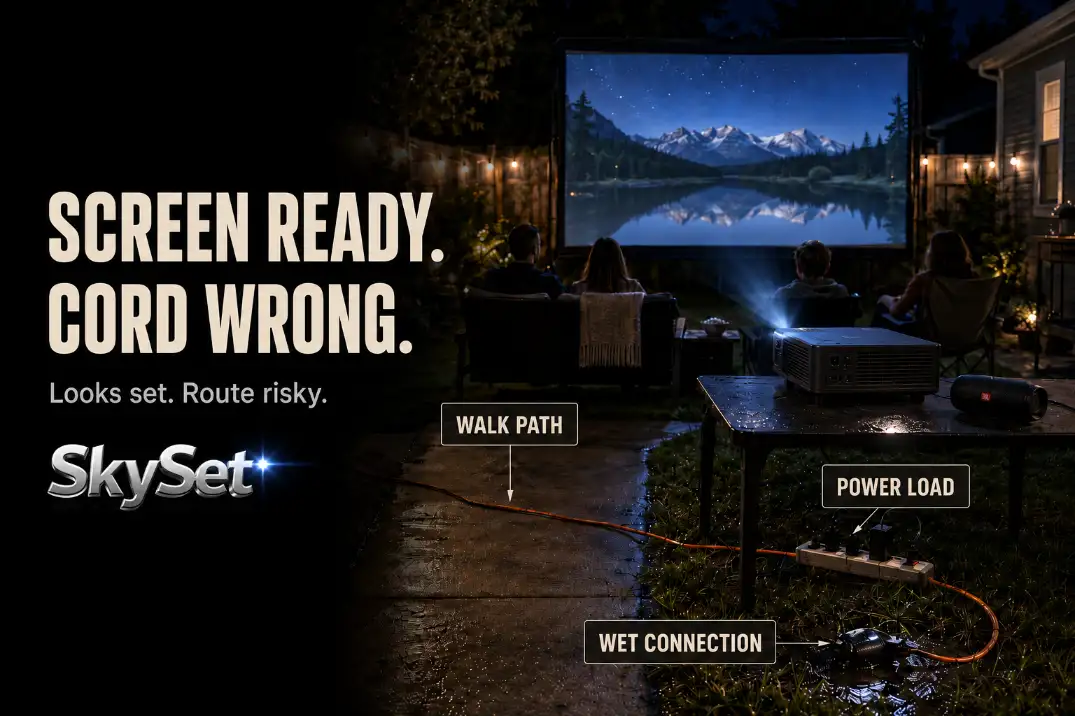
The biggest outdoor extension cord mistake on movie nights is choosing the shortest route instead of the safest route.
That one choice can create three problems at once: a cord across the walking path, a plug connection near wet grass, and too much gear stacked onto one line for a 2–3 hour movie.
Before plugging in the projector, check three things: the cord must be outdoor-rated, the main walking route should stay at least 30–36 inches clear, and every plug connection should be raised off grass, mulch, or low wet spots.
A flickering projector or sudden speaker dropout may look like a device problem, but the underlying mechanism is often a warm plug, loose splitter, damp connection, or long undersized cord.
If the setup needs tape, plastic bags, daisy-chained cords, or a stretched plug to survive the night, the cord route is already doing too much work.
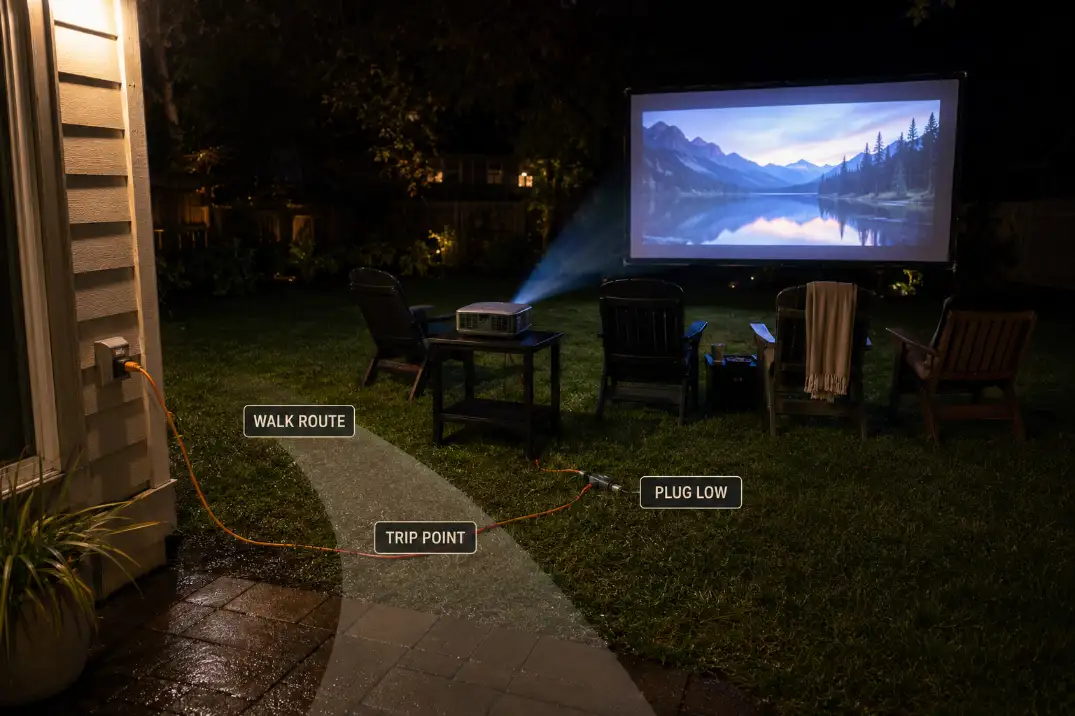
Using Indoor Cords Outside
The cord rating comes before the cord length
An indoor extension cord is the wrong starting point for an outdoor movie setup, even for one dry evening. The problem is not only rain.
Outdoor cords are built for yard exposure, temperature swings, jacket abrasion, moisture near plug ends, and movement around patio furniture or grass.
Do not judge the cord by color, thickness, or the phrase “heavy duty” on the package.
Check that it is rated for outdoor use, has intact insulation, uses a grounded three-prong plug when the connected equipment requires it, and matches the load you plan to run. A thick indoor cord is still an indoor cord.
A better power plan follows the same logic as a full backyard projector power setup and cable hazards: power is not just about reaching the projector.
It is about where the cord touches the yard, who walks over it, how long the setup runs, and what else is connected to the same line.
The weak point is usually the end, not the middle
The middle of the cord often looks fine. The first trouble usually appears at the plug end, splitter, connection cover, bend near a patio edge, or spot where a chair leg presses the cord down.
A plug that feels warm after 20–30 minutes is not a minor warning. Reduce the load, change the route, or stop using that setup.
The same applies when a GFCI outlet trips once during setup. Resetting it and continuing without changing anything treats the symptom, not the mechanism.
| Mistake | What it usually means | Better decision rule |
|---|---|---|
| Indoor cord outdoors | The cord is not built for yard exposure | Use an outdoor-rated grounded cord |
| Cord across seating path | The route was chosen for reach, not movement | Keep 30–36 inches of clear walking space |
| Plug on grass | The connection is in the wettest part of the setup | Raise and protect the connection |
| Crowded splitter | One cord is carrying too much of the night | Separate essential AV from comfort gear |
| Extra-long thin cord | Convenience may increase heat and voltage drop | Match length, load, and cord gauge |
Running Cords Across Walking Paths
The straightest line is usually the wrong line
The easiest cord path is often a straight run from the outlet to the projector table. That is also the path people use to carry snacks, adjust chairs, check the screen, or walk back to the house during the movie.
For backyard movie nights, the walking path deserves priority over the straight power line.
A safer route usually follows a patio edge, fence line, planter edge, deck border, or the back side of the seating area before turning toward the projector. It may add 6–12 feet to the route, but it removes the cord from the place people naturally step.
This matters even more when kids are moving between blankets, chairs, and the snack table. A good backyard movie night family setup treats the cord route as part of the seating plan, not as a cleanup detail after the picture looks right.
Tape often hides the mistake instead of fixing it
Taping a cord down across grass or uneven pavers often feels practical. It is rarely enough for a full movie. Dew, dust, foot traffic, and temperature change can loosen tape before the second half of the film.
A low-profile outdoor cord cover can help on a short hard-surface crossing, such as a patio slab or walkway. It does not make a bad route good. If the cord still crosses the busiest walking lane, rerouting beats covering.
Setup Note: Walk the route once in the dark before guests sit down. If your foot naturally crosses the cord, the cord is in the wrong place.
Leaving Connections on Wet Grass
Dew can change the setup after sunset
A plug connection on grass may look harmless at 7:30 p.m. By 9 p.m., the same spot may be damp from irrigation, humid air, coastal moisture, or normal evening dew.
In humid parts of Florida or the Midwest, the grass can feel acceptable during setup and still collect enough moisture to make a low connection a bad idea before the movie ends.
This is why weatherproof cable management for outdoor AV should be treated as route planning, not just accessory placement. The cord jacket and the plug connection should not be treated the same.
A properly rated outdoor cord is designed for outdoor exposure. The plug connection is the vulnerable point because moisture, dirt, movement, and loose contact all meet there.
The warning signs may look like electronics trouble: projector flicker, speaker dropout, streaming device restart, or a tripped GFCI. The real issue may be simpler and more serious: the connection point is sitting in the wrong place.
Covered does not mean safe if the location is wrong
A weather-resistant connection cover helps only when the connection is also raised, visible, and away from the wettest ground. A covered plug sitting in a low damp patch is still a weak plan.
Plastic bags, duct tape, or a loose storage bin are worse because they can trap moisture, shift during the night, or make the connection harder to inspect.
The better fix is not just “cover the plug.” It is: move the connection off the ground, protect it from splash, and keep it outside the walking path.
The decision is simple: if the connection point has to sit low, hidden, or damp, the route is wrong before the cover even matters.
Overloading One Cord With Too Much Gear
The projector is not the whole movie-night load
A projector may not overload a circuit by itself, but it is rarely the only thing plugged in. A real backyard movie setup can include a projector, speaker, streaming stick, laptop, Wi-Fi extender, phone charger, decorative lights, fan, or small table lamp.
A standard U.S. outdoor receptacle is often on a 15-amp or 20-amp circuit. At 120 volts, many movie-night loads stay well below the theoretical limit, but that does not make every cord route smart.
A 2–3 hour continuous setup needs margin, especially when the cord is long, thin, coiled, pinched, or connected through a cheap splitter.
The more common problem is not dramatic overload. It is heat at a plug, voltage drop on a long run, or a crowded splitter becoming the fragile center of the setup.
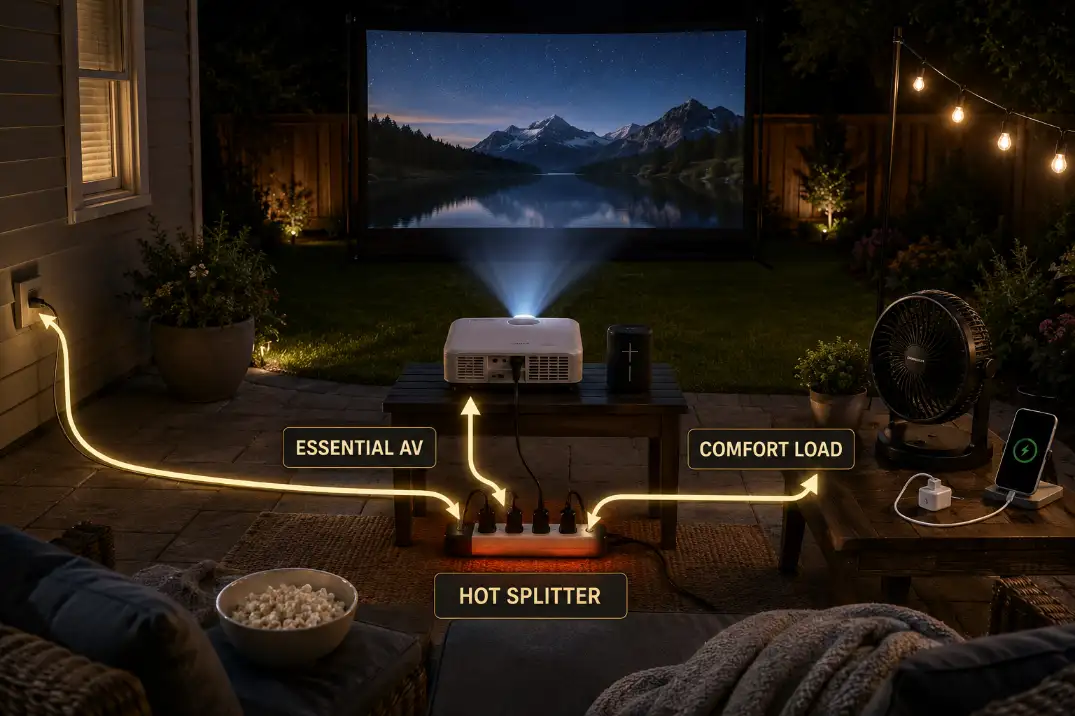
Split the load by importance, not convenience
The projector and main sound should get the cleanest power path. Optional comfort items should not compete with them if the route is already long or the connection point is marginal.
This is where many setups look organized but perform poorly. A neat splitter under the projector table can hide a bad plan.
If every device runs from one cord because it looks cleaner, the cord has become the single failure point for the whole night.
The same planning logic applies when choosing the rest of the setup. A reliable best backyard movie setup is not just about picture size or speaker volume; it also keeps power, walking paths, and equipment placement from fighting each other.
Choosing the Wrong Cord Length
Too short creates tension
A cord that barely reaches the projector table is not the right cord for that setup. Tension pulls on plug ends, lifts the cord into foot traffic, and makes people move equipment to serve the cord instead of the viewing layout.
The correct order is route first, cord second. Measure the edge route from the outlet to the equipment area, then add enough slack for the cord to lie flat without pulling on the plug.
A cord should not be stretched tight across grass, pinched under furniture, or used to “hold” the projector table in position.
Power should be part of the same planning pass as screen position, seating distance, speaker location, and projector throw.
A strong backyard theater planning checklist helps prevent the common mistake of placing all the fun pieces first and letting the cord cut across the yard afterward.
Too long can create heat, loops, and voltage drop
A longer cord is not automatically safer. A 25-foot route with the right outdoor cord is often cleaner than a 100-foot run that loops near the table, crosses a walkway, and feeds a crowded splitter.
As a practical movie-night rule, use the shortest safe edge route that keeps people away from the cord. For short 25–50 foot runs with modest AV gear, a properly rated outdoor cord may be enough.
Once the route approaches 75–100 feet, or the cord is powering several devices, gauge and load matter much more. If you need more than 100 feet or multiple connected cords, the layout deserves a rethink.
Daisy-chaining extension cords is the wrong way to solve a distance problem. It adds another plug connection, another moisture point, and another failure location in the yard.
Safe slack is different from loose loops
Some slack is necessary. Loose piles are not. A healthy setup has enough slack to prevent tension at plug ends, but not so much excess that loops collect near chairs, projector legs, or the snack table.
If extra cord remains, keep it away from the walking route and do not leave it tightly coiled while powering multiple devices.
Coils can trap heat, and loose loops invite trips. The better answer is often a more suitable cord length, not a bigger pile of spare cord.
Safer Cord Routes for Backyard Setups
Build the route before placing the projector
The safest backyard movie power route usually follows this order: outdoor outlet, edge route, raised connection point, projector table, essential AV gear, then optional accessories.
That sequence prevents the common mistake of placing the projector first and forcing the cord to chase it.
For small yards and patios, route the cord along the least active edge and bring power to the equipment from the side or rear. A 6-foot shift in projector table position can remove the cord from the walking lane without changing the viewing experience.
That is especially useful in a small backyard movie setup, where every chair, cord, table, and screen stand competes for space.
In compact layouts, power routing is not a background detail. It decides whether the setup feels clean or constantly in the way.
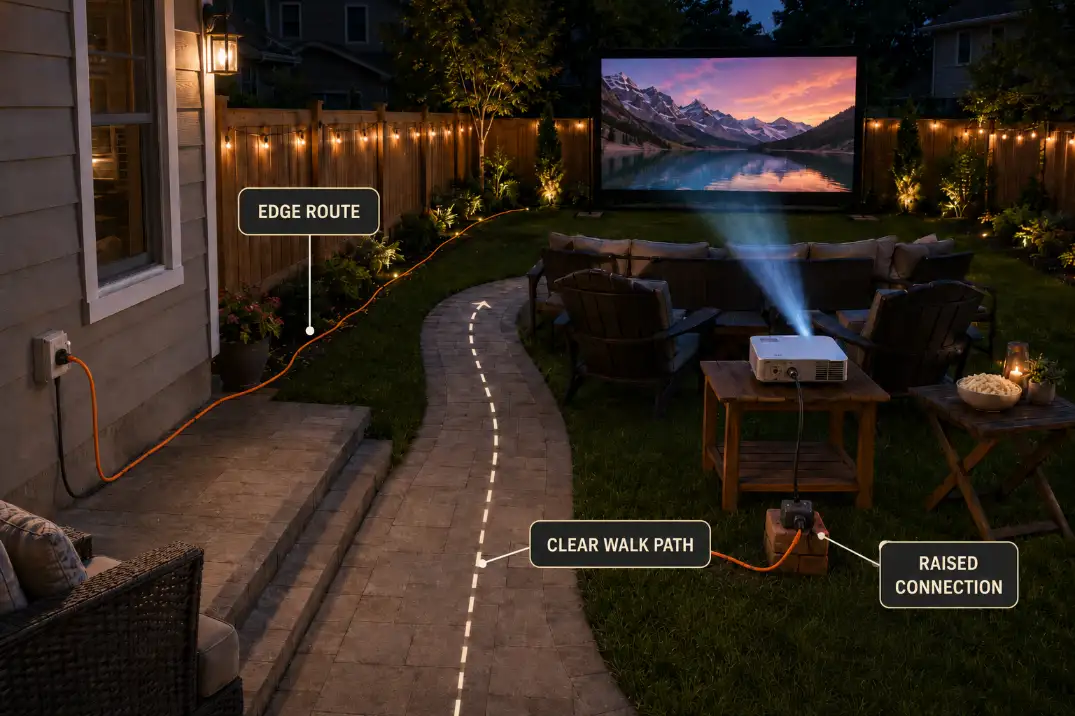
Use a final 6-point cord check
Before guests sit down, make the cord route pass these checks:
- The cord is outdoor-rated and grounded.
- The main walking route stays at least 30–36 inches clear.
- No plug connection rests on grass, mulch, or a low wet spot.
- Plug ends stay cool after the first 20–30 minutes.
- The cord is not pinched under furniture, doors, screen legs, or table legs.
- The setup does not rely on daisy-chained cords or a crowded splitter.
This checklist is short because the real risks are not complicated. Most unsafe movie-night cord setups fail around route, moisture, load, or tension. Fix those before worrying about smaller accessories.
Know when an extension cord stops making sense
Extension cords make sense for occasional movie nights. They stop making sense when the same cord route is used every weekend, the outlet is always too far away, the connection always lands near wet grass, or the only workable path crosses foot traffic.
At that point, a longer cord is often the wrong fix. The better answer may be a dedicated outdoor-rated outlet in a better location, a licensed electrician checking GFCI protection, or a revised backyard cinema layout that puts the equipment closer to safe power.
The decision line is simple: if the temporary cord route has to be taped, hidden, covered, stretched, defended, or rebuilt every time, the setup is not just dealing with a cord problem. It has a power-location problem.
Questions People Usually Ask
Can I use an indoor extension cord outside for one dry movie night?
No. Outdoor conditions are not limited to rain. Evening dew, grass moisture, movement, plug exposure, and temperature change can affect the setup during a 2-hour movie. Use an outdoor-rated cord from the start.
Is it safe to run an extension cord under an outdoor rug?
Usually not. A rug can hide damage, trap heat, and make the cord harder to inspect. If a short crossing on a hard surface cannot be avoided, use a suitable low-profile outdoor cord cover instead of hiding the cord.
What is the safest place for the plug connection?
The safest practical location is raised off the ground, visible, protected from splash, and outside the walking path. If the connection has to sit in grass or a low wet spot, move the equipment or change the route.
For broader official guidance on extension cord safety, see the Electrical Safety Foundation International extension cord safety tips.