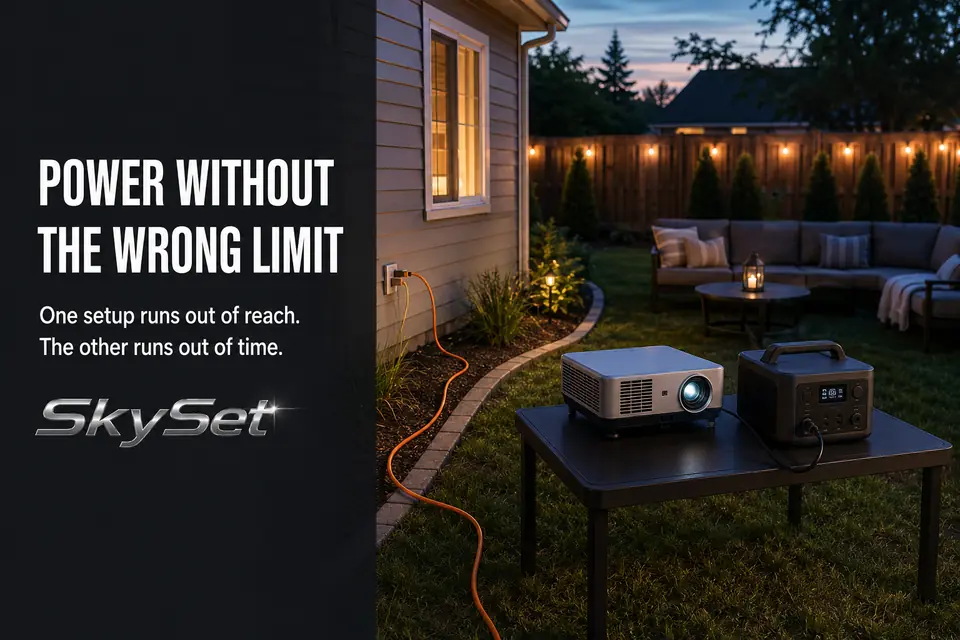
The real choice is not simply battery power versus household power. It is whether the yard makes a physical power route or a finite energy budget harder to control.
An extension cord can keep an outdoor projector running for the entire evening, but only if it can reach the equipment without crossing doors, seating, walkways, or active lawn space. A portable power station moves the source beside the projector, yet every connected device consumes a limited supply that must last through setup, streaming, the movie, pauses, and shutdown.
Projector wattage alone cannot settle this comparison. Speakers, streaming equipment, routed distance, ground conditions, and after-use habits can make the apparently simpler option the less dependable one.
The stronger setup is therefore the one whose limitation remains predictable in the specific yard: cord reach or battery runtime.
Distance From the House Outlet
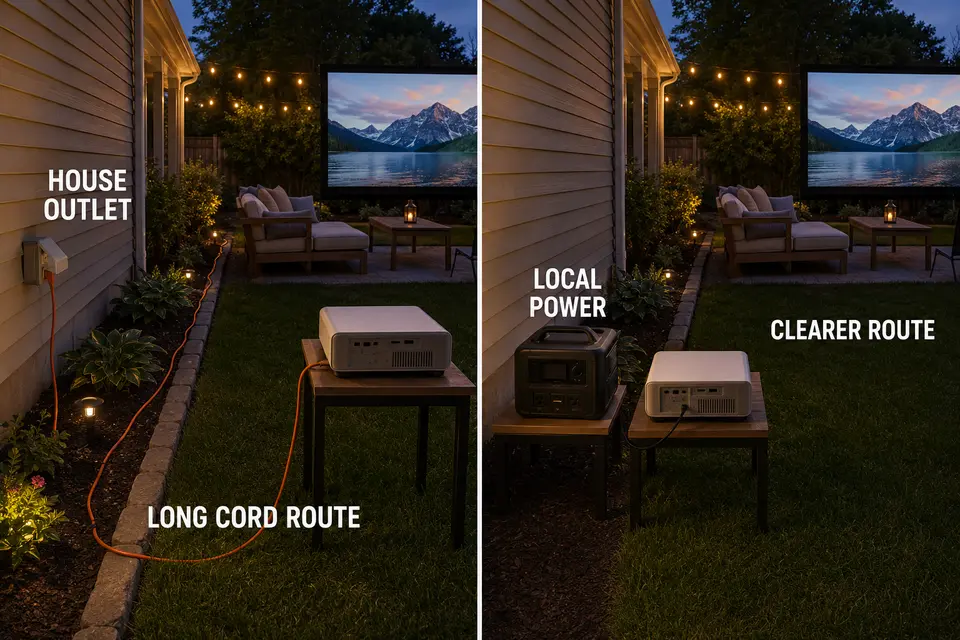
Measure the route a cord can safely follow, not the straight line between the outlet and projector. A 40-foot visual gap can require a much longer cord once the route follows the house wall, turns around the patio, and stays outside the main walking area.
This is where a nearby outlet can become functionally distant. A cord that cuts directly across the lawn may reach easily while creating a poor temporary layout. The same cord following the yard perimeter may be practical, but only if its full routed length remains appropriate for the connected load.
An extension cord has the stronger fit when the projector uses a fixed position and an outdoor-rated cord can remain along a protected edge. The repeatable route is its advantage: once established, it can provide continuous power without reorganizing the viewing area each time.
A portable station becomes more attractive when the projector sits deep in the yard, moves between locations, or would force the cord through an active circulation zone. It removes the long house-to-projector cable, although short power leads may still remain around the projector table.
When planning household power, apply the same route logic used for routing outdoor AV cables around walking paths. A route that technically reaches the equipment but passes through the busiest part of the yard is not a successful route.
Use only outdoor-rated cords and connections appropriate for the intended load and conditions. Do not daisy-chain cords to gain reach, and do not treat a temporary extension cord as a substitute for permanent exterior wiring.
Projector and Speaker Load
Choose the power path using the complete simultaneous load, not the projector specification alone. A setup that supports the projector but fails when the speaker and streaming stick are connected is undersized for the actual movie night.
Count the projector, powered speakers or soundbar, streaming stick, and every other device drawing from the same source. Brief startup or operating peaks can also matter, so a portable station should not be selected merely because its stated output exactly matches the expected running load.
Portable stations have two separate limits. Their AC output determines whether they can operate the connected equipment at once, while stored energy determines how long they can continue doing so.
An extension cord does not have the same stored-energy limit, but cord length and conductor size still matter when carrying a meaningful load. Continuous household power cannot compensate for an unsuitable indoor cord, damaged cable, or improvised daisy chain.
Compare the real simultaneous demand with the verified ratings of the equipment being used. The guide to calculating the power load of outdoor cinema gear explains this without reducing the calculation to projector wattage.
Common mistake: Sizing for only the projector overlooks powered audio, streaming accessories, and the energy consumed while a station converts battery power to AC output.
Audio configuration can materially change the result. A powered soundbar sharing the main source raises the combined load. A separately charged battery speaker may remove that demand from the cord or station. The choice between projector speakers and external outdoor audio therefore affects more than sound quality.
A higher shared load usually makes household power more predictable when the route is controllable. A portable station can still fit, but its output and energy reserve must be judged against the complete system.
Runtime vs Cord Reach
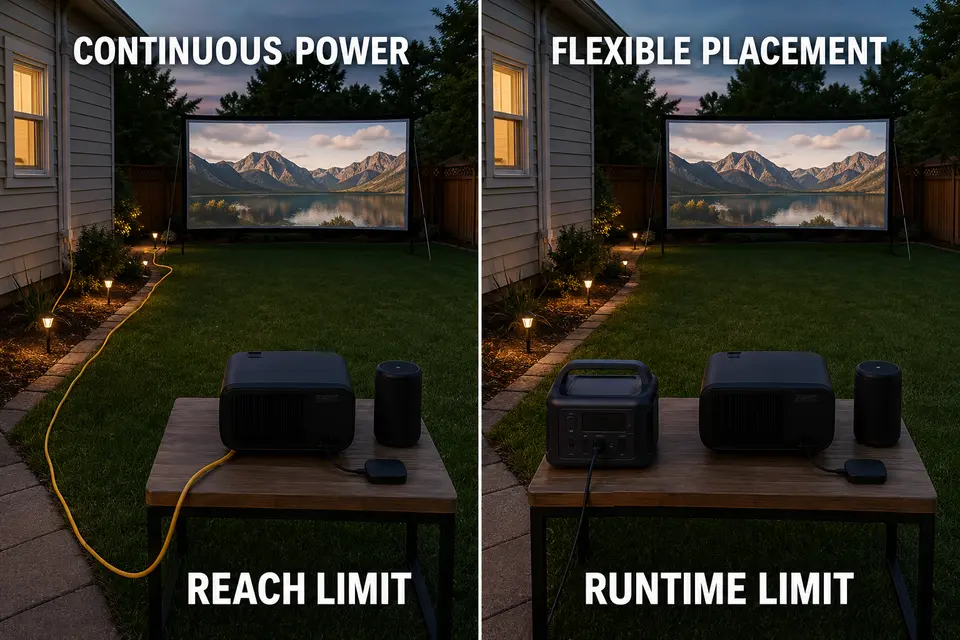
This is the comparison’s controlling trade-off: a cord does not run out of stored energy, while a portable station does not need to reach the house.
A stable household supply can support setup, a long movie, pauses, and extended use without a movie-length battery deadline. Its weakness remains physical. The cord must be long enough for the protected route, suitable for the load, and kept outside normal circulation.
A portable station solves that route problem by moving power beside the projector. Its advertised capacity, however, is not identical to the energy ultimately delivered to AC-powered equipment. Conversion and operation of the station consume some of the stored energy.
The relevant operating window also begins before the opening credits. Image alignment, app navigation, audio testing, streaming, guest delays, pauses, and shutdown all add to the session. A station that appears adequate for a two-hour film can have little reserve once the complete evening and shared audio load are included.
The useful test is therefore not whether the system turns on. Run the intended projector, streaming device, and audio together for a realistic session before guests arrive. Exact runtime claims are unreliable without the actual device load and usable station capacity.
A controlled cord route is often more predictable for double features, longer gatherings, or demanding powered audio. Battery power becomes the cleaner practical choice when the alternative is an excessively long cord or a route through the yard’s main use zone.
Wet Ground Concerns
Do not treat removal of the long lawn cord as removal of the weather risk. A portable station relocates the vulnerable electrical point beside the projector; it does not make that point rainproof.
Keep the station, its outlets, and connected plugs on a dry, stable, protected surface away from wet grass, irrigation, accumulating dew, and direct exposure. Avoid improvised sealed containers that can retain heat around operating equipment.
An extension cord creates a longer exposure route and may introduce connections between the house and projector. Plugs resting on the ground are especially vulnerable to dampness, puddling, and accidental disturbance.
The U.S. Consumer Product Safety Commission advises using undamaged extension cords marked for outdoor use and suitable for the intended current. Its guidance also calls for properly tested ground-fault circuit-interrupter protection and warns against using corded equipment in damp or wet conditions. See the CPSC outdoor electrical safety guidance.
Ground-fault protection is a safeguard, not permission to leave a connection exposed. Active rain, puddling, a wet plug, or water reaching either power source is a reason to stop and correct the setup.
Weather boundary: Battery power removes the extended cord route, not the need for a dry source and protected connections. Neither option automatically wins on wet ground.
Dew can create the same boundary without rainfall. If grass, railings, or tables begin collecting moisture, use a planned shutdown rather than waiting for the equipment or connections to become visibly wet. See protecting outdoor projector equipment from dew for the wider moisture-control process.
Recharge and Storage
The ownership question is which routine the household will perform reliably: charging and carrying the station or inspecting, routing, and repacking the cord.
A portable station must be recharged before the next movie night and stored indoors under conditions permitted by its manufacturer. Infrequent use can make readiness easy to overlook, especially when the station was returned to storage only partially charged.
Weight and storage access also matter. A station capable of supporting a complete AV setup may be awkward to carry through narrow doors or up stairs. Flexible placement in the yard is less useful if moving the power source becomes the part everyone avoids.
An extension cord has no charge state to remember, but it still requires inspection, drying when necessary, loose coiling, and protected storage. A damaged or damp cord is not ready simply because it is available.
Choose the station when charging and checking it can become a consistent part of movie-night preparation. Choose the cord when retrieving, inspecting, routing, and packing it is the more dependable routine.
Projectors, speakers, adapters, cords, and power stations should be brought inside after use unless specifically designed and installed for continued outdoor exposure. A consistent method for storing outdoor AV gear after movie night keeps either option ready without packing equipment while it is damp or warm.
Which Setup Fits the Yard
The stronger option is the one whose weakness the yard and household can control every time, not the one that looks cleaner during a single setup.
An extension cord usually fits a fixed projector position near a usable exterior outlet when the cable can follow a protected perimeter. It also fits longer sessions or larger combined loads when uncertain battery reserve would complicate the evening.
A portable power station usually fits a remote or changing projector position where the household route would be long, obstructive, or difficult to protect. That flexibility depends on sufficient output, verified runtime, and a dry operating position.
| Yard or setup condition | Better fit | Watch out for |
|---|---|---|
| Fixed projector near an exterior outlet | Extension cord | Actual route must avoid circulation areas |
| Remote projector position | Portable power station | Confirm output and usable runtime |
| Long session or higher combined AV load | Extension cord | Cord rating and routed length still matter |
| Frequently changing projector location | Portable power station | Recharging and lifting become recurring tasks |
| Damp or dew-prone yard | Neither automatically wins | Keep the source and all connections protected |
| Several occasional viewing positions | Hybrid approach | Maintain two safe, tested routines |
A hybrid strategy can be more practical than forcing one method into every arrangement. Use household power for the regular fixed layout and reserve the portable station for occasional remote positions where the normal cord route stops working.
Neither option is universally safer or simpler. The station removes a long energized route but adds finite runtime, charging, weight, and local moisture exposure. The cord removes the energy deadline but adds reach, routing, connection, and trip concerns.
In a fixed layout, continuous household power may be the easier limitation to manage. Farther into the yard, a tested portable station can remove the more troublesome part of the setup: the route back to the house.