Outdoor cinema power load is not decided by how many plugs fit. It is decided by the weakest part of the chain: the devices, the cord, the outlet, the circuit, and any strip or adapter sitting between them.
That is where many backyard movie setups get sloppy. The projector looks like the main load, the speaker feels secondary, and the streaming stick seems too small to matter. Then a laptop charger, Wi-Fi extender, small fan, adapter, and power strip quietly join the same outlet.
Do the load check before you choose the cord route or add convenience pieces. The practical sequence is simple: list every powered item, find its watts or amps, add the total, then compare that total against the cord, outlet, and circuit you plan to use.
This is not a guide to doing electrical work. It is a homeowner pre-plug-in check for a temporary outdoor cinema setup. If the labels are missing, the cord rating is unclear, the outlet already serves other loads, or breakers have tripped before, the safe answer is not to guess.
For the broader screen, seating, sound, and projector flow, keep this separate from the general backyard movie night setup. Power load is its own gate. If it fails, the rest of the setup is not ready.
Add Up the Projector and Speaker Load
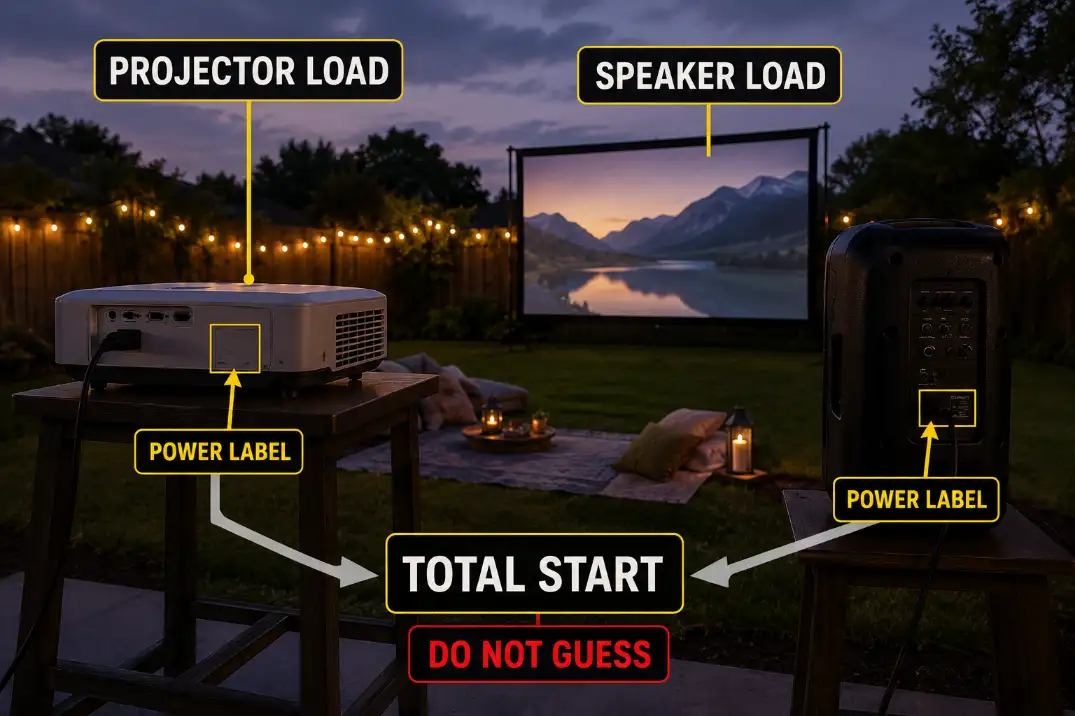
Start with the devices most likely to set the load floor: the projector and the speaker system. A setup with two plugs can be light, or it can already be close to the practical limit, depending on what those plugs actually draw.
Look for the power label on the projector body, the power brick, or the manufacturer manual. Some labels give watts. Others give amps. Some show input values on the adapter instead of on the projector itself. Use the marked input value for the part that actually plugs into the outlet.
The same rule applies to sound. A small portable Bluetooth speaker may only need charging. A powered soundbar, outdoor speaker amplifier, or subwoofer can change the load picture quickly. If the speaker system has its own wall plug, power brick, or amplifier, count it separately.
The simple conversion is:
- Watts ÷ volts = amps
- Amps × volts = watts
For a rough U.S. household estimate, 120 volts is commonly used when converting between watts and amps, but the equipment label, cord marking, and circuit rating matter more than a casual estimate.
The first useful number is not perfect. It is the combined load you can actually verify.
If the projector label gives watts, write that number down. If the speaker label gives amps, convert it to watts or keep a separate amp total. What matters is that both devices are counted before anything else is plugged in.
Leave some judgment room for startup behavior. Some devices may draw more briefly when they turn on than they do while running. You do not need to invent a startup number, but you should avoid a setup that only works because every number is treated as best-case.
Include Streaming Devices and Accessories
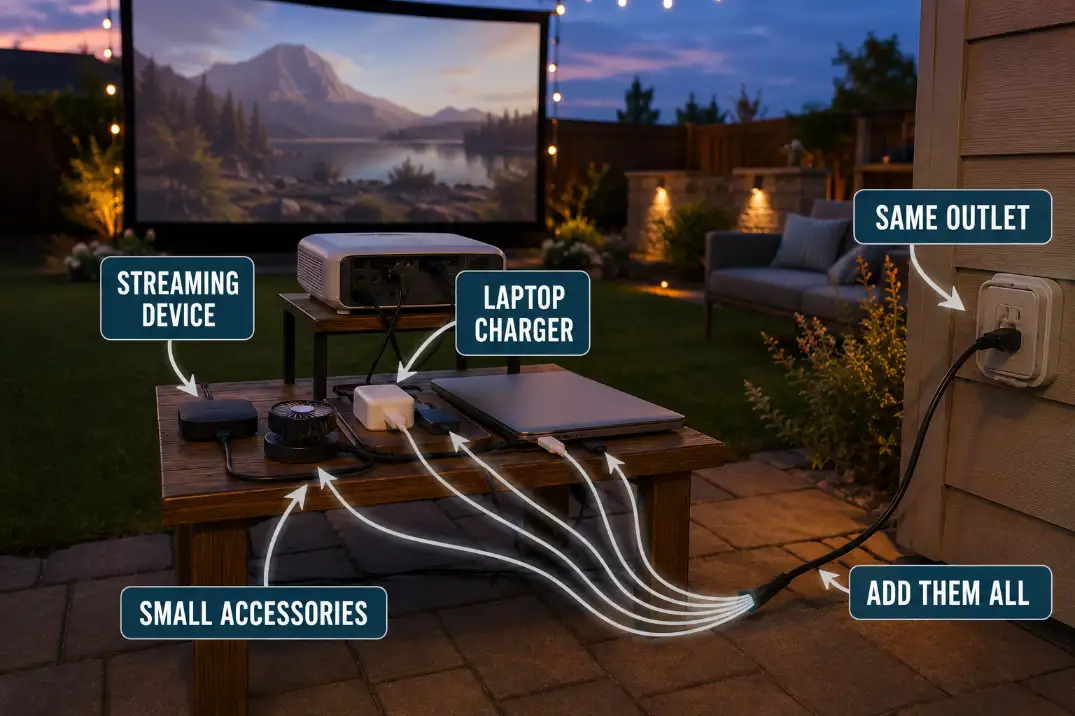
The second pass is where the real setup usually changes. Count every small powered item before you decide the cord or outlet is enough.
A streaming stick may be powered by the projector, or it may need its own adapter. A streaming box, laptop, game console, Wi-Fi extender, powered HDMI splitter, USB hub, charger, small fan, or inflatable screen blower can all add load. One item may be small. Several small items sharing the same source are no longer invisible.
Walk the setup from screen to outlet and write down every item that needs power.
| Item | Where to find the value | Watts or amps to record | Notes |
|---|---|---|---|
| Projector | Projector label, manual, or power adapter | Actual marked value | Count the input side that plugs in |
| Speaker or soundbar | Speaker label, amplifier, or charger | Actual marked value | Count powered audio separately |
| Streaming device | Device adapter or USB power source | Actual marked value | Include if it uses its own adapter |
| Laptop or media player | Charger label | Actual marked value | Do not ignore large chargers |
| Wi-Fi extender or hub | Power adapter | Actual marked value | Count small network gear |
| Screen blower or fan | Device label | Actual marked value | Important if running continuously |
| Other accessories | Each adapter or plug | Actual marked value | Add only what is actually used |
The point of the table is not fake precision. It is to stop the common undercount: treating the projector as the whole setup when the outdoor movie only works because five other powered pieces are supporting it.
If your setup uses a laptop for playback, check the charger, not just the laptop. If it uses powered speakers, check the amplifier or power brick. If it uses a screen blower, count it because it may run the entire movie.
Once this list is complete, the question changes from “Can I plug this in?” to “Can this cord, outlet, and circuit support the total?”
Understand Extension Cord Capacity
The extension cord is not just a reach tool. It is the first capacity test after your gear total is known.
Check the cord marking for its rating. Many cords list amps, watts, wire gauge, outdoor use markings, or a combination of these. The cord must be rated for the load you calculated, and the rating should still make sense after the cord length and condition are considered.
The lowest-rated part controls the setup. A strong outlet does not make a weak cord stronger. A heavier cord does not make a small adapter safer. A power strip does not raise the limit of the cord feeding it.
Electrical Safety Foundation International warns not to overload extension cords, run them through water or snow, substitute them for permanent wiring, or cover them in a way that traps heat. (ESFI) The Consumer Product Safety Commission also notes that extension cords can overheat when overloaded or used with equipment that consumes more watts than the cord can handle. (CPSC)
For a backyard movie night, the practical check is direct:
- Add the projector and speaker load.
- Add streaming devices and accessories.
- Compare the total to the cord rating.
- Inspect the cord for damage, loose ends, crushed areas, or heat during use.
- Use one properly rated outdoor cord instead of daisy-chaining multiple cords.
Cord length matters because longer runs can create more voltage drop and heat pressure, especially under heavier loads. You do not need to calculate voltage drop like an electrician for a basic temporary setup, but you should avoid treating a long, light-duty cord as harmless just because the plug fits.
A good power route is also a walking-route decision. If the cord has to cross traffic paths, pinch under a door, sit in wet grass, or run through a place where chairs roll over it, the issue is no longer only load. It is also cable placement. That is where a separate outdoor AV cable route plan becomes part of the setup.
Field Check:
If the cord rating is hard to read, the plug feels loose, or any part of the cord warms up during the movie, do not treat that as normal. Reduce the load, stop using that route, or get qualified help before repeating the setup.
Avoid Overloading One Outdoor Outlet
The outlet check is where plug space and electrical capacity get confused. Two receptacle openings may still share the same circuit, so the faceplate can look more capable than the circuit actually is.
Your outdoor outlet may also be connected to other loads. Landscape lights, garage outlets, patio equipment, pond pumps, decorations, or other devices may be on the same circuit even if they are not plugged into the same faceplate. You may not know this without tracing the circuit, and that uncertainty should affect how much confidence you place in the setup.
NFPA states that outdoor receptacles should be GFCI protected and that GFCIs should be tested regularly after installation. (NFPA) That protection is important, but it does not mean the outlet can carry unlimited combined load.
Use this judgment matrix after you have the total:
| Setup condition | What it means | Setup decision |
|---|---|---|
| Total load is clearly below the cord and outlet limits, and the circuit is not shared with other known loads | Basic temporary setup may be reasonable | Use the outdoor-rated cord and keep checking for heat or trips |
| Total load is close to the marked cord or circuit limit | Little margin | Reduce devices, shorten the route, or split the setup only if you know the circuits are separate |
| Circuit is unknown and other outdoor loads may be active | Capacity is uncertain | Do not add more devices just because plugs are available |
| Breaker trips, GFCI trips repeatedly, plugs feel warm, or the outlet feels loose | Stop signal | Unplug and get the issue checked |
Avoid combining outdoor cinema gear with other heavy outdoor loads. A projector and speaker system is one thing. Adding heaters, cooking appliances, large fans, pumps, or high-draw tools to the same area is a different electrical plan.
This page is not trying to teach breaker mapping or outlet installation. The field rule is simpler: if the outlet history is unclear and the setup is no longer small, do not keep adding devices until something trips.
For a deeper hazard-focused route, keep the load calculation separate from the physical risks covered in backyard projector power setup and cable hazards. The load number tells you whether the source is being asked to do too much. The route tells you whether the setup is safe to walk around.
Know When a Power Strip Is Not Enough
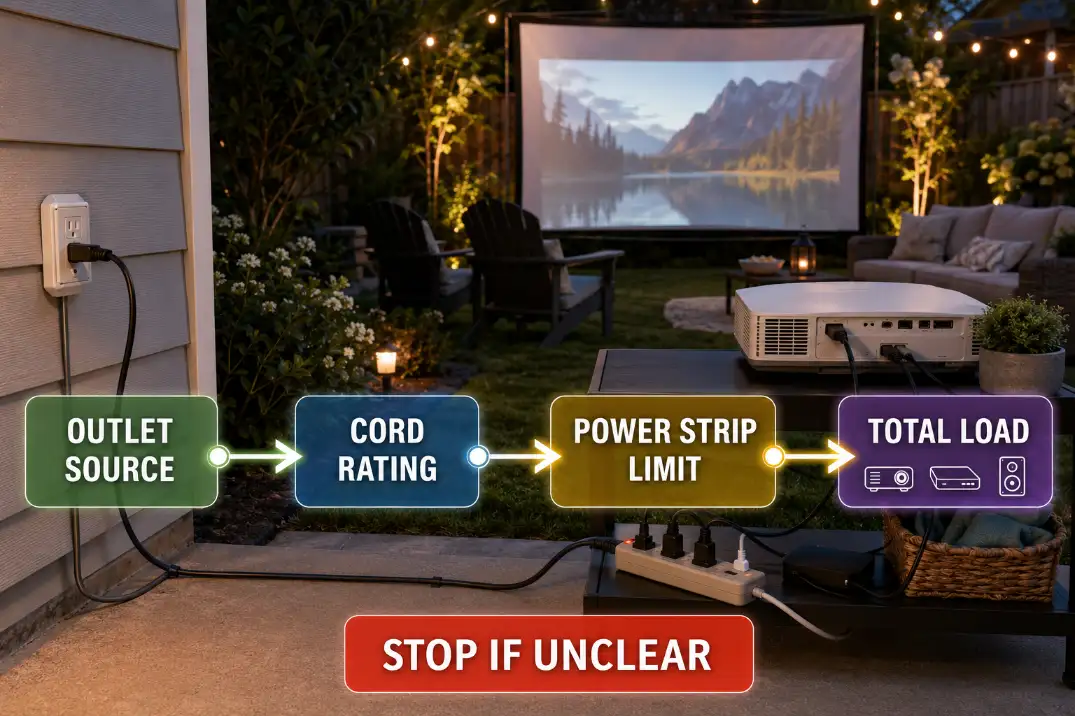
A power strip can organize plugs, but it cannot rescue an overloaded plan.
That is the mistake to catch before the final setup. A strip can make a messy setup look controlled while every device is still drawing through one cord and one outlet. The strip has not changed the source. It has only made it easier to add more loads to that source.
A power strip is not enough when the total load is unclear, the strip is not rated for outdoor conditions, the cord feeding it is undersized, or the outlet capacity is already uncertain. It is also not a workaround for missing outdoor outlets. More slots do not mean more available power.
For outdoor use, indoor strips are the wrong default. Outdoor conditions add moisture, temperature change, ground contact, and trip exposure. Even with outdoor-rated equipment, the strip still has a rating, the cord still has a rating, and the outlet still has a limit.
Common mistake box:
- Counting six plug openings as six safe loads.
- Using a strip to avoid calculating the total.
- Plugging a strip into a weak or unclear extension cord.
If your setup needs a strip only because several low-load accessories need organization, the load calculation still comes first. If your setup needs a strip because the main outlet is not enough, the strip is not solving the real problem.
Cable protection also matters once a strip enters the setup. Keep strips, adapters, and cord connections out of walking paths and weather exposure. If the physical route is the weak point, review weatherproof cable management for outdoor AV before treating the power layout as finished.
When to Ask an Electrician
The homeowner calculation ends when the unknowns become stronger than the numbers.
Ask an electrician when the circuit capacity is unknown and the load is not small. Ask when a breaker trips repeatedly. Ask when a GFCI trips again after reset. Ask when an outlet feels loose, a plug feels warm, a cord shows damage, or the setup depends on permanent outdoor power rather than a temporary movie-night route.
Also ask before adding new outdoor outlets, modifying existing outlets, running permanent wiring, or building a repeated backyard theater setup that will use the same power area often. At that point, the decision is not only “Can tonight’s movie work?” It is “Should this area have a better power plan?”
Before plugging in, run this final check:
- Every powered device is listed, including small accessories.
- Watts or amps come from labels, adapters, or manuals, not guesses.
- The total load is below the rating of the cord and the power device feeding the gear.
- The outdoor outlet is GFCI protected and weather-protected.
- No cord, plug, adapter, or strip is damaged, loose, warm, pinched, or sitting in water.
- The setup stops if the circuit, cord rating, or outlet behavior is unclear.
A safe outdoor cinema setup is not the one with the most plug spaces. It is the one where every stage earns the next: load counted, accessories included, cord checked, outlet understood, strip treated as organization instead of extra capacity, and professional help called before guessing becomes the plan.